REVIEW · 2020-10-19
Kine
Roulez, pivotez, montez sur scène : un puzzle 3D de machines musiciennes
Introduction
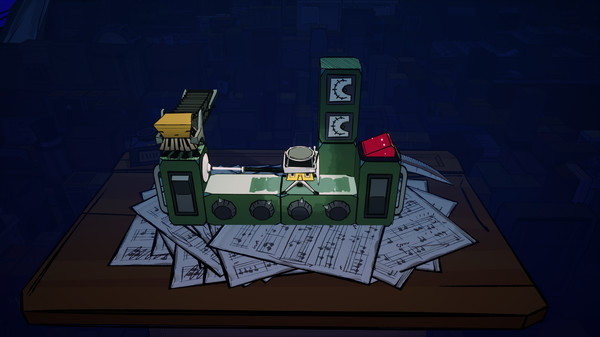
Three musical machines dreaming of a big break — Quat the snare drum, Roo the accordion, Euler the trombone — roll and rotate through a theatrical city toward each level's exit. Every body moves by tumbling like a die, and its ungainly shape makes landing on the right square, in the right orientation, anything but simple. Chump Squad, the studio said to be led by Gwen Frey, built its 120-plus stages. It was an Epic timed exclusive in 2019; the Steam version arrived on 19 October 2020.
I write this from the Steam review pool. The rating is 'Very Positive,' 94% of 107 (117 of 123 across all sources, snapshot 2026-07-19). Edge gave 9/10 and Eurogamer a Recommended; the critics run warm too. On the numbers, it looks like a near-unanimous gem.
But inside that small count, the split is a single question: is this a puzzle you think through, or one you tumble until it clicks? Praise and complaint both point there. I will read that question out of the pool's own vocabulary.
 Kine — Steam store key art
First Impressions
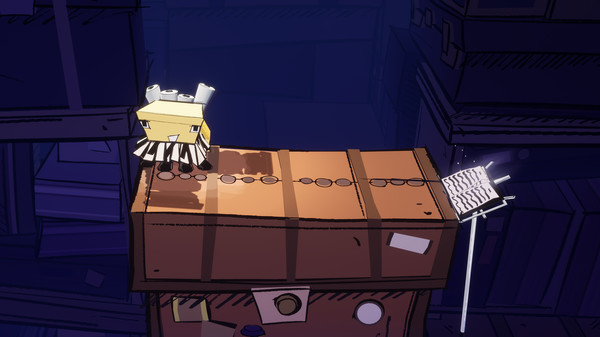
Across the helpful positives the recurring note is love for the cast and the look. 'Weird but lovable,' 'charming,' 'a labour of love' — the sight of instruments walking and trying to form a band softens nearly everyone. The hand-drawn city, the award-winning soundtrack, the fluid animation: almost no one disputes any of it.
What's telling is that even the negative reviews concede this. 'Aesthetic and style are top notch,' 'graphics and animations are great' — people who left a thumbs-down still spend their words praising the craft. On first impressions, nearly every review shakes hands.
In Puzzlebyrinth terms, this is a verb-personification that works. Quat, Roo and Euler each tumble with their own quirk, so character lives inside the verb of movement itself, and learning the controls runs continuous with reading the story. The split is over what these charming verbs are made to solve — and that starts next.
 Kine gameplay — Steam store screenshot
Putting the Mechanics into Words
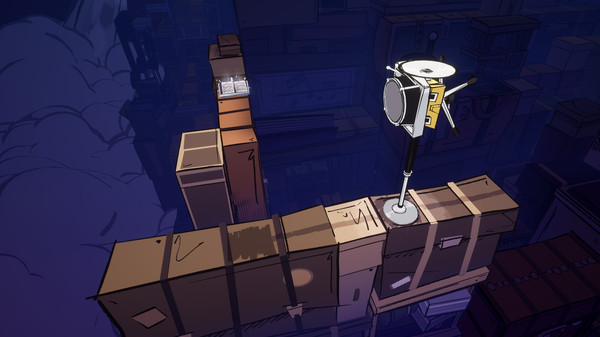
When the pool explains the mechanics, the die metaphor always shows up: one reviewer calls it 'like rolling weighted dice, except with strange appendages that change how they roll.' Quat rolls four ways as a drum, Roo advances by stretching her accordion bellows, Euler folds his L-shaped body over ledges. The story introduces them one at a time — drum, then accordion, then trombone — before making you coordinate all three.
One helpful positive names the design exactly: 'the level design is brilliant because it perfectly controls the state-space, even in a 3D multi-character game — it keeps the core logic mostly 2D and uses the third dimension only for movement and platforms.' That is combinatorial explosion, tamed, in Puzzlebyrinth terms. A three-body 3D state count that would otherwise be unmanageable is folded back toward 'essentially 2D plus a little' by letting the machines occupy different Z heights.
Handing out the verbs one at a time, paced by the story rather than all at once, draws the learning curve as a line. 'I'm in the camp that narrative gets in the way,' one writes, 'but here it never feels tacked on.' Because the story doubles as the doorway for each new verb, there is no stall called a tutorial. This much is clearly praiseworthy.
 Kine — Steam store key art
The Texture of Difficulty
The sharpest split is over the texture of the difficulty. The negatives cluster on one line: 'it doesn't feel like solving — when you're stuck you just tumble at random until you hit the exit.' One review, marked helpful by 28 people, invokes Stephen's Sausage Roll and Baba Is You: 'the eureka moment those give you, where you read it out and the board becomes visible, never came once in Kine.'
The positives report the opposite feel. 'Some levels I could see the mate four moves ahead'; 'by the back half I was finishing every stage smiling, in awe of the design.' The same board looks like a solvable chess problem to one player and a brute-force maze to another. Not a contradiction — how far you can rewind a tumble in your head, your observation resolution, splits the experience in two.
Here the control design matters. Several reviewers keep naming the single one-way cycle key for selecting machines and limbs, and the fact that reset has no undo. Contrast a recent gem like Patrick's Parabox, which puts undo at its center as a 'draft pad' for thought. When retrying is expensive, people drift from planning toward brute force. So part of the 'no eureka' complaint comes not from the puzzles but from an input scheme that denies you room to run your thinking on paper. The texture of the difficulty is partly decided at the fingertips, not on the board.
 Kine — Steam store key art
Sources
This piece was written from the Steam store's user reviews as of 2026-07-19. No review text is quoted directly; recurring typical claims are reconstructed.
・Steam: Kine ('Very Positive,' 94% of 107 / 117 of 123 overall; developed and published by Chump Squad; released 2020-10-19)
・Read the top 10 helpful positive, the top handful of helpful negative, and several recent reviews. Cited playtimes ranged from ~6 to ~15 hours (median around 7–8), across 120-plus stages plus side quests. Recent reviews from August 2025 also flag launch failures on some Intel CPUs and frustration that it went unfixed for five years.
・Cross-read Edge (9/10) and Eurogamer (Recommended) to gauge the critic–player gap (near alignment), and verified release date, engine (Unreal Engine) and review breakdown on SteamDB.
Closing
What's left after reading the pool is that no one argues about quality. The city, the music, the three characters — nearly everyone loves them. The dispute is a single point: does the core puzzle reward looking ahead? And the answer splits cleanly with how far a player can spin a tumble in their head.
This is scope, not quality. Kine gives its verbs character, draws the learning curve through story, and folds the state-space cleverly. In exchange it trims the margin of thought that undo provides and chooses the cleanliness of reset. It has a body close to the 'try lightly, often' design of Cosmic Express, yet a look that promises a weighty single move — and that gap between look and feel is, I read, the epicentre of the split.
Against Steam's 94%, I give it 7.8 on the ruler this site uses: puzzle design. Staging, sound, character and state-space control are excellent; the deduction comes off one point for how weakly planning is converted into reward. But that is less a flaw than a texture Chump Squad chose in trade for approachability. Light for anyone who came for the severity of a chess problem; just right for anyone after a charming spatial puzzle. If this studio ever hands you an undo, I will gladly measure again.
 Kine — Steam store key art
Reactions (no login)
Anonymous • one of each per visitor per day
次に読む

関連レビュー
Filament
小さな探査機を動かし、引きずる一本のケーブルを柱に巻きつけて解く、無人の宇宙船を舞台にしたパズル。交わらない一本の線で、船内の部屋を一つずつ解き明かしていく。
Pipe Push Paradise
孤島の水道を直すため、床のパイプを押し、形に応じて転がし立ち上がらせて水路をつなぐ 3D の倉庫番パズル。動詞は「押す」ひとつだけ、しかしパイプの形と重力が底の見えない仕掛けを生む。Corey Martin と Teo Zamudio による一作。
Murder by Numbers
1996年のロサンゼルスを舞台に、女優オーナーと廃棄ロボットSCOUTがピクロス(お絵かきロジック)を解いて手がかりを集め、証人に突きつけて殺人事件を追う2Dのビジュアルノベル×パズル。『逆転裁判』の作曲家 Masakazu Sugimori と『はーとふる彼氏』の Hato Moa が参加した、The Irregular Corporation 発行の一作。


