REVIEW · 2021-12-12
Lingo
Lire les avis d'un labyrinthe fait de mots et d'espaces impossibles
Introduction
A panel on a wall shows a single word. Type an answer in the box below — built from an anagram, a spelling trick, a rule you have to guess — and a door opens. That is all Lingo is, except the stage is a non-Euclidean world stitched from warps and impossible staircases, where walking around is itself part of solving the rules. Released December 12, 2021, developed and published under the name Brenton Wildes.
I write this from the Steam review pool: 748 user reviews, 'Very Positive,' 93% of them positive, with the last 30 days holding at 88% of 18 (snapshot 2026-06-25). By the numbers, an easy recommendation.
What interests me is that this reputation stands almost without mainstream press. There is no big-outlet review to anchor it; the game's standing is built entirely from those 748 reviews, Workshop maps, community guides, and niche curators like Thinky Games. This is a game that only comes into focus when you read its reviews — which makes it an ideal subject for a meta-review.
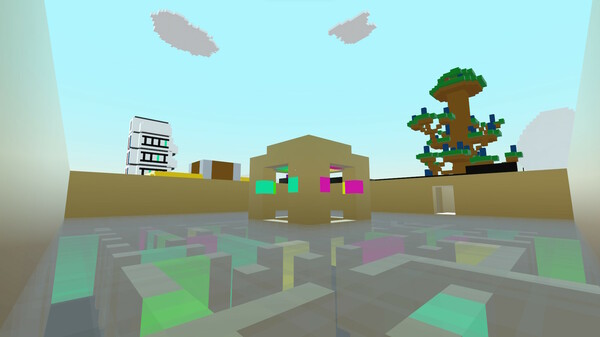 A non-Euclidean world built from words — Steam store
First Impressions
Line up the helpful and recent positive reviews and the vocabulary locks into place: 'the most evil game I've played, and the best,' 'never had my brain more of a smoothie, 10/10,' 'recommend it to your worst enemies.' Praise delivered almost entirely in metaphors of pain. What they point at is the epiphany — the lightning of digging out one more rule yourself and watching the world open up.
The negatives and the qualified positives use a different set of words: 'navigation is horrendous,' 'a non-Euclidean maze and I can't find my way back,' and 'you'll struggle if English isn't your first language.' A few add that the visuals are bare — 'like an untitled Unity project ported to Roblox.'
As with ChromaGun, the interesting part is how often praise and complaint point at the same thing. One reviewer's 'getting lost is the joy' is another's 'I'm just lost.' My job is to name which design choices that fork stands on.
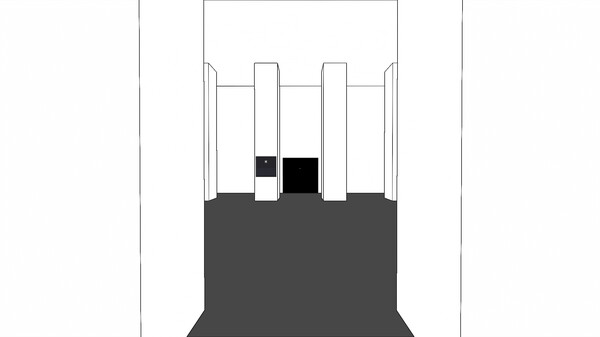 A single word on the wall is your clue — Steam store
Putting the Mechanics into Words
What the positive reviews praise most is that you discover the rules rather than being taught them. Thinky Games files Lingo under rule-discovery and metroidbrainia — the genre where what gates your progress is not a key or an item but your own understanding. The only thing your inventory ever holds in Lingo is the table of rules in your head.
In Puzzlebyrinth terms the verb is subtracted to one: decode and type. But one verb carries a thick grammar. Differently colored panels mean different rules — anagrams, homophones, word chains — taught one at a time, then stacked late so several apply at once. When reviewers say 'the real game is how the rules combine,' that's the combinatorial explosion. As with Understand and The Witness, the core is the observation resolution it takes to find the rule itself.
This design lasts. Reviewers put the base game near 40 hours, and Workshop maps — fan works like 'Liduongo' and 'Duolingo (Don't Sue Me)' — add new rules without breaking the old ones, piling on hundreds more. A quiet hint mode waits for the stuck. One verb, an enormous run-time carried by discovery alone: that restraint is what the top reviews near-unanimously recommend.
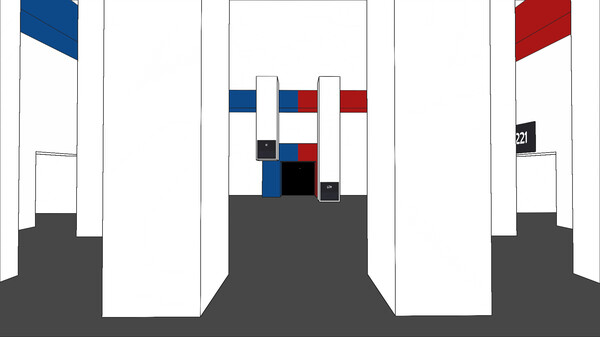 Differently colored panels encode different rules — Steam store
The World
Lingo's stage is a non-Euclidean space of warps, portals, infinite staircases, and false walls. Walk straight ahead and you're back where you started, connections appearing that couldn't exist in the real world. As one reviewer yells, 'why does the silly word game have a non-Euclidean map' — this maze-quality defines the first impression. Call it the spatial sense of Antichamber grafted onto a word puzzle.
And this space is the sharpest fork in the reviews. The positive side reads 'learning to navigate the map is itself a key to the rules'; the negative side writes 'I can't find my way back, I want a bookmark or a teleport.' The same non-Euclidean geometry arrives for one as an object to observe and for the other as a punishment for getting lost.
To me this is reach, not flaw. Lingo designs the act of memorizing and reading the map as part of the puzzle, and deliberately omits the conveniences. It extends the metroidbrainia creed shared by Outer Wilds — refuse to hold your hand, and you protect the purity of discovery. Who it's for, and who it leaves outside the line, is decided right here.
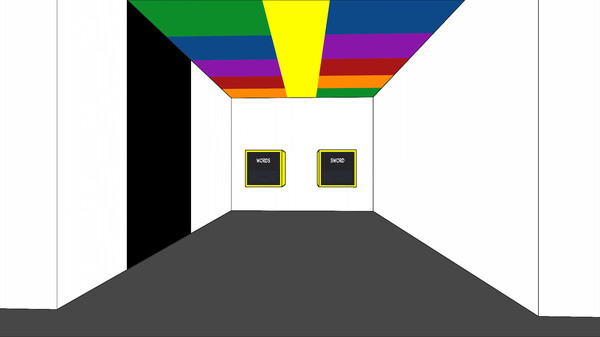 A labyrinth linked by warps and impossible staircases — Steam store
The Texture of Difficulty
You can split the difficulty into three kinds from the pool. First, vocabulary itself — 'I didn't know the word chimerical,' 'it makes you learn color names you've never seen.' Second, finding and combining the rules. Third, the navigation already discussed. Most reviewers get stuck on the first and third; the second is the core they love.
This is where the axis splits. For non-native English speakers the vocabulary wall can read as unfair, and even a review-site verdict (SomeAwesome gave 9/10, but only 4/10 for music) names 'you'll struggle if English isn't your first language' as a clear con. The devoted, meanwhile, enjoy the whole process of reaching for a dictionary, borrowing the community's help, and still digging it out themselves.
I read this as a question of kind, not amount. Lingo's learning curve is well-built for discovering rules, but the axes that demand knowledge and memory from outside the game — vocabulary and the map — change the experience wildly from player to player. Its difficulty forks less on skill than on tolerance for English and for getting lost. The quiet hint mode is the author's compromise for bridging that fault line.
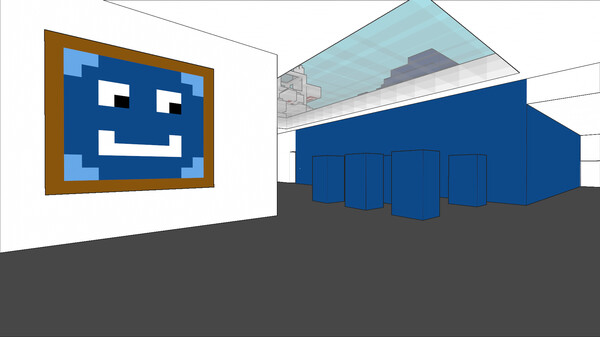 Late on, the rules start combining against you — Steam store
Sources
This piece was written by reading the user reviews on the Steam store page as of 2026-06-25. No review text is quoted directly; typical claims are reconstructed.
- Steam: Lingo (Very Positive, 93% of 748 reviews; last 30 days 88% of 18)
- Read via WebFetch: a dozen-plus helpful and recent positive reviews, plus negative/qualified reviews on navigation and the English-vocabulary barrier
- Press/curators: SomeAwesome (9/10), Thinky Games (filed under rule-discovery / metroidbrainia)
Closing
Steam reads 93% positive; the critics land near 9. My design-critique score is 8.5. The discovery-driven structure, a single verb made to carry dozens of hours on the combination of its grammar alone, the openness to Workshop — all first-rate. The half-point comes off only because the navigation friction and the bare presentation, frictions apart from the design's own logic, narrow the doorway in a little.
Reported completion times scatter widely, from the low twenties to past forty hours. For anyone who wants the lightning of epiphany dozens of times over, who can take getting lost as observation rather than punishment, there is hardly a better word puzzle. For anyone who wants to solve briskly and move on, or who is unsure of their English vocabulary, it's worth knowing going in that the hint mode and the community are part of the design. Rarely does a split tell you so clearly who a game is for — and reading it is itself the way in.
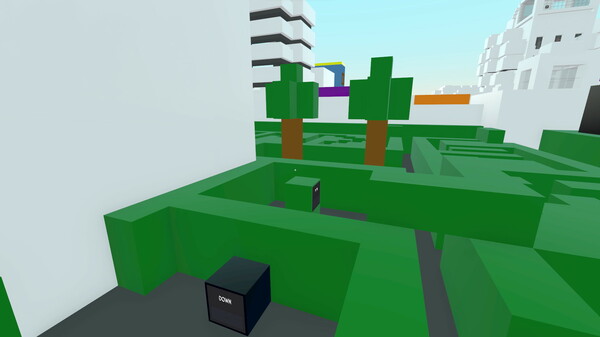 A labyrinth built to make you dig out epiphanies — Steam store
Where are you with this game?
Press one and the game goes on your shelf. You can see it on your account page.
Reactions (no login)
Anonymous • one of each per visitor per day
Read next
Related reviews
Myst
A first-person puzzle adventure: you arrive on an unknown island and move between an abandoned library and four Ages, piecing together a story of family betrayal from machines and journals alone. Cyan Worlds' own Unreal Engine rebuild of their 1993 original, walkable flat or in VR, with optional puzzle randomization.
Portal Reloaded
Un mod communautaire gratuit construit sur Portal 2. En plus des portails spatiaux bleu et orange, on peut désormais tirer un troisième portail, vert, reliant le présent à la même installation vingt ans plus tard, et résoudre 25 chambres de test en faisant l'aller-retour entre présent et futur. Publié en 2021 par le développeur solo PORTANIS, avec 20 niveaux coopératifs ajoutés en 2023.
Escape Simulator
Un puzzle d'évasion à la première personne où vous déplacez les meubles, brisez les poteries et ramassez presque tout ce que vous voyez. Résolvez 28 salles conçues avec de vrais exploitants d'escape rooms, en solo ou en coopération en ligne, puis enchaînez sur des milliers de salles communautaires bâties avec l'éditeur inclus. Par Pine Studio.


