REVIEW · 2020-09-29
The Sojourn
Un puzzle a la premiere personne de lumiere et d'ombre
First Impressions
Line up the helpful positive reviews and the words rhyme: gorgeous, relaxing, 'every puzzle meticulously designed,' and that feeling of being clever once it clicks. Most praise the colour-soaked world, the soft score, and how failure just rewinds your steps.
The negative side and the qualified positives keep returning to repetitive, derivative, and 'a world dry as toast.' Many add that walking between puzzles drags and the story is thin. Tellingly, the critics (Metacritic 78 on PC, 71 on PS4, 'mixed or average') run cooler than Steam users.
Praise and complaint often point at the same thing: one reviewer's 'meditative' is another's 'padded.' My job is to translate where they fork, not stage a fight. For the record, Steam sits at 73% positive (of 220, 2026-06-27 snapshot).
 store key art — Steam store
The World
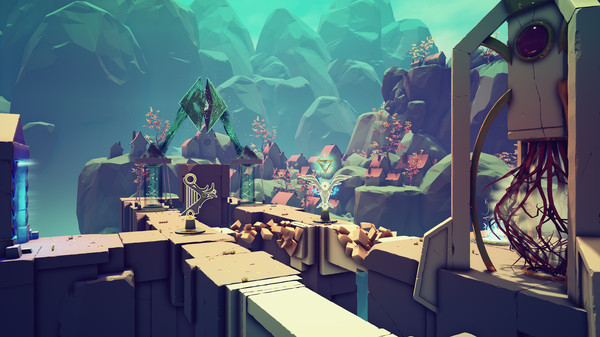
What the positive pool agrees on first is atmosphere, not mechanics: colour-drenched, surreal, great soundtrack. Several reviewers call the place a 'sanctuary.' The shifting light and shadow is, for most, the real star.
In Puzzlebyrinth terms the world is a device for observation resolution: toggling brightness changes what you see, what you can cross, what hides. That space-as-textbook idea echoes what I wrote about The Witness — though The Sojourn leans toward immersion over testing.
The negative side reads the same calm in reverse: 'sterile,' 'dull between the good moments.' Publisher Iceberg Interactive also put out Strange Horticulture; atmosphere-first design is part of the label's colour.
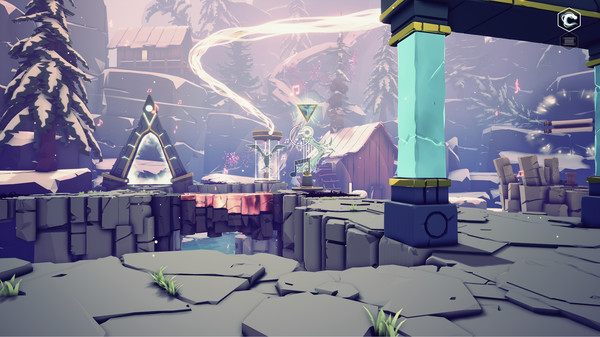 a world of shifting light and shadow — Steam store
Putting the Mechanics into Words
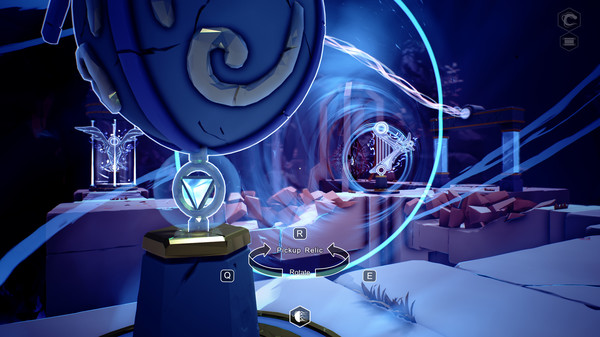
Pooling the descriptions, the verbs are few: light a lamp, step into darkness, and swap places with a statue. Darkness changes what is passable, and your stay there is 'measured in steps, not time.' Positives call the result clever and satisfying.
This is verb subtraction with a move economy laid on top. The swap moves view and position in one stroke; the step limit prunes the combinatorial space in advance. As a system it is restrained and tidy.
Even the recommendations carry a caveat: a good base that doesn't quite extend. New parts appear, but they rarely translate into a rising sense of understanding. Restraint and under-development, side by side.
 swapping places with a statue — Steam store
The Texture of Difficulty
Opinion splits cleanly. Some call it 'fair, not too hard but with bite'; others write 'stuck after 25 minutes' or 'tougher than it looks.' The shared note is an inconsistent curve — breeze one room, stall on the next.
To me it's about distribution, not amount. The curve doesn't rise; it steps unevenly. Critics say ideas get 'used up through repetition' and rooms feel like remixes — new parts skew toward reinforcement, not escalation.
Slow movement and backtracking amplify the friction. Set The Talos Principle beside it and the gap is in the design of difficulty, not its height — a choice about who the game is for.
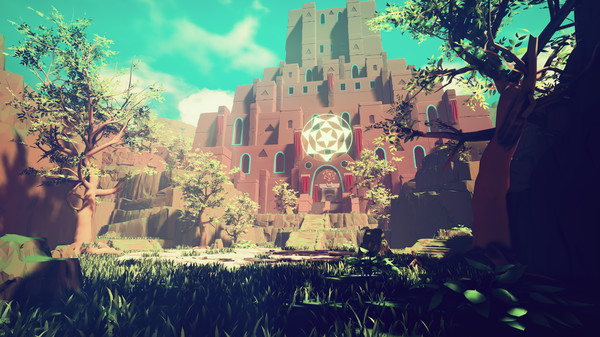 difficulty shifts chapter to chapter — Steam store
Place in the Lineage
Almost every review measures this against Myst, The Witness, and The Talos Principle. 'DNA from the finest puzzle games' is praise for the positive side and grounds for 'derivative' on the negative — the same lineage, read in opposite signs.
Pro and player use different rulers. Metacritic critics land mixed, judging it against the genre's peaks; Steam users sit at 73%, measuring quiet, solid solving. Expect the density of The Witness or the weight of Myst III and it falls short; arrive cold and it feels fresh.
Its shelf spot is clear: less sharpened than The Witness, less philosophical than Talos — a calm, capable middle. The more lineage you know, the more the references set your expectations.
 in the Myst and Witness lineage — Steam store
Sources
Written by reading the Steam user reviews and aggregators as of 2026-06-27. No review text is quoted directly; typical claims are reconstructed.
- Steam: The Sojourn (Mostly Positive, 73% of 220, Player Score 73)
- Read across the top helpful positive reviews, representative negatives, and the recent trend (roughly flat) via Steam, Steambase monthly data, and Metacritic user/critic reviews
- Press across the spread: Game Informer (65), Push Square (70), PlayStation Universe (95)
Closing
Steam reads 73% positive; my design-critique score is 7.0, and they don't diverge. The world-building, the soft score, and the deliberately small mechanics are real. Marks come off for a verb that doesn't fully extend and for new parts that reinforce rather than escalate.
Reviews put completion around 6-8 hours. The reach is clear: short of the genre's peaks, but well worth it for anyone who wants to switch light and shadow at their own pace. If you liked Iceberg's Strange Horticulture, the mood will rhyme. The split itself tells you who it's for.
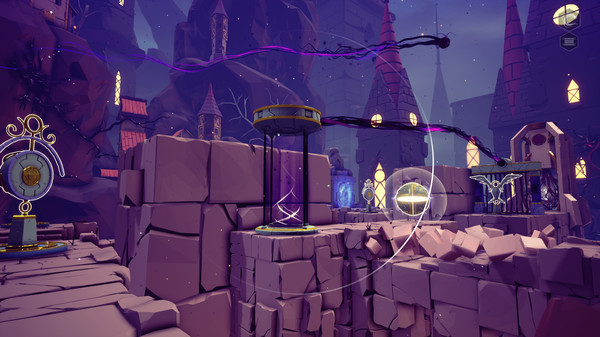 a calm first-person puzzler — Steam store
Where are you with this game?
Press one and the game goes on your shelf. You can see it on your account page.
Reactions (no login)
Anonymous • one of each per visitor per day
Read next
Related reviews
SUPERHOT: MIND CONTROL DELETE
La suite de SUPERHOT, le puzzle d'action à la première personne où le temps n'avance que lorsque vous bougez. Il abandonne les niveaux construits à la main, un par un, pour un format de combats enchaînés dans des salles distribuées au hasard, et y ajoute un système de capacités à choisir pour se renforcer. Le troisième jeu de SUPERHOT Team.
Observation
Vous êtes S.A.M., l'IA d'une station spatiale endommagée : changez de caméra, dérivez dans les couloirs sous la forme d'un drone sphérique et reconstituez ce qui est arrivé à l'équipage disparu — et à vous-même. Vous n'êtes pas sur la station ; vous êtes la station. Par No Code (Stories Untold).
Lightmatter
Un puzzle a la premiere personne ou toucher une ombre vous tue. Eclairez votre fuite d'une installation effondree a l'aide de lampes portables et de pylones relayant la lumiere. La lettre d'amour assumee de Tunnel Vision Games a Portal.


