TAG
#player-experience
0 reviews · 12 essays
Related essays
Guo et al.: humans drifted off the greedy move within about ten games; self-evolving AI did not — Fukai Reads
A preprint by Yingying Guo and four co-authors (arXiv:2608.07490, not peer-reviewed). They propose a way to measure how repeated play changes the way humans and language agents choose moves. Thirty-two students played 709 games across three board games, and four self-evolving language agents were run through the same metric space. Humans mostly shifted from the locally greedy move toward more global play: on the game-specific behavioral metrics, 11 of 12, 10 of 11 and 8 of 9 participants improved. The agents' gains were short-lived. The authors write that the central limitation is not the absence of reflection but the failure to convert reflection into reusable changes in behavior.
Li et al.: the AI that showed up uninvited was closed by five players out of ten — Fukai Reads
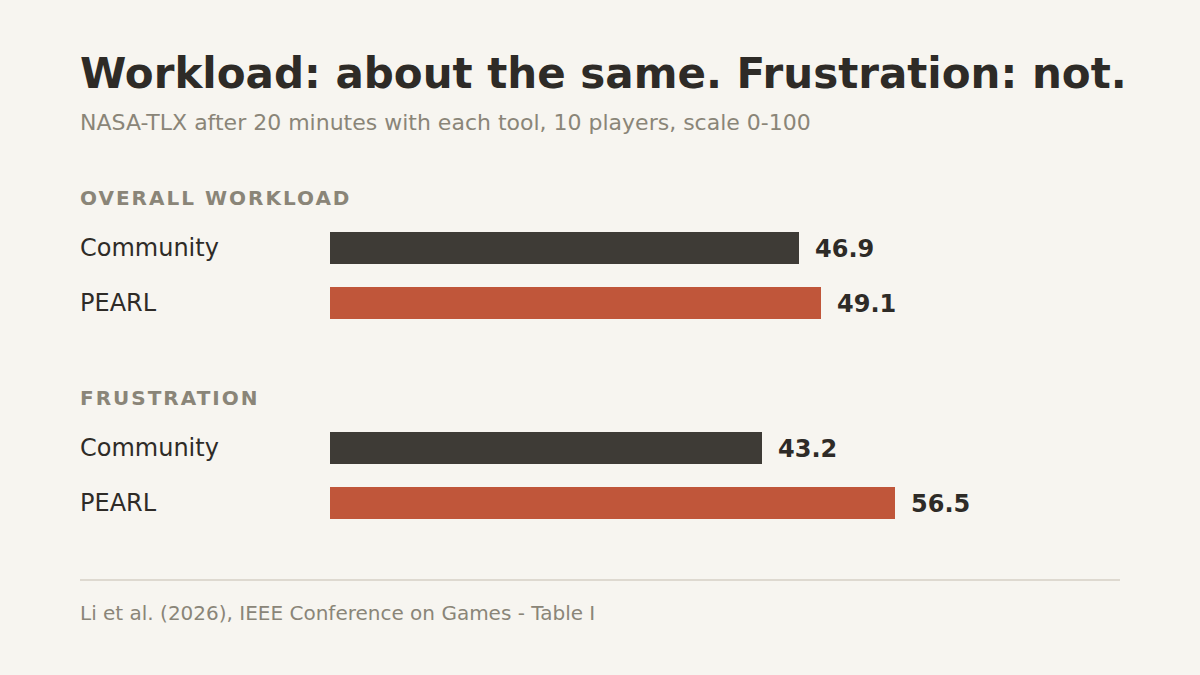
A peer-reviewed paper by Jiahong Li and eight co-authors (accepted to the 2026 IEEE Conference on Games, arXiv:2609.13718). They built PEARL, an AI support agent that retrieves expert-annotated move explanations and structurally similar peer boards, into Parallel, a puzzle game for learning parallel programming, and evaluated it with ten players. Participants rated the existing visualization tool more useful, and at least five minimized or abandoned the AI during play. Frustration scored 43.2 against 56.5. The authors conclude that what players rejected was not the content of the help but its unsolicited delivery, and ask of their own system: are we building Clippy?
"Getting It Wrong Isn't the Punishment" — 20 Puzzle Developers on Redesigning Failure
One piece today: "Designed to Fail: Puzzle Game Developers' Perspectives on Designing Challenge and Failure" by Craig G. Anderson (University of Utah) and Nasim Eshgarf, Zack Carpenter, David DeLiema (University of Minnesota), published in the FDG 2026 proceedings. Based on semi-structured interviews with 20 professional puzzle game developers, the paper shows that developers reframe "failure" away from wrong answers or performance and toward complete player disengagement — which they treat as a failure of the design, not the player. Trial and error and wrong guesses are viewed as an intentional learning mechanism that encourages experimentation and nudges players toward solutions. ACM's download page returned a 403 error for me, so this summary is based on the authors' published abstract, cross-checked across academic databases.
Hu et al.: We Judge Others' Satisfaction Without Counting Their Options — Fukai Reads
A peer-reviewed paper by Beidi Hu, Alice Moon and Eric VanEpps in Psychological Science (January 2026). Across six preregistered experiments with 10,092 participants, people factored choice set size into their own satisfaction but barely factored it into predictions of someone else's. Three things shrink the neglect: showing the different set sizes side by side, asking for a ranking, and restating the number of options. It bears directly on how we read playtests and pick rates.
Pfau & Vrettis: What Happens When Players Generate Their Own Pokémon Cards — Fukai Reads
An arXiv preprint (not peer reviewed) by Johannes Pfau and Panagiotis Vrettis at Utrecht University. A player writes a name and some flavour text; retrieval, a text model and an image model turn it into a Pokémon-style card in about 20 seconds. Forty-nine students made 196 cards. Visual satisfaction averaged 4.25 out of 5 and mechanical fit 4.04, and 93.5% said the final design was their own idea. None of the cards has been played, so balance remains unverified.
Lu et al.: Is Flow Made of Difficulty, or of the Effort You Spend? — Fukai Reads
A peer-reviewed study by Hairong Lu and colleagues (Psychological Research, 2025) on flow and mental effort. Manipulating perceived difficulty and expected odds of success separately in a visual discrimination task, the difficulty manipulation landed hard (partial eta-squared = 0.64) while expectancy showed only a weak trial-level effect (d = 0.04); the inverted-U in flow was marginal (p = 0.053) and P300 showed no relation to flow. An exploratory study with N = 37.
Teo et al.: AI Assistants Overassist — Int-Bench Measures Intervention in Problem-Solving — Fukai Reads
Teo et al. on LLM intervention behavior. Using Int-Bench, a simulated setting, they measure when and how much AI assistants help during problem-solving, finding AI intervenes earlier and more often than humans, tends to leak the answer, and does not improve transfer. A useful read for puzzle hint design.
Hsu et al.: LLM-Voiced NPCs Make Players' Heads Heavier -- A 'Double-Edged Sword' Experiment — Fukai Reads
An empirical LLM-NPC paper by Hsu et al. (Communication University of China and others). They built a scripted-NPC version and a GPT-4.1 LLM-NPC version of the same game and ran a between-subjects test with 130 players. LLM-NPCs significantly raised cognitive load (p<.001), did not significantly improve overall enjoyment (p=.195), and increased autonomy while lowering usability and trust.
Johnson et al.: What Changes in a Game When You Build an LLM Into It — Fukai Reads
A qualitative study by Johnson and colleagues at the University of Calgary on developing two games with an LLM embedded in their structure. Reading developer reflections, it analyzes how embedding an LLM as a component (not decoration) changes gameplay, playability, and player experience. Variability and personalization increase, but new burdens of correctness, difficulty calibration, and coherence emerge, with schema enforcement and validation as the keys.
Shyne et al.: How Far Do Puzzle Solver Loops Match Human Felt Difficulty — Fukai Reads
A logic-grid-puzzle difficulty study by Shyne, Facey & Cooper. Using solver loops (the pass count of a human-style solver) as a difficulty proxy, they generate difficulty-varied puzzles with a quality-diversity algorithm and, in a 63-player study, show solver loops correlate significantly with subjective difficulty (c=0.30, p=0.015).
Bazzaz et al.: Believing It's AI Changes the Experience — Fukai Reads
A CHI '26 paper by Bazzaz and Cooper on perception bias toward generated content. Mixing human-made and AI-generated levels in Super Mario Bros. and Sokoban for 142 players, they report that players can barely identify the creator, yet levels believed to be AI-made are rated less fun, harder, and more frustrating.
Sun et al.: Why Do Players Lose Themselves in Punishingly Hard Games? — Fukai Reads
A paper by Sun et al. on difficulty design in Soulslike games. Through a qualitative analysis of 600 Steam reviews it asks why players immerse themselves in punishingly hard games, and proposes 'resilient flow' — absorption sustained by meaningfully framing frustration.