PAPER-DIGEST · 2026-09-18
Guo et al.: humans drifted off the greedy move within about ten games; self-evolving AI did not — Fukai Reads
What repeated play changes — measuring the shape of a move, not the win
In short — the win rates matched; the moves did not
What changes in a person who plays the same game over and over? This paper does not measure win rate. It measures the way moves get chosen. Thirty-two students played 709 games across three board games, and four self-evolving AI agents were run through exactly the same measurements.
The contrast is the finding. Humans mostly moved away from the action that gains the most this turn and toward moves that account for what comes next. On the game-specific behavioral metrics, 11 of 12, 10 of 11 and 8 of 9 participants improved by the end.
What makes it interesting is that none of this is visible in wins and losses. Win rates for humans and agents alike sit near zero. That is why the authors built behavioral metrics in the first place. Note that this is a preprint and has not been peer-reviewed; read it with that discount applied.
Who wrote it, and what kind of paper it is
The authors are Yingying Guo, Zhuoxuan Ju, Ruibo Ming, Ruicheng Feng and Jinjin Gu. The manuscript lists affiliations at the Chinese University of Hong Kong, Shenzhen; Georgetown University; INSAIT in Sofia; and Tencent.
It is posted on arXiv as arXiv:2608.07490, primary category cs.HC (human-computer interaction), secondary cs.AI. No conference or journal is listed. In other words this is a preprint, not a peer-reviewed paper, and its numbers should be read on that footing.
My reason for picking it today is simple. There is no shortage of work evaluating large language models (LLMs — AI systems trained on enormous amounts of text to work with language) through games. Almost all of it looks at who won at the end. What a puzzle designer actually wants to know is how the experience of playing changes the next move.
And this manuscript spells out a procedure for pulling that change out of the logs. A proposal about measurement is also a design tool. Reading it only as "the AI did badly" is reading half of it.
Why win rate is not enough
There are reasons games are a favourite testbed for AI. The rules can be written out in full. The moves come in sequence. And every move leaves a record. Not many subjects have all three.
But according to the authors, evaluation so far has leaned on competence within a single play: can the model pick a legal move, can it spot a win. Everything that fits inside one episode.
What has gone unmeasured is a second kind of competence. In the manuscript's phrasing: whether repeated interaction changes how an agent evaluates states, selects actions, and reuses experience across episodes. Something humans do without thinking about it had fallen outside the frame.
The introduction's example is Othello. "A novice player may look at a board state and prefer the move that flips the largest number of discs in the current turn, since flipping more discs appears to make immediate progress under a simple reading of the rules." A strong player often does the opposite, flipping few discs to keep future options open. Getting better is that switch.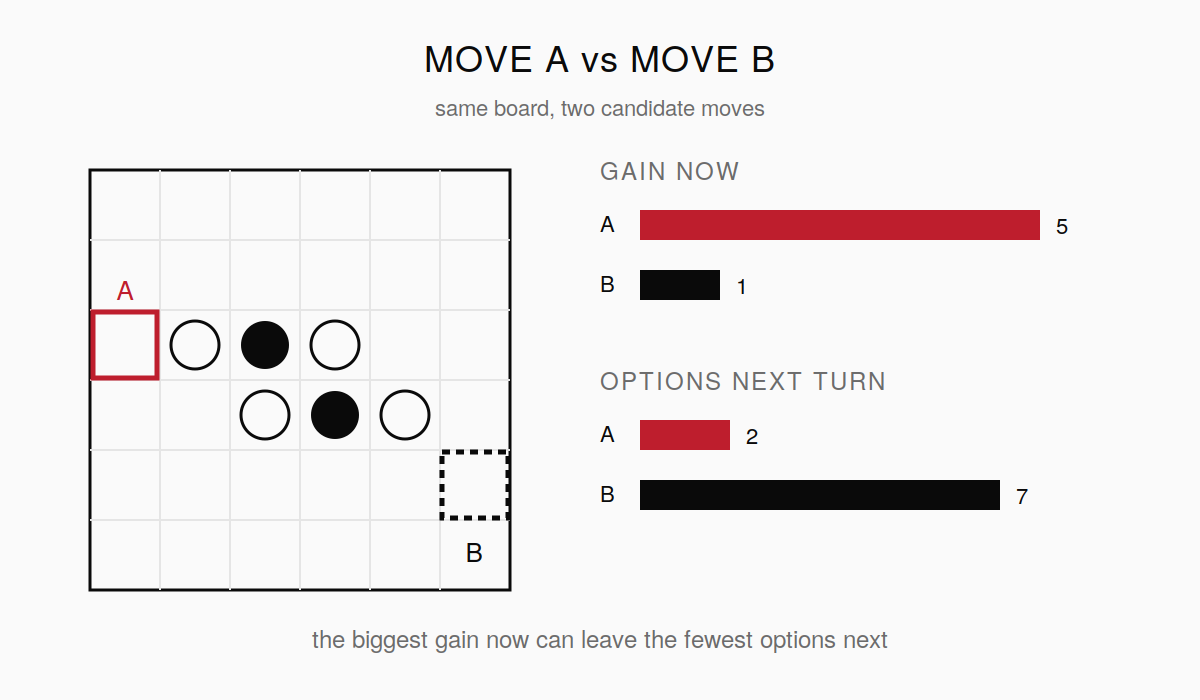 (Illustration, schematic) Two candidate moves on one board. The move with the largest gain now can be the one that leaves the fewest options next turn. The numbers illustrate the idea; they are not data from the paper.
Three games and two shared yardsticks
Three games are used: Four in a Row, Othello6 (Othello on a 6×6 board) and CircleCat, a cat-trapping game. The manuscript states CircleCat's rules like this: players place one wall on an empty cell per turn; the cat moves one step; you win if the cat cannot reach the boundary and lose if it does.
Two yardsticks are shared across all three. The first is GVD (Greedy Value Difference). The definition in the text: it "measures whether the player's action is better than the game-specific greedy baseline." The greedy move here means the one that maximises immediate gain and nothing else.
The second is GTA (Greedy Trap Avoidance), which "focuses only on states where the greedy baseline is substantially worse than some available alternative." In other words, it pulls out exactly the positions where grabbing the immediate gain costs you, and scores what you did there. Marking only in front of the traps.
On top of that sit game-specific behavioral diagnostics: EAR, CPQ (critical-position quality) and OCI for Four in a Row; MCI (mobility control) and CPQ for Othello6; EPD, EPC and CAR (containment-area reduction) for CircleCat. The acronyms are heavy, but the work is plain: turn each thing good players do in that game into a number.
The human data: 32 participants, master's and doctoral students, 709 games in all. Participants had to report no recent experience with the game in question, so that pre-existing strategies would not contaminate the trajectories. After filtering, 12 players for Four in a Row, 11 for Othello6, 9 for CircleCat, each with at least 11 complete games. For analysis, consecutive games are grouped into five-game bins, and each trajectory is split into Early (first three games), Mid (middle five) and Final (last three).
On the AI side, four methods that claim to evolve themselves — CEL, EvoTest, EvolveR and ReasoningBank — were run under the same logging and evaluation protocol, 128 episodes per game.
Humans moved. The agents moved, then drifted back
Start with the humans. On the shared metrics (GVD and GTA), the median player improved within the first two five-game bins. That is: within roughly ten games, the reach for the immediate gain drops off.
The game-specific metrics are sharper. CPQ improved for 10 of 11 participants in Othello6, CAR for 8 of 9 in CircleCat, and CPQ for 11 of 12 in Four in a Row. Nearly everyone.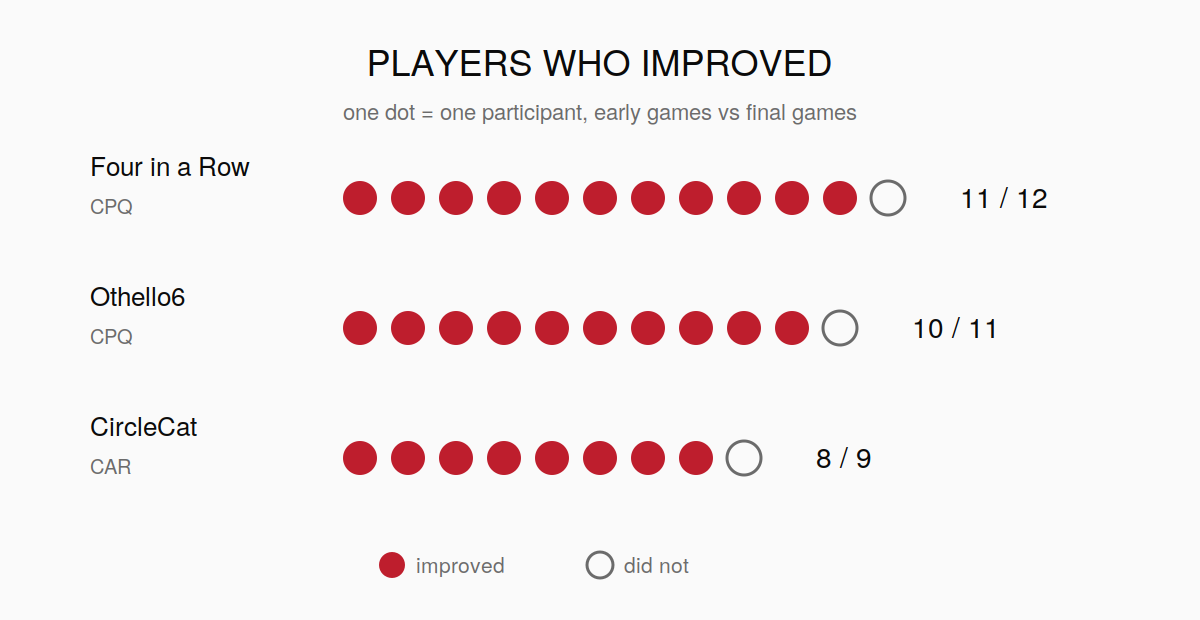 (Illustration) Participants who improved on the game-specific behavioral metric by the final games. One dot is one participant; the counts are as stated in the paper.
On the agents, the authors write: "Across the three games, current self-evolving agents do not exhibit the stable behavioral improvement observed in human trajectories." They are careful to say the gains are not absent: "Although individual methods sometimes improve over short stretches, the gains are often noisy, method-specific, and not consistently maintained across later episodes."
This is where the win-rate table (Table 4) earns its place. Human medians: Four in a Row 0.0% over the first ten games and 10.0% over the last ten; Othello6 0.0% to 0.0%; CircleCat 20.0% to 20.0%. Among the agents, CEL, EvoTest and ReasoningBank stay at 0.0% throughout; only EvolveR posts 10.0% in the first ten of Four in a Row and CircleCat, dropping to 0.0% in the last ten. Look only at wins and losses and nothing appears to happen, to anyone. The authors say as much in the table caption: win/loss alone is a weak and insensitive signal.
One more thing worth taking away is the table that splits the failures into four levels (Table 3). Level 1 is not being able to picture the next board: the agent verbally checks legal moves and wins, but cannot reliably simulate the resulting state. Level 2 is not comparing moves by what they are worth later: it knows the future matters and still cannot rank candidates by downstream value.
Level 3 is not converting a stated strategy into a constraint at move time: useful principles are stored but never bind the actual choice. Level 4 is not turning experience into lasting behavioral change. The levels are nested, the authors note: you cannot reach an upper one without the one below. Their closing sentence puts it plainly: "Their central limitation is not the absence of reflection, but the failure to convert reflection into reliable, verifiable, and reusable changes in decision-making behavior."
What a puzzle designer can take from this
1. Plant greedy traps on purpose, and score only there. GTA's logic transfers directly. Put exactly one position in the level after the tutorial where the move that looks best is the wrong one. If you want to measure learning, watching that one choice beats averaging over every position. I would mark trap cells explicitly in the level data and log nothing but whether the player walked into them.
2. Move your telemetry from wins to moves. Log not whether the player won but the gap between the move they chose and the greedy move in that position. For a daily puzzle, the gap between the shortest-solution move and the played move is enough. Usually this is one extra column in a log you already keep.
3. Rebuild your progress display. Streaks and clear rates are blunt, as Table 4 shows. Show a trap-avoidance rate instead. As a number to put in front of a player it is also more legible as progress. The cost is that you, the designer, have to decide what counts as a trap — which is the work, and also the interesting part.
4. Borrow the unit of analysis. Five-game bins; Early / Mid / Final. The direction of learning was visible with nine participants, so this scales down to a small playtest. Ten people playing eleven times each is a realistic ask even for a solo developer.
5. Draw a line around what an AI playtester is for. Read straight, this manuscript says self-evolving agents are not yet a stand-in for a human who gets better with repeated play. Checking legal moves or spotting a forced win inside a single play is a different ability. If you are adding automated playtesting, split your expectations along that line.
6. Copy their recruitment condition. Requiring that participants had no recent experience with the game is unglamorous and it matters. Bring in people who already know the tricks and the learning curve is flat from the first game. If you are testing an onboarding flow for new players, do not skip this step.
What is not established
Start with what the authors concede. There are only three environments. They frame this as a deliberate choice of quality over quantity, but nothing guarantees that what shows up in three games holds elsewhere — and all three are adversarial board games, with no single-player puzzle among them.
Then the variability and cost of the human data: a larger, more diverse dataset would be needed to say anything about individual differences, as they note. And there is no comparison with reinforcement-learning agents, which they state was placed outside the present scope because it would require a different protocol.
What follows is where Fukai adds his own reservations. First, the trial counts do not match. Humans played at least 11 games; agents ran 128 episodes per game. So this cannot be read as "humans learn faster." What is being compared is not speed but whether the gain holds.
Second, the sample is narrow. All 32 participants were master's and doctoral students, and filtering leaves 9 to 12 per game — people trained to approach an unfamiliar abstract board game analytically. The accurate reading is not "humans move away from greedy play" but "students under these conditions did, in these three games, within eleven plays."
Third, the yardstick depends on how the greedy baseline is defined. Both GVD and GTA are defined against a game-specific greedy baseline. Make that baseline weak and humans and agents alike look better than they are. Since the baseline is authored per game, porting this to another subject means designing that baseline first.
Fourth, the near-universal 0% win rate is not disentangled. The authors treat win/loss as an insensitive signal, but this table cannot separate "insensitive" from "the built-in opponent was simply too strong." If it is the latter, the humans' stable improvement is improvement while still losing, which is a narrower claim.
Fukai's reading
I want to place this manuscript in a longer move: shifting the measure of learning from outcomes to the shape of a move. Game evaluation has been spoken in win rates and completion rates for a long time, which also means nothing is visible until the outcome moves. What is proposed here is a way to see the change before the result changes. In the vocabulary of design criticism, I read this less as automating playtesting than as redefining where to look during one. And the first beneficiaries of that redefinition, I suspect, are not the agents — they are those of us watching human players.
What to read next to see the map
If this manuscript interested you, read it alongside Zhao et al. on how people build their own library of parts while solving puzzles, which I covered here earlier. That one is about what accumulates across repetitions; this one is about how the accumulation shows up in a move. They are two sides of the same question.
On how far ahead people look in a game they have never seen, Collins et al. is worth having. And if you want to feel the greedy-versus-global problem in something playable, a design where all the information is visible — Into the Breach — gets you there fastest. You can see everything and still choose wrong, which tells you this is a problem of evaluation, not of memory.
Sources
Sources referenced in this article:
・The HTML rendering of the same manuscript (quotations, Table 3 and Table 4 are taken from here)
・Where the numbers come from: participant and game counts from the experimental setup; per-metric improvement counts from the results; win rates from Table 4; the four-level failure hierarchy from Table 3.
・The manuscript lists no venue, journal or DOI, so this article does not treat it as peer-reviewed.
Reactions (no login)
Anonymous • one of each per visitor per day
関連シリーズ
Paper Digest第89回 / 全89回
