PAPER-DIGEST · 2026-09-17
Williams et al.: only six brain-imaging studies of Sudoku exist in the world — Fukai Reads
Cognitive neuroscience — what Sudoku uses in the brain, and whether we may call it training
In short — the entire brain-imaging literature on Sudoku is six papers
Tens of millions of people solve a Sudoku every day. So how many studies have imaged the brain while someone is actually solving one? The answer is six. Add up every participant in all six and you get 119 people.
Today's paper is a systematic review that gathers those six and compares them. What shows up consistently is the frontoparietal "executive control" circuit, plus the anterior cingulate cortex, a region that watches for hesitation and error. On harder boards, the circuitry associated with idle, inward-directed thought went quieter instead.
The authors themselves are careful not to push the conclusion hard. Six is too few. What I found most interesting was not the brain science but the plain fact underneath it: a pastime this widely played has been studied this little.
Who wrote this, and what kind of paper is it?
Three authors: Morgan J. Williams (Department of Psychology, University of Leicester, UK), Ellie J. Williamson (School of Psychology, Liverpool John Moores University, UK), and Samantha Jane Brooks (NeuRL, Department of Psychology, University of the Witwatersrand, South Africa).
It appeared in Frontiers in Neuroimaging on 20 April 2026. It is peer-reviewed (checked by researchers in the same field before publication) and free for anyone to read in full. This is not an unreviewed arXiv preprint.
The type is a systematic review: a survey that follows a pre-declared procedure for finding papers, then collects every one that meets the criteria and compares them. No new experiment was run here. This is a paper that re-counts the existing ones.
I picked it because Sudoku is not an abstract topic for readers of this site. What mental machinery does a grid of numbers actually use? And — this is the important part — are we allowed to say that Sudoku makes you sharper? The paper tries to answer both.
Why imaging Sudoku is worth doing at all
The rules of Sudoku are short. A 9x9 grid is divided into nine 3x3 boxes, and every row, column and box must contain each digit from 1 to 9 exactly once. That is all.
What the solver does is not short. You have to hold in mind where on the board you have already looked (working memory). You have to reason a line through: only a 3 fits here (logical deduction). And you have to doubt yourself: this reading might be wrong.
Psychology has known for a while that Sudoku performance tracks measures of working memory and executive function — planning, switching, holding to a rule. But that is behaviour. What happens inside the head had been scattered across separate studies.
The authors' point is that without tidying this up, you cannot responsibly talk about Sudoku as a cognitive training tool. If a clinic or a care home is going to hand out Sudoku, someone has to be able to say what it exercises.
There is a second value, as a research instrument. Standard lab tasks such as n-back or mental arithmetic isolate one function. Sudoku uses memory, deduction and self-monitoring at once. That is closer, the authors write, to how thinking actually works outside the lab.
How the six were arrived at
The procedure is simple. They searched the PubMed database for "Sudoku AND fMRI OR EEG OR MEG OR SPECT OR fNIRS". That returned 289 records. Removing 78 duplicates left 211 to screen.
Screening then ran in three passes — title, abstract, full text — and six studies survived: five fMRI and one fNIRS. No date limit was applied. In other words, they went looking for everything ever published, and six is what there was.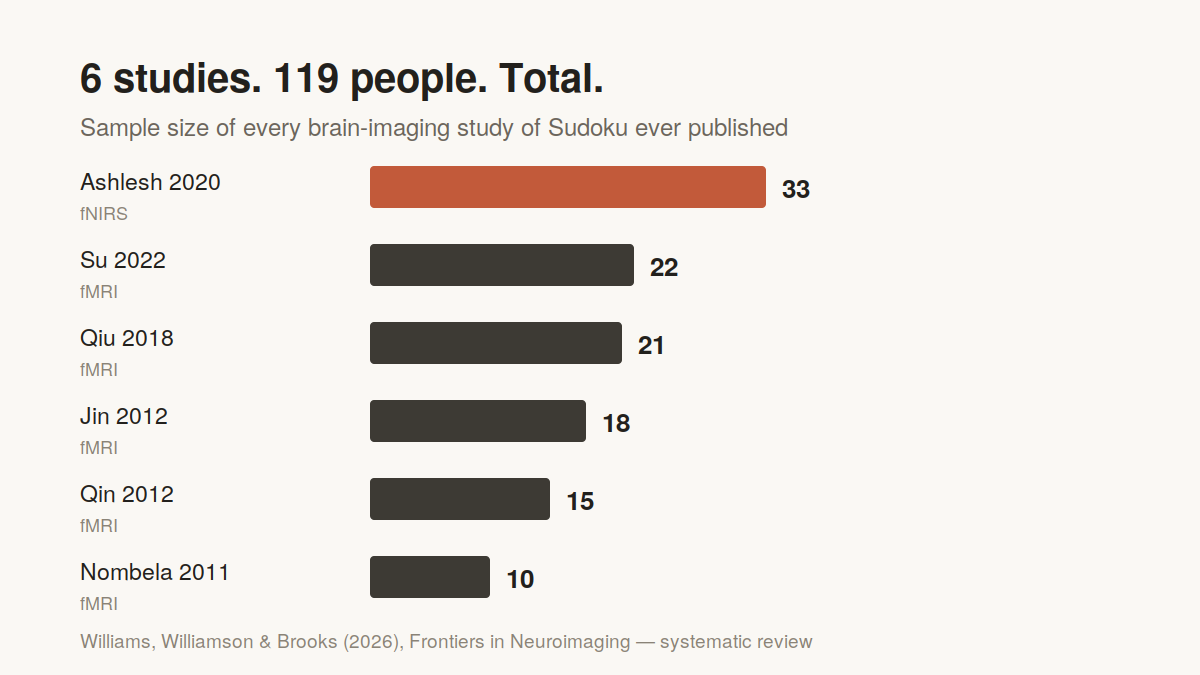 (Diagram) Participants in each of the six brain-imaging studies of Sudoku. All six together come to 119 people.
Two terms, briefly. fMRI (functional magnetic resonance imaging) means lying inside a large tube while the machine records where blood flows in the brain; blood flow is an indirect trace of neural activity. It is precise, but the posture and the noise are nothing like daily life.
fNIRS (functional near-infrared spectroscopy) shines near-infrared light at the head and reads the oxygen level in the blood from what bounces back. You wear something like a cap, so you can be measured sitting and playing normally. The trade-off is that it only reaches near the surface of the brain.
The exclusions are stated too. Studies that measured only heart rate or skin response were out. So were studies using chess, crosswords or generic "brain games". The review sticks to Sudoku and Sudoku-like tasks.
Reporting follows PRISMA, the international guideline for how a systematic review should be written up. The search was run on 9 July 2025 and data extraction finished on 13 August 2025.
What lines up across the six
The overall picture first. In every study, the outer surface of the prefrontal cortex (the dorsolateral prefrontal cortex, DLPFC) worked together with the parietal lobe. The circuit joining them is called the executive control network, and it is associated with allocating attention, holding a goal, and supporting working memory.
The anterior cingulate cortex (ACC) joins them. It becomes active when a conflict or an error is detected — in Sudoku terms, the instant you notice that this column already has a 7 in it.
The individual studies sharpen the picture. Qin et al. (2012, 15 people, mean age 23.1) varied rule complexity on 4x4 Sudoku and found increased activity in all five regions they examined: fusiform gyrus, prefrontal cortex, posterior parietal cortex, caudate and dorsal anterior cingulate.
Jin et al. (2012, 18 healthy older adults, mean age 63.6) compared simple and complex boards. On the complex one, the posterior cingulate cortex and precuneus went down further. Those two sit at the centre of the circuitry that runs inward-directed thought when you are doing nothing in particular. The hard board quietened that inner chatter.
Qiu et al. (2018, 21 people) built ten difficulty levels and adjusted them as a staircase: two correct in a row steps up one level, two wrong steps down one. This puts players of different ability at the same place — right at the edge of what they can just about solve.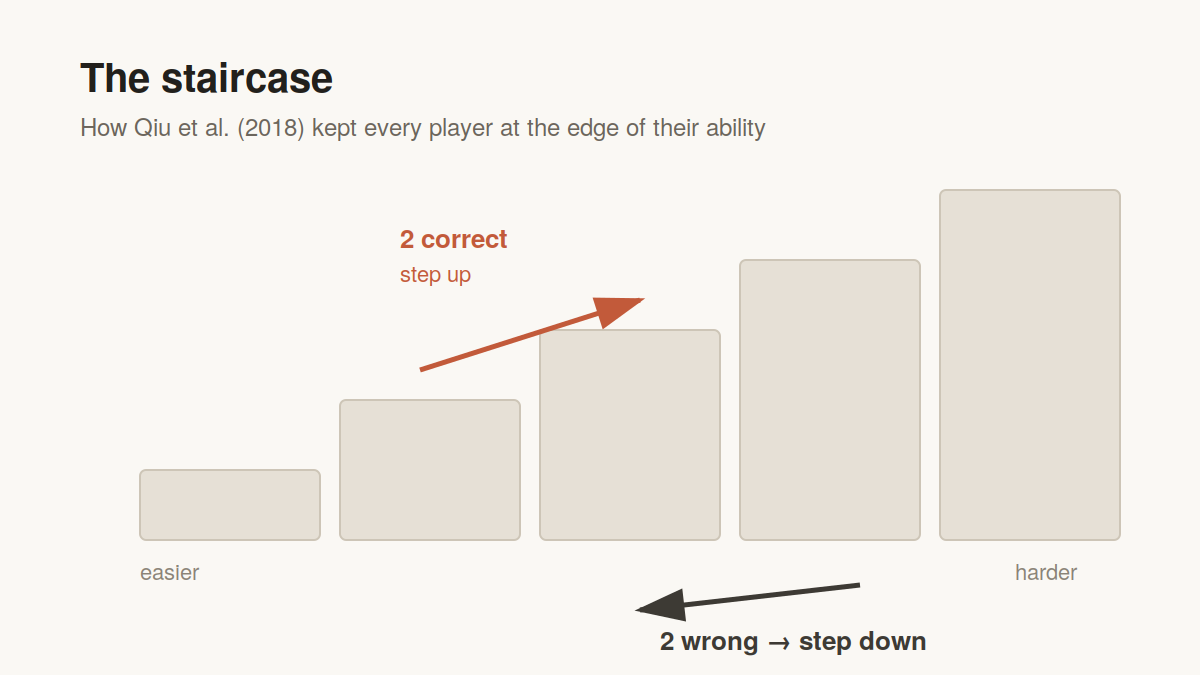 (Diagram) The staircase used by Qiu et al. (2018): two correct answers step the difficulty up, two wrong answers step it down.
What that design revealed was the lateral frontopolar cortex. In the authors' account, it handles adjusting a decision according to how uncertain it feels. The dorsal anterior cingulate and the anterior insula supported the monitoring of that uncertainty, and the ventral striatum supported motivation.
Su et al. (2022, 22 people, mean age 24.5) separated the moment of deciding from the moment of going back over the answer. Dorsal anterior cingulate activity rose during the re-decision. Precuneus, DLPFC and the intraparietal sulcus were involved as well.
Finally Nombela et al. (2011, 10 people, mean age 60.5, with Parkinson's disease). They compared before and after a training programme that included Sudoku; the trained group showed higher temporal, frontal and parietal activity at follow-up. But the scanning was done during a separate Stroop task, not during Sudoku itself.
What a puzzle designer can take from this
1. Start dynamic difficulty with the two-in-a-row rule. The Qiu staircase takes a few lines to implement: two correct steps up, two wrong steps down. Without building any model of skill, it puts players of different ability at the same edge. If you are adding ranks to a daily puzzle, try this simple form first and add complexity only once you have found a reason it is not enough.
2. Build a screen that does not punish second-guessing. This is the most usable result here. When a player goes back over an answer they already committed to, the brain is doing something different. Revision is not failure; it is a separate job. Undo, pencil marks and candidate display are therefore tools for that job, not indulgences. A design that makes a commitment hard to reverse is obstructing the work itself.
3. Try measuring difficulty as doubt, not as time. If frontopolar activity moved with how uncertain a decision felt, then perceived difficulty may sit closer to "how unsure was I" than to "how many seconds did it take". In practice: number of undos, how often a pencil mark was rewritten, how many times the same cell was revisited. Those numbers may say more than a stopwatch.
4. Do not stack high load indefinitely. Jin's finding — the harder the board, the quieter the inward circuitry — is evidence of concentration and also a warning. An experience that leaves zero room to drift, run end to end, banks fatigue rather than pleasure. Putting a light board after a hard one, or ending the day at one puzzle, is a meaningful boundary.
5. Do not write "makes you smarter". The ventral striatum showing up can be read as suggesting that Sudoku carries its own motivational machinery. But on whether training benefits generalise beyond the puzzle itself, the authors say more evidence is required. It is too early for the marketing copy.
6. For anyone who wants to use a puzzle as an instrument. The authors position Sudoku as a promising task for probing executive function and self-regulation. If you are building an educational or clinical puzzle, simply grading the difficulty and logging move by move turns it into a research tool as it stands.
What is not known
Start with what the authors concede. Six is very few. They state plainly that the quirks of any single study — a small sample, a methodological choice — risk shaping the whole observed pattern.
Most of the studies are single-session and cross-sectional; they do not follow the same people over time. So they cannot answer what keeping up a Sudoku habit does to the brain. Only Nombela et al. looked at longitudinal outcomes, and that was in the specific context of Parkinson's disease.
Differing imaging methods also make comparison hard. The authors add that no study has segmented the individual phases of solving a Sudoku — where you looked, how you reasoned, how you committed — and that no study has recorded two modalities in the same people for cross-validation.
Now the points I noticed reading it. First, only one database was searched: PubMed. IEEE Xplore and the ACM Digital Library, where engineering-side work collects, are not included, and neither is PsycINFO. Studies using Sudoku could plausibly sit there.
Second, I could not find any mention of prospective registration (PROSPERO or similar, where a review's plan is published in advance). PRISMA is followed, but whether the plan was fixed beforehand is not stated.
Third, what I want to flag here is board size. At least two of the six used 4x4 Sudoku. Inside a scanner time is short, so the choice is reasonable, but a 4x4 and a 9x9 load working memory differently. Read this as a paper about the 9x9 you solve on a Sunday morning and you need to discount accordingly.
Fourth, Nombela et al. did not image the brain during Sudoku. They imaged it during a Stroop task. That makes it evidence about what changed on another task after training, not about the neural correlates of Sudoku. The authors call it indirect. Within a count of six, this one does not weigh the same as the others.
How I read it
I want to read this less as a map of the brain than as a map of where the research is not. That there are only six papers does not mean Sudoku is an exhausted topic; I read it as meaning the puzzle is so familiar as a pastime that it never looked like an object of study. And that emptiness is not bad news for people who build puzzles. A puzzle with graded difficulty and a move-by-move log is itself a measuring instrument — so when the authors call Sudoku a promising task for probing executive function, the ones holding that instrument are not the labs. They are us.
What to read next to see the map
The paper itself touches on a comparison with chess. Both recruit the frontoparietal circuit, but chess carries a strong flavour of visual expertise, while Sudoku isolates working memory and self-monitoring more cleanly. The literature on chess expertise is much deeper, so entering from that side is also an option.
I have covered the relationship between difficulty and enjoyment here before. Reading this alongside Lu et al. on whether flow comes from difficulty or from effort and Melo Legarda et al. on changing difficulty from heart rate puts today's staircase in place.
References
Papers and related material referenced in this article:
・DOI: 10.3389/fnimg.2026.1756394 (peer-reviewed, open access)
・Frontiers in Neuroimaging (the journal)
・Related articles mentioned above: Lu et al.: does flow come from difficulty or from effort? / Melo Legarda et al.: before changing difficulty from heart rate, they built the part that does not change
Reactions (no login)
Anonymous • one of each per visitor per day
関連シリーズ
Paper Digest第88回 / 全89回