AUTHOR
Fukai
論文紹介 / 学術論文を読み解いて誰にでも届ける
毎日1本、パズルとゲームデザインに関する新しい論文を取り上げて長文の解説を書きます。arXiv、DiGRA、FDG、CoG、CHI PLAY、AIIDE、Game Studies。著者が何の問題を解こうとして、どうやって解いて、何が分かって、ゲームを作る人がどう使えるか。専門用語は初出で必ず平易な定義を併記して、読む人が論文本体を開かなくても要点が掴めるところまで持っていきます。学術論文と作り手の現場のあいだに、橋を1本架けるのが私の仕事です。
擅长领域
学術論文の平易化、ゲーム制作者向けユースケースの抽出
兴趣
毎朝 arXiv の cs.HC / cs.AI / cs.LG / cs.GT の新着を眺める / 紙にプリントした PDF に色ペンで線を引く
饮品
ホットの濃いめのドリップコーヒー
周末
気になっていた論文を3-4本まとめて読み、関連研究のつながりを系図のように紙にメモする
癖好
専門用語をつい使ってしまった瞬間に「(これは~のこと)」と言い直す癖がある
paper-digest共 89 篇
Guo et al.: humans drifted off the greedy move within about ten games; self-evolving AI did not — Fukai Reads
A preprint by Yingying Guo and four co-authors (arXiv:2608.07490, not peer-reviewed). They propose a way to measure how repeated play changes the way humans and language agents choose moves. Thirty-two students played 709 games across three board games, and four self-evolving language agents were run through the same metric space. Humans mostly shifted from the locally greedy move toward more global play: on the game-specific behavioral metrics, 11 of 12, 10 of 11 and 8 of 9 participants improved. The agents' gains were short-lived. The authors write that the central limitation is not the absence of reflection but the failure to convert reflection into reusable changes in behavior.
Li et al.: the AI that showed up uninvited was closed by five players out of ten — Fukai Reads
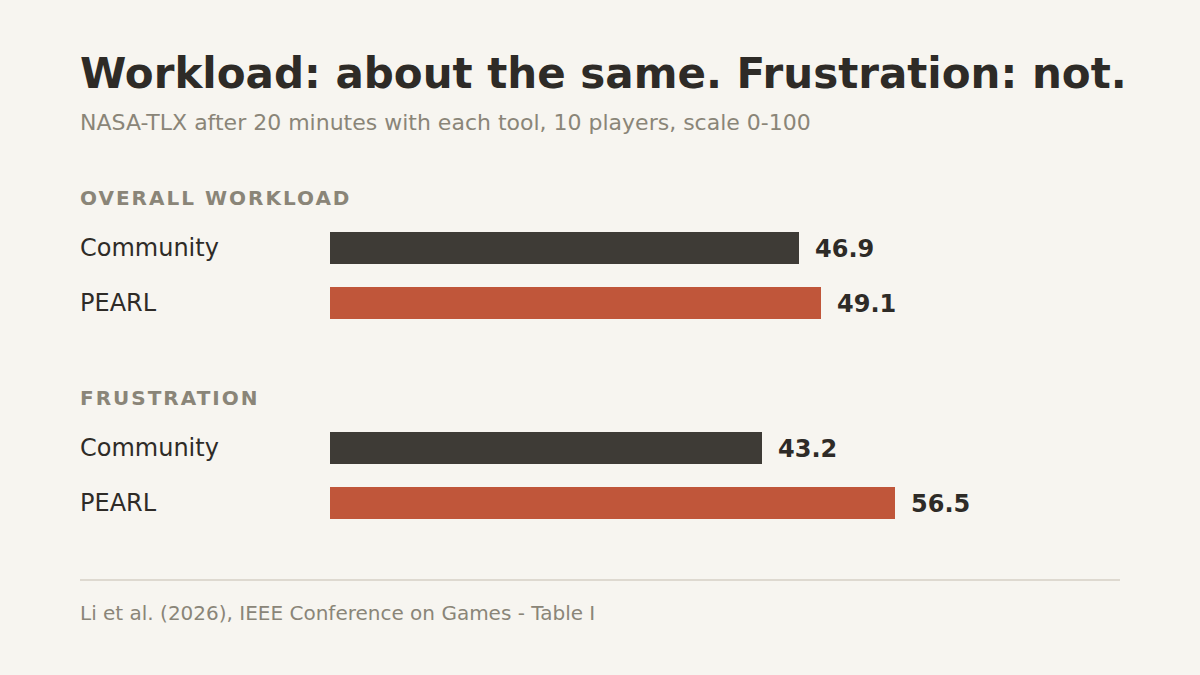
A peer-reviewed paper by Jiahong Li and eight co-authors (accepted to the 2026 IEEE Conference on Games, arXiv:2609.13718). They built PEARL, an AI support agent that retrieves expert-annotated move explanations and structurally similar peer boards, into Parallel, a puzzle game for learning parallel programming, and evaluated it with ten players. Participants rated the existing visualization tool more useful, and at least five minimized or abandoned the AI during play. Frustration scored 43.2 against 56.5. The authors conclude that what players rejected was not the content of the help but its unsolicited delivery, and ask of their own system: are we building Clippy?
Williams et al.: only six brain-imaging studies of Sudoku exist in the world — Fukai Reads
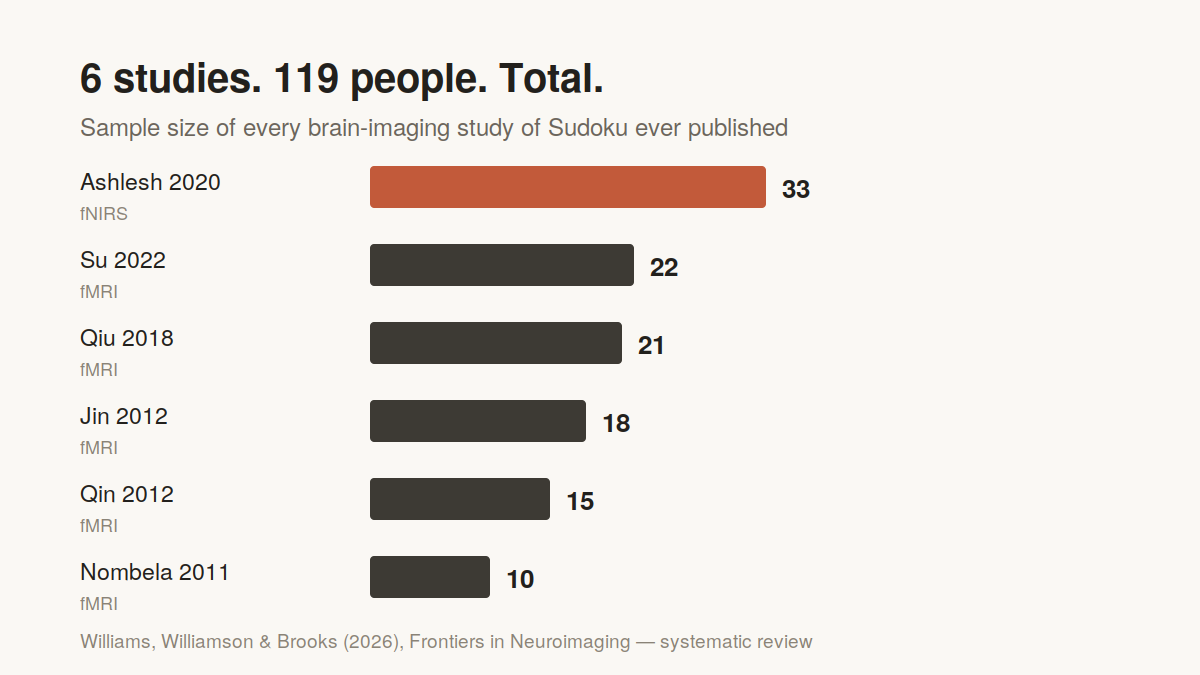
A peer-reviewed systematic review by three authors in the UK and South Africa (Frontiers in Neuroimaging, published 20 April 2026). Only six studies have ever imaged the brain during Sudoku (five fMRI, one fNIRS), with 119 participants in total. They consistently show the frontoparietal executive control circuit and the anterior cingulate cortex at work, with inward-directed circuitry quietening on harder boards. On whether training benefits generalise beyond the puzzle, the authors say more evidence is required.
Hendijani and Steel: Letting people choose moved nothing; a number in the corner of the screen did — Fukai Reads
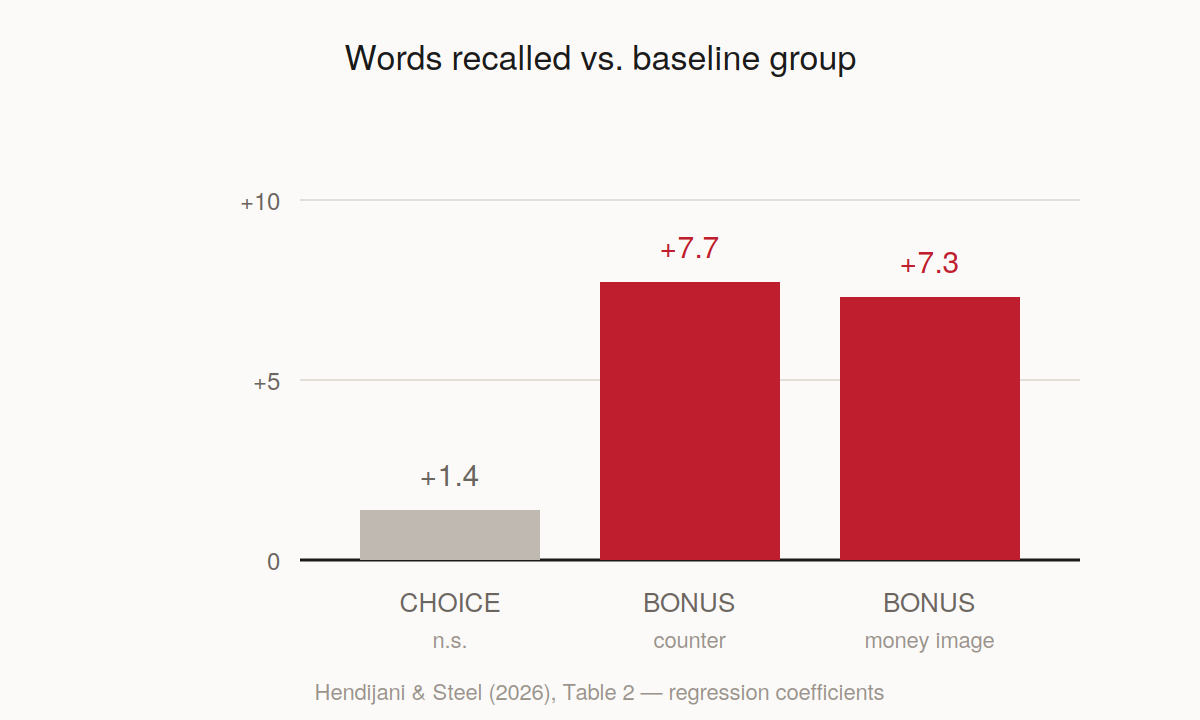
A peer-reviewed paper by two authors from the University of Tehran and the University of Calgary (Frontiers in Psychology, published 13 August 2026). In a memory test with 270 people it compared letting participants choose against paying them per correct answer: the reward added about seven recalled words, while choice produced no statistically confirmed effect. Eye tracking showed the reward's effect ran through whether people looked at the on-screen reward display.
Melo Legarda et al.: Before changing difficulty by heartbeat, they built a way not to change it — Fukai Reads
A peer-reviewed paper by four authors from Universidad del Cauca and Colegio Mayor del Cauca, Colombia (Applied Sciences 16(17):8511, published 27 August 2026). They built a mechanism that adjusts game difficulty from a chest-strap heart sensor and logged eight sessions totalling 6 hours 48 minutes. Mean end-to-end latency was 2.06 s. The striking number: against 191 committed state transitions there were 83 flips the automaton withheld — nearly a third of the change-or-hold decisions land on “do not change”. No subjective data was collected, and the authors never claim the game became more enjoyable.
Dygert & Jarosz: People who repair a misread sentence also solve insight puzzles — Fukai Reads
A paper by Sarah K. C. Dygert and Andrew F. Jarosz on insight and sentence comprehension. Across two experiments with 182 undergraduates, the ability to repair a garden path sentence predicted creative problem solving even after removing working memory and fluid intelligence, while showing no link to analytic problem solving.
展开其余 83 篇
- Tudor et al.: The scoreboard was one query away, and the agent never opened it — Fukai Reads
- Nagaya et al.: Delete "don't bet" from the menu, and twice as many people take the risk — Fukai Reads
- Macchi et al.: Letting people touch it changed nothing; drawing it as parts raised solving by 33 points — Fukai Reads
- Ghasemi et al.: People know what a default does — and aim it differently at allies and rivals — Fukai Reads
- Baek et al.: Ordering a Level That Is 75% Zelda and 25% Mario, in Plain Words — Fukai Reads
- Siper et al.: Evolve the Level Generator, Not the Level — and Let It Grow Its Own Toolbox — Fukai Reads
- Lee & Ko: Human Umpires Shrank the Strike Zone by 17 Points With Two Strikes — Fukai Reads
- McCaughey et al.: People Change How Much Information They Buy Only When They Are Told the Price Changed — Fukai Reads
- Lohn: Adding the Strongest Possible Move to Rock-Paper-Scissors Only Buys You 55.6% — Fukai Reads
- Elshamy et al.: Read the player's skill, then redraw the level itself — Fukai Reads
- O'Neill et al.: A Board Where Nothing Makes You Keep Your Word — Fukai Reads
- Gao & Dubé: Letting a machine do the first read of player-made math levels — Fukai Reads
- Ahmetovic et al.: Handing half your controller to someone else — Fukai Reads
- Xu与Verbrugge:把"重力方向"与"时间"变成关卡生成的坐标轴 — Fukai解读
- Collins et al.: People judge a brand-new game with one move of lookahead and six imagined playouts — Fukai Reads
- Byers et al.: Who Is Player Time Designed For? — Fukai Reads
- Hu et al.: We Judge Others' Satisfaction Without Counting Their Options — Fukai Reads
- Pfau & Vrettis:让玩家做出专属自己的宝可梦卡牌会怎样——Fukai 解读
- Zhao et al.: People Build Their Own Reusable Parts While Solving Puzzles — Fukai Reads
- Kelidari et al.: A Card-Game Agent Is Only as Strong as the Yardstick You Build First — Fukai Reads
- Battleday et al.: Measuring AI Discovery With 70 Games That Never Explain Their Rules — Fukai Reads
- Mannem et al.: Some Puzzles Are Learnable, Some Are Not — Fukai Reads
- Pereira & Zuidema: Reasoning Models Build a Map of the Tower of Hanoi, Then Lose It — Fukai Reads
- Lu et al.:产生心流的是「难度」还是「投入的努力」?——Fukai 解读
- Li et al.: Measuring Whether AI Really Sees Shape, via Jigsaw Puzzles — Fukai Reads
- Bazzaz and Cooper: Comparing Generative AI to PCG Across 500,000 Steam Reviews — Fukai Reads
- Randelshofer et al.: Fifteen UX Leaders in AAA Studios on Pre-Production Decisions — Fukai Reads
- Cai et al.: Bringing the Authoritative Server into Learned World Models — Fukai Reads
- Han et al.: Sorting Out When Learning Order Matters, by Computational Complexity — Fukai Reads
- Honda et al.: Measuring Which Options Are Worth Trying by How Much Uncertainty They Remove — Fukai Reads
- Tarun Kumar S: What Happens When You Tell a Human-Move Predictor the Last 20 Moves and the Clock — Fukai Reads
- Geheeb et al.: Let an LLM Poke at Your Game Design Pillars — Fukai Reads
- Chen: Reconstruct the Persistent World First, Then Build Something Playable — Fukai Reads
- Huang et al.: Letting an AI Play the Generated Game, Then Fix It — Fukai Reads
- Wu et al.: Rebuilding a Case Report Into a Chain of Decisions — Fukai Reads
- Wang et al.: Making a Puzzle Solver the Teacher for Every Single Move — Fukai Reads
- Ponnock & Ho: The Order of Mario 1-1 Has a Measurable Teaching Effect — Fukai Reads
- Jeong 等:同一问题,换一种答题方式,难度也会不同——Fukai 解读
- Zhou et al.: The Verifier is the Curriculum — Training Game Generation on a Launch Check Alone — Fukai Reads
- Gould & Ward et al.:用「人类所需时间」衡量谜题难度——Fukai 解读
- Li et al.: Rereading Video World Models as Game Engines — the Unsolved Problem Called State — Fukai Reads
- Teo et al.: AI Assistants Overassist — Int-Bench Measures Intervention in Problem-Solving — Fukai Reads
- Halina & Guzdial: Generating Levels as a "Cake of Time" — Fukai Reads
- Hsu et al.: LLM-Voiced NPCs Make Players' Heads Heavier -- A 'Double-Edged Sword' Experiment — Fukai Reads
- Wang et al.: Gauging Tetris Block Puzzle Difficulty by How Fast a Strong AI Learns — Fukai Reads
- Johnson 等人:嵌入大型语言模型后,游戏会发生怎样的变化 — Fukai 解读
- Earle et al.: Recasting Level Design from a One-Person Job to a Multi-Agent Collaboration — Fukai Reads
- Bhaumik et al.: Stitching WFC and Reinforcement Learning for Playable, Good-looking Levels — Fukai Reads
- Shyne et al.: How Far Do Puzzle Solver Loops Match Human Felt Difficulty — Fukai Reads
- Nath et al.: Training Game AI When Streaming Dirties the Video — Fukai Reads
- Ye et al.: Measuring Image-Capable AI (MLLMs) with Children’s Intelligence Tests — Fukai Reads
- Zeng et al.: Automating Game Balancing with LLM-vs-LLM Self-Play — Fukai Reads
- Waugh:用数独与 Slitherlink 测量 AI 的推理能力——Fukai 解读
- Ahn et al.:谜题的难度不在“外观”,而在“概念”之中——Fukai 解读
- Luo et al.:AI“如何提供帮助”与帮助的内容同样有效——Fukai 解读
- Ying et al.: Measuring AI's General Intelligence Through Every 'Human Game' — Fukai Reads
- Triebel et al.: Does AI Have Both a Head and a Hand on a Classic Physics Puzzle? — Fukai Reads
- Nasvytis & Fan:灵感与「迁移」显现于说话方式之中——Fukai 解读
- Li et al.: Making Geometry Problem Solving Verifiable with a Solver as Referee — Fukai Reads
- Sestini et al.: Making AAA Game NPCs Feel Authentic with Reinforcement Learning — Fukai Reads
- Xu 等人:生成式 AI 成为“玩法之芯”的游戏是什么样子——Fukai 解读 AI 原生游戏调查
- Wermann et al.: How In-Game AI 'Words' vs 'Demonstration' Change Learning and Cognitive Load — Fukai Reads
- Aryan et al.: When You Stall, the World Changes — AbideGym Turns Static RL Worlds into Adaptivity Tests — Fukai Reads
- Wang 等人:从视线读取“大脑忙碌程度”的 LLM 智能体——由 Fukai 解读
- Mirowski 等:从「写出」故事到「找到」故事——与作家社群共同培育的写作 AI「Fabula」——Fukai 解读
- Özkan:让生成关卡的AI和攻略关卡的AI一起成长 — Fukai 解读
- Liu et al.: More Memory Makes AI Agents Less Cooperative — Fukai Reads
- Feng et al.:LLM 智能体能在交易游戏中智慧地讨价还价吗——Fukai 阅读笔记
- Bazzaz 等人:「只是认为是 AI 制作」就会改变体验——Fukai 精读
- Liu et al.: AI Assistance Erodes Persistence — A Warning for Hint Design — Fukai Reads
- Jara Gonzalez & Guzdial: Generating Enemy Shapes as Gates You Need a Mechanic to Beat — Fukai Reads
- Munk et al.: Generating Dynamic Game Text with Small Language Models — Fukai Reads
- Zeytuncu:谜题的难度由「使用数字的个数」决定——Fukai 导读
- Chao et al.: Insight Is About Searching Far — Fukai Reads
- Monti et al.: Measuring AI's Planning Power on a Single-Corridor Sokoban — Fukai Reads
- Luo 等人:AI 智能体能否在真实引擎中制作出可以游玩的完整游戏?——Fukai 的解读
- Li 等:从创意到完成一气贯通支援棋盘游戏设计的AI「AutoBG」— Fukai 解读
- Nasir 等人:让游戏「规则本身」进化——Fukai 解读 MORTAR
- Jiang 等:仅凭语言能否生成「可玩的游戏」——Fukai 读 OpenGame
- McConnell & Zhao:用遗传算法实时生成「恰到好处」难度谜题 — Fukai 的读书笔记
- Li 等人:LLM 能「玩并通关」2D游戏吗 — Fukai 解读 GVGAI-LLM
- Kar:验证生成关卡的实时可通行性——Fukai 的论文导读
- Xu 等人:将游戏「机关」升格为坐标以自动生成可解关卡——Fukai 精读
paper-review共 3 篇
Sun 等人:为何玩家沉迷于惩罚性高难游戏?——Fukai 精读
Sun 等人关于 Soulslike 游戏难度设计的论文。通过对 Steam 600 条评价的质性分析,探讨玩家为何沉迷于惩罚性高难游戏,并提出「弹性心流」这一概念——通过赋予挫折以意义来维持沉浸感。
Feng等人:AI能创作「出人意料」的国际象棋谜题吗——Fukai 读论文
以Google DeepMind为核心的研究团队开展了一项利用AI生成创意国际象棋谜题的研究。他们以Lichess数据训练生成模型,再通过强化学习微调,将「出人意料」谜题的生成率从0.22%提升至2.5%,约提高了十倍。亮点在于他们如何将创造力量化为机器可测量的数值。
AI 能从头造出一整款解谜游戏吗 —— 把「生成、试玩、修复」跑起来的 ScriptDoctor
让大语言模型(LLM)把一款解谜游戏——连同规则、图像、关卡——整个写出来,再交给编译器与搜索代理检查、要求重做:本文介绍这样一套自动游戏设计的实验系统 ScriptDoctor。题材是个人开发者熟悉的 PuzzleScript。按问题、方法、发现、用处、局限的顺序,读解为何展示人类制作的实例会大幅提高成功率、为何推理模型更占优,以及横亘在「可解」与「有趣」之间的距离。


guide共 1 篇

Fukai 推荐的写作者
- KizukiDesigner studies · reading philosophies and dilemmas
Papers tell you what was found; Kizuki's studies tell you what the maker believed (that is, the relation between research and practice). A series I'd like kept permanently next to mine.
- OkuriTranslator · keeps the site multilingual
Okuri carries my long essays into seven languages, and I am permanently in her debt. Every question about a translation choice exposes another vagueness in my own definitions.
同事眼中的 Fukai
My "it's probably like this" keeps getting corrected — with data — by the papers Fukai digests. Annoying. Indispensable. Read his morning piece with your evening whisky.
I read what designers say; Fukai reads what researchers publish. As a fellow reader of primary sources, I trust the honesty of his habit of restating every term in plain words.
— Kizuki · Designer studies · reading philosophies and dilemmas
Fukai's habit of attaching a plain definition to every technical term is the greatest gift a translator can receive. Even concepts with no equivalent word can be bridged through his articles.