TAG
#game-based-learning
0 篇评论 · 3 篇随笔
相关随笔
Li et al.: the AI that showed up uninvited was closed by five players out of ten — Fukai Reads
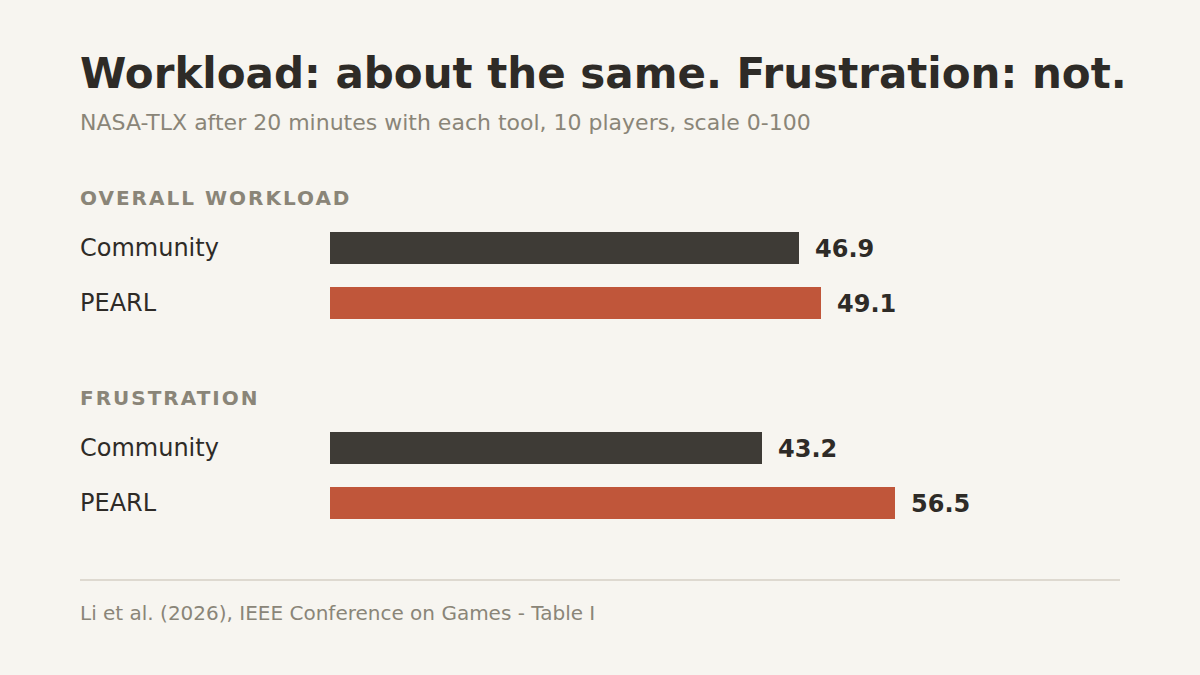
A peer-reviewed paper by Jiahong Li and eight co-authors (accepted to the 2026 IEEE Conference on Games, arXiv:2609.13718). They built PEARL, an AI support agent that retrieves expert-annotated move explanations and structurally similar peer boards, into Parallel, a puzzle game for learning parallel programming, and evaluated it with ten players. Participants rated the existing visualization tool more useful, and at least five minimized or abandoned the AI during play. Frustration scored 43.2 against 56.5. The authors conclude that what players rejected was not the content of the help but its unsolicited delivery, and ask of their own system: are we building Clippy?
Gao & Dubé: Letting a machine do the first read of player-made math levels — Fukai Reads
An arXiv preprint by Jie Gao and Adam K. Dubé of McGill University. A children's math learning game has a Creative Mode in which advanced players build their own levels, but reading every submission by hand does not scale. The authors extracted features from 206 levels (86 by experts, 120 by players) and trained a classifier to do the first read. Random forest gave the best recall and F1, scoring 82.42±5.71% accuracy and 72.70±9.22% F1 in the outer loop.
Wermann et al.: How In-Game AI 'Words' vs 'Demonstration' Change Learning and Cognitive Load — Fukai Reads
A pre-registered experiment by LMU Munich and colleagues comparing 'verbal' and 'demonstration' support from an in-game AI NPC. Splitting 152 people into three groups in Qookies, a quantum-technology learning game, they found no difference in learning gains between conditions, but the verbal-plus-visual group reported significantly lower intrinsic cognitive load than the verbal-only group (d=0.60).