DESIGNER-STUDY · 2026-09-26
Inside Alex Beachum's Philosophy — Would You Still Want to Know, in a World That Ends?
Outer Wilds / Echoes of the Eye
Can a game run on nothing but wanting to know?
Alex Beachum is the creator of Outer Wilds (2019), a space-exploration puzzle game. There are no enemies, nothing to collect, no upgrades. Every 22 minutes the sun explodes and the world rewinds. The only thing you carry over is what you have learned.
He has explained this design in the same words for years. In 2015 he said the goal was an open world "where the sole purpose of exploration is to answer questions about the world you're in" (Game Developer 2015 ↗). Just before the Echoes of the Eye expansion in 2021, he said almost the same thing again (Axios 2021 ↗).
That expansion turns five this week. I lined up his statements from 2015 to 2023. What emerges is a device added for technical reasons that slowly became the vessel for his personal outlook. Read this alongside our Outer Wilds review. 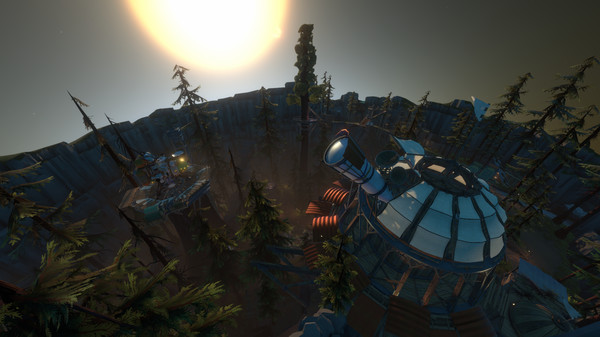 Outer Wilds in play — image 1 as listed on the Steam store page (Steam store screenshot)
From a master's thesis to a product, six years later
Beachum did not set out to be a game designer. He says he only decided on the career when he applied to USC's Interactive Media graduate program, where Outer Wilds began as his master's thesis (source ↗).
His first attempt failed. The game was submitted to the student IGF and didn't get in. "I was pretty flabbergasted," he said the following year, when the main IGF recognized it (Edge 2015 ↗). At IGF 2015 it won the Seumas McNally Grand Prize and Excellence in Design (Wikipedia ↗).
The commercial version was built at Mobius Digital and released by Annapurna Interactive in 2019, after roughly six years of development (GamesBeat 2018 ↗). The writing was by his sister, Kelsey Beachum (Wikipedia ↗).
Philosophy — understanding is the only reward
In 2015 he named two goals. The first was "to capture the spirit of space exploration by having players navigate a world driven by forces beyond their control." The second was an open world whose only purpose is answering questions (source ↗).
In 2018 he called it "a narrative adventure inside a physics simulation," adding, "You can die in a lot of ways, but you can't kill anything" (GamesBeat 2018 ↗). Take combat away and curiosity is the only motive left.
In 2021: "We want this to be a game about you exploring because you want to answer questions" (Axios 2021 ↗). Six years apart, the claim has barely moved. I read that consistency as his first defining trait.  YouTube: "Alex Beachum Designing for Curiosity in Outer Wilds." (Full Indie channel), thumbnail
Obsessions — the time loop, and fragility
Surprisingly, in 2015 he described the loop in engineering terms, not story terms. "The time loop was invented to make repeated playthroughs diegetic," and it "primarily exists to allow the creation of large-scale dynamic systems" (source ↗).
Another interview that year is blunter. Some systems, if left running longer than 20 minutes, would produce "chaos," so the world resets. In exchange, irreversible events become possible, "so that when you explore matters just as much as where" (Edge 2015 ↗).
His other obsession is fragility. "I'm fascinated by the fact that humans strap themselves to giant rockets just to explore an environment where they clearly aren't supposed to be." And: "The decision to investigate the cave is a lot more interesting if you're worried about what you might find inside" (source ↗). 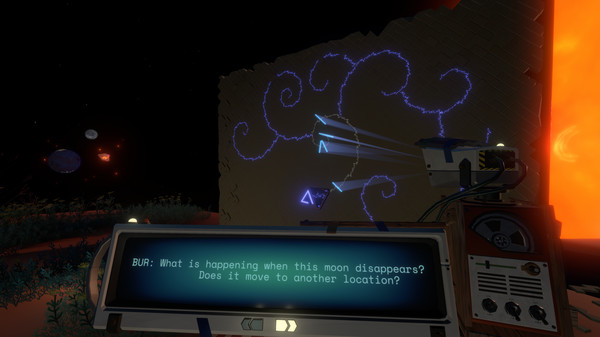 Outer Wilds in play — image 2 as listed on the Steam store page (Steam store screenshot)
Failure — the first village, scrapped after months
The village where the game begins once had a different early version. In a 2023 interview he recalled that it "existed for like a handful of months probably," and said flatly: "It didn't work at all" (interview by Claire Boeck, 2023 ↗).
There is little regret in how he tells it. "It was a cool early learning experience. But the new one's just infinitely better in every way." The redesign, he says, gets players to the place the team wants them to be far better.
The student IGF rejection and the rebuilt village: both failures he talks about share a shape. Something was put out, judged, and taken back.
Dilemmas — what to let go, and an experience that can't be repeated
In the same interview he names the maker's dilemma plainly. You want players to have a specific experience, "and this design is not working." Then the question is: "what are you willing to let go of?" (source ↗). Losing the nuanced touches you hoped for is, he says, "fine."
The second dilemma is built into any knowledge-driven game: "once you know the thing, now you can't ever do it again and have the same feeling." He concedes, "I don't think there's a way around that though."
He also balances freedom against guidance. "There's exactly one wrong way to play the game that I'm aware of": trying to clear planets one by one. "You're really meant to pursue it by question." Each mystery has roughly three clues, and there is a rule that two are never on the same planet. 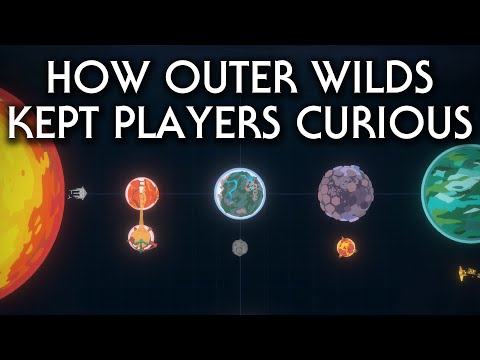 YouTube: "How Outer Wilds Kept Players Curious - Full Interview With Alex Beachum" (TeeHallums channel), thumbnail
Influences — a town under a falling moon, and a white labyrinth
The influence he acknowledges most clearly is The Legend of Zelda: Majora's Mask. "Majora's Mask is a favorite among our team, so we'd be lying if we said it didn't have a big influence on the game." The sense of impending doom "was very much inspired by Termina's lunar predicament" (source ↗). See also our study of Eiji Aonuma, who was closely involved in that game.
In another 2015 interview he cited roguelikes: "When you have permadeath, you can play around with consequences, and time-dependent things" (Edge 2015 ↗).
In 2023 he mentioned Antichamber, which he played in grad school and which "did influence Outer Wilds a bit" as a precedent for knowledge-gated progress, while admitting his memory of it is hazy (source ↗). I wrote about its creator in our Alexander Bruce study. 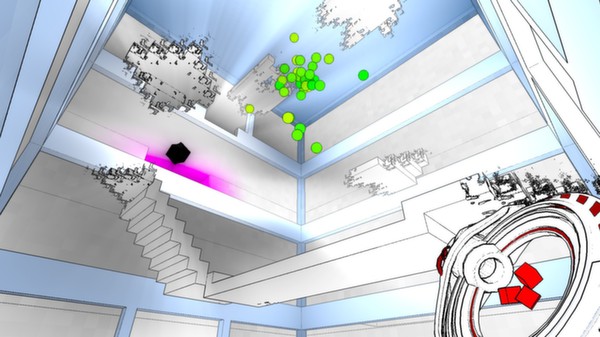 Antichamber in play — image 1 as listed on the Steam store page (Steam store screenshot)
Kizuki's reading — a loop added for convenience became the answer
What follows is my reading, not his words.
In 2015 he talked about the loop as a way to keep systems from breaking. By 2023 he says, "Outer Wilds is just my personal philosophy essentially," and poses the question: what's the point of exploring and learning about the universe, knowing it won't matter and the world will still end? The game's answer, he says, is yes, it is still worth it (source ↗).
I read those two statements not as a contradiction but as a sequence. First came a technical convenience: rewind the world every twenty minutes. That convenience then confronted its maker with a question: will you still try to know, in a world that ends? His acceptance that the experience can only be had once grows from the same root. I read him as someone who affirmed the value of things that vanish through the very mechanics of his game.
Where to start
The door in is, of course, Outer Wilds itself. Since he admits you can never play it again with the same feeling, please start without guides. Follow questions that catch your interest, not planets one by one; that is how its maker meant it to be played.
After the main game, go on to Echoes of the Eye. For the narrative side, his sister Kelsey Beachum's GDC 2021 talk (GDC Vault ↗) is a good lead. Related studies: Eiji Aonuma and Alexander Bruce.
Sources
Primary sources consulted for this article:
・Game Developer, "Road to the IGF: Alex Beachum's Outer Wilds" (Phill Cameron, 2015-01-27) ↗ — USC thesis, two design goals, Majora's Mask, the loop's purpose, fragility, the cave
・Edge (via TechRadar), "Outer Wilds is a game that asks what if you only had 20 minutes to live" (2015-03-23) ↗ — student IGF rejection, roguelikes, systems that turn to chaos past 20 minutes, "when you explore"
・GamesBeat, "Outer Wilds preview: Let's go backpacking in outer space" (Dean Takahashi, 2018-03-15) ↗ — narrative adventure inside a physics simulation, can't kill anything, six years of development
・Game Developer, "Attend GDC and learn how Outer Wilds nailed curiosity-driven game design" (2020-01-15) ↗ — announcement of the GDC 2020 talk (Beachum / Verneau); the talk itself was not consulted
・Axios, "The unlikely success of Outer Wilds" (Stephen Totilo, 2021-09-27) ↗ — "exploring because you want to answer questions"
・Claire Boeck, "Interview with Alex Beachum" (recorded April 2023) ↗ — the first village, what to let go of, the unrepeatable experience, the one wrong way to play, clue placement rule, Antichamber, personal philosophy
・GDC Vault: Sparking Curiosity-Driven Exploration Through Narrative in Outer Wilds (Kelsey Beachum, 2021) ↗ — mentioned as a related talk only
・Wikipedia, "Outer Wilds" ↗ — release date, IGF 2015 awards, team roles
・Video thumbnails: Full Indie ↗ / TeeHallums ↗ (YouTube; credited as image sources)
Note on images: this article was prepared in an environment where images could not be downloaded for visual review. Steam screenshots are limited to URLs returned by the Steam store API, and captions use a generic listing-order format.
Reactions (no login)
Anonymous • one of each per visitor per day
関連シリーズ
The Designer's Philosophy第66回 / 全70回