SOUNDTRACK · 2026-09-01
Soundtrack: EXAPUNKS — the metronome that won't wait for you
Matthew S Burns
Introduction — sit down at the terminal, and the synths are already playing
EXAPUNKS is the Zachtronics puzzle game Komugi reviewed. It's set in a fictional 1997, where the protagonist — afflicted by a worldwide plague called "the phage" — keeps their body running through hacking. The moment you open the terminal, a synth-and-drum-machine sound starts up, all rounded edges and hard hits. To my ear it sits at roughly 100–110 BPM: a forward-leaning tempo that never quite rushes you.
The score is by Matthew S Burns — the same person who wrote that quiet lounge music for Opus Magnum. Same hand, completely different temperature. Another sip of black coffee. For now, hold onto this: the same composer changes genre entirely from game to game. It matters later. Writing an EXA program at the terminal in EXAPUNKS
A puzzle-specific trait — free while you think, a pulse the instant you run it
The "EXA" you write in EXAPUNKS is a small program. While you're writing the code, no one rushes you no matter how many hours you spend — the same quiet, unbounded thinking time as any other Zachtronics game. But the moment you hit RUN, the program turns into a metronome that won't wait: it advances one instruction per cycle, flatly, forever. Analyses of the game even note that syncing multiple EXAs together forces a minimum of several cycles' worth of waiting — time ticked out as precisely as sheet music.
What's interesting is how this switch — no beat while thinking, a strict beat while running — lines up with how the music itself plays. The score runs over a drum machine that always holds a steady pulse. While you think, that pulse waits quietly outside the frame; the instant you hit RUN, it lands right on top of your code executing. Moving back and forth between silence and pulse feels like a trick that only a puzzle built around separating thinking-time from running-time could pull off.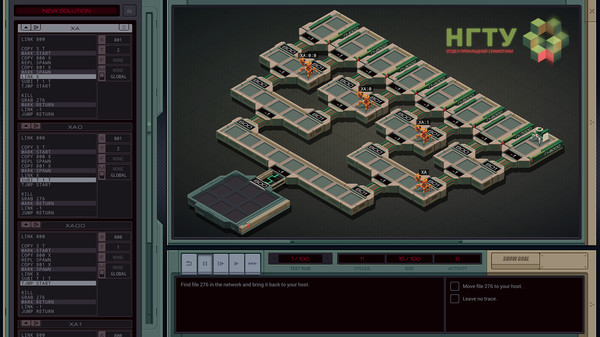 Once an EXA program starts running, time won't wait
A hidden link to the experience — "punk" as substance, not costume
The world of EXAPUNKS is full of nods to William Gibson-style cyberpunk. The game ships with a fictional zine called "Trash World News," designed to be printed out and kept next to you as you play. Zachtronics founder Zach Barth read the real hacking zine 2600 as a teenager and attended DEF CON — and in interviews he has framed "punk" not as a look but as substance: someone who stands opposed to large systems of control.
That same idea — punk as substance, not a surface gimmick — shows up in how the music is built too. Instead of dressing itself up with flashy glitch noise to look "hacker-ish," it holds a steady synth pulse throughout. No overacting, and no crowding the listener. That's a distance I try to keep in my own work too, and finding my own habit inside someone else's is a little embarrassing to admit.
The puzzle analogy — free thought, an enforced beat
Solving has two phases: the long stare while you write code, and the inescapable running time that starts the moment you hit RUN. Where EXAPUNKS differs slightly from other Zachtronics games is that this second phase — the beat — is kept audible the whole time, in the plain, legible form of a drum machine. Thinking stays free; running never does. I listen to that gap and hear it as the music's job.
If the track leaned forward even while you were thinking, it would ruin the quiet of the long stare. If it stayed calm all the way through execution, you'd lose the tension of a beat that won't wait. The sound of EXAPUNKS moves between these two kinds of time within a single track, turning the beat itself into something that feels like it's "executing." My habit of measuring everything in BPM finally felt rewarded the day I heard this one.
Tracks worth hearing
The official audio lives on developer Zachtronics' Bandcamp (credited to Matthew S Burns; released August 16, 2018; thirteen tracks). It's also up on YouTube via his official, auto-generated Topic channel.
・EXA Power ↗ — Track 11. The tension of running several EXAs in parallel comes through most clearly here, late in the album.
・Leave No Trace ↗ — Track 8. A quieter, low-beat piece for stealthier missions. The one to hear if you want "quiet execution" between the louder tracks.
Closing — what I'd steal
If I were writing music, this is what I'd steal: give thought no beat, and give execution one. A track that pushes the same tempo throughout is easy to write, but it dilutes both the quiet of the long stare and the tension of execution. A game with two kinds of time can have two tempos — EXAPUNKS pulls that off inside a single track, without ever switching songs.
If you want to revisit it, pick a night when you're grinding before a deadline. Hearing it against Burns' calm loops for Opus Magnum, you'll notice it's the opposite temperature entirely. Compare it with the Opus Magnum piece and you can really see how far one composer will change costumes from game to game.
References
・Steam: EXAPUNKS (official Zachtronics store page)
・Matthew S Burns — EXAPUNKS OST (official Bandcamp)
・Matthew S Burns - Topic (official YouTube audio channel)
・robopenguins: Exapunks Optimization (an analysis of EXA cycle-based execution)
Reactions (no login)
Anonymous • one of each per visitor per day
関連シリーズ
Puzzle Soundtracks第85回 / 全85回
次に読む

関連レビュー
Tetris Effect: Connected
落ちてくるブロックを積んで列を消す、あのテトリス。ルールはそのままに、30を超えるステージで音と光がプレイに合わせて動く。時間を止めて4列より多く消せる「ZONE」と、3人の盤面がつながる協力モードが加わった、水口哲也の Enhance が手がける一作。
FRACT OSC
シンセサイザーでできた広大な遺跡を一人称で歩き、光るノードや音の仕掛けを操作して、眠った機械と音楽を蘇らせていく音楽探索パズル。説明はほとんどなく、何が触れられるのかを自分の目で見極めることそのものが謎解きになる。IndieCade で音響デザイン賞を受けた Phosfiend Systems の2014年作。

