SOUNDTRACK · 2026-08-31
Soundtrack: Kaizen: A Factory Story — the cue that opens every morning
Matthew S. Burns, Sam Kulchin, Drew Messinger-Michaels
Introduction — the factory's morning starts with a workout cue
Open Kaizen: A Factory Story and the first thing you hear is a synth-keys tone that feels oddly nostalgic. Maybe around 90 BPM — measured by ear — less a march than the tempo of 'all right, everyone, line up by the radio.' I didn't expect an automation puzzle about assembling parts on a conveyor belt, set in 1980s Japan, to sound this much like it has people in it.
The music is by three composers: Matthew S. Burns, Sam Kulchin, and Drew Messinger-Michaels. Matthew S. Burns is a name I recognize from his Zachtronics-era work on EXAPUNKS. Developer Coincidence has said they built this game as a nod to 1980s Japanese product design, music, and work culture (per a MonsterVine interview). According to Komugi's review, it's a Zachtronics-lineage 'build it, then fix it' puzzle where you script the motion of arms, the flow of belts, and the order of welds to optimize a line.
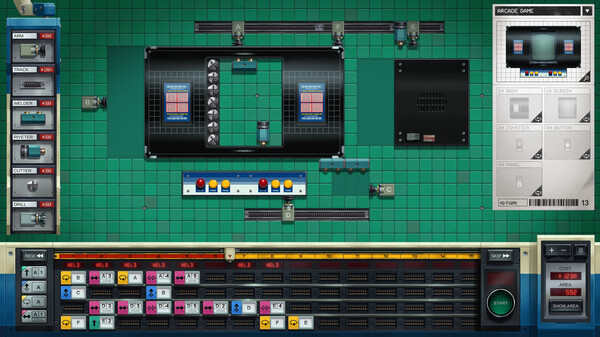 Kaizen: A Factory Story (from the official Steam screenshots)
A puzzle-specific trait — a title that plays back a real-world cue
One track on the list is called 'Radio Taiso.' That's not a made-up phrase. Radio calisthenics (rajio taisō) is a real NHK radio program running since 1928, broadcast at set times not just in schools but as a morning ritual on factory floors, cueing a fixed sequence of stretches. If this game's core loop is building and re-fixing a procedure fresh every morning, naming the very start-of-day track after a real broadcast cue is more than atmosphere — it's a device that overlays the player's own day onto a factory worker's.
The developers have also spoken concretely about the sound of 1980s pachinko parlors: 'almost always, terrible, almost like military marching music, with an announcer patterning constantly on top of it,' as they put it in a MonsterVine interview. That sensation — one phrase looping endlessly with a voice layered over it — sits strangely close to the core of an automation puzzle, where a procedure you set once keeps looping forever. I suspect the track 'Pachinko Nights' is carrying that exact sonic memory straight into the game.
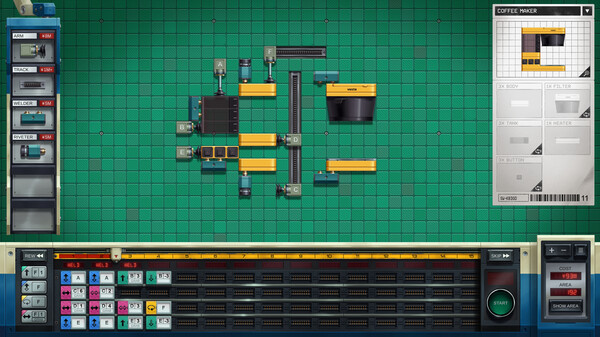
 The line you built keeps looping, forever (from the official Steam screenshots)
The puzzle analogy — the tempo of a cue, and the breathing of optimization
I always overlay the tempo of solving onto the tempo of music. Thinking in an automation puzzle proceeds by 'build, run it, spot the mismatch, fix it.' Once you've written a procedure, the machine repeats it forever after — the same structure as a radio calisthenics broadcast playing the exact same sequence, in the exact same order, every single morning. As your body falls into sync with a fixed cue, the feeling of movements gradually lining up overlaps directly with the feeling of refining a puzzle's procedure.
So it's good that the music isn't afraid of looping. If anything, it affirms the pleasure of a phrase repeating. Watching your own assembly line loop endlessly while listening to music that loops in the same way isn't a doubled boredom — it's a doubled pleasure of things falling into sync. The closer a puzzle gets to finished, the less the music's repetition gets in the way. I think that's this soundtrack's real invention.
Tracks to hear — start with the title track
The official audio streams in full on the composing team's own Bandcamp (Coincidence Games). Start with the album's title track, 'Kaizen.' Kaizen — Coincidence Games official Bandcamp ↗ — it's where that nostalgic synth-keys texture comes through clearest.
Then, the track this whole essay grew out of: 'Radio Taiso.' Radio Taiso — Coincidence Games official Bandcamp ↗. Listen while tracing the real-world cue it echoes, and you'll feel like you're falling into line for morning exercises.
Finally, 'Matsuzawa Spirit.' Matsuzawa Spirit — Coincidence Games official Bandcamp ↗ — I think this is the track where affection for the factory as a place comes through most directly.
Closing — if I were stealing, I'd steal 'name it after a real cue'
If I were writing music, what I'd steal isn't the timbre but the naming instinct: instead of invented mood-words, title a track after a real broadcast, announcement, or ritual sound from the world. That alone lets the track shortcut straight into a memory the listener already carries. Even when I write loop material now, I decide 'what cue is this the sound of' before anything else.
As for when to relisten — right before any task where you repeat the same procedure every morning. A radio-calisthenics moment, syncing your body to the same order again. For companions, I'd point toward EXAPUNKS, which also carries music by Matthew S. Burns, and the rest of the Zachtronics lineage. I think I'll brew a black coffee and run today's line one more time.
Reference links
・Coincidence Games official Bandcamp: Kaizen: A Factory Story Original Soundtrack
・Steam: Kaizen: A Factory Story
・Unseen Japan: Radio Taisō — A Nuanced History of a Nearly 100-Year-Old Tradition
Reactions (no login)
Anonymous • one of each per visitor per day
関連シリーズ
Puzzle Soundtracks第83回 / 全83回
次に読む

関連レビュー
Tetris Effect: Connected
落ちてくるブロックを積んで列を消す、あのテトリス。ルールはそのままに、30を超えるステージで音と光がプレイに合わせて動く。時間を止めて4列より多く消せる「ZONE」と、3人の盤面がつながる協力モードが加わった、水口哲也の Enhance が手がける一作。
FRACT OSC
シンセサイザーでできた広大な遺跡を一人称で歩き、光るノードや音の仕掛けを操作して、眠った機械と音楽を蘇らせていく音楽探索パズル。説明はほとんどなく、何が触れられるのかを自分の目で見極めることそのものが謎解きになる。IndieCade で音響デザイン賞を受けた Phosfiend Systems の2014年作。

