PAPER-DIGEST · 2026-09-23
Chien et al.: Say “90% payout” and the game looks winnable — and the meaning gets lost — Fukai Reads
Behavioral economics — how odds are framed, and how different ages read them
TL;DR
The same number can look winnable or not depending on how you phrase it. Today’s paper tests that with both younger and older adults.
Some participants were told a casino game “has an average percentage payout of 90%”. Others were told the game “keeps 10% of all money bet on average”. The content is identical.
With the payout wording, fewer people could say correctly what the message meant — and more people felt they were likely to win. The pattern appeared in younger and older adults alike.
Age by itself did not predict who understood. For anyone who shows probabilities on screen, the lesson is that showing the correct number is not enough.
Who wrote it, and where?
There are four authors: Chih-Yuan Chien and Teal Eich (Gerontology, University of Southern California), S. Duke Han (Psychology, USC), and Elliot Ludvig (Psychology, University of Warwick, UK). Eich is the corresponding author.
It appeared in Judgment and Decision Making, a peer-reviewed journal on judgment and decision research published by Cambridge University Press. It went online on 15 September 2026 under a CC BY 4.0 licence, so anyone can read the full text. DOI: 10.1017/jdm.2026.10049.
According to the paper, the sample size and main analyses were preregistered (preregistration: publicly committing, before the experiment, to how many people you will recruit and how you will analyze the data). The later mediation analyses, by contrast, are labelled “exploratory” by the authors themselves. That distinction matters later.
I chose it today because games are full of probabilities shown as text: gacha rates, proc chances in roguelites, payouts in minigames. How is that text actually read? This paper measures exactly that.
The “payout” wording was already under suspicion
Slot machines and similar games sometimes display a return-to-player figure: on average, what share of the money bet comes back as prizes. The goal of such displays is to prevent mistaken beliefs.
Yet prior work (a series of studies by Newall and colleagues) found the opposite. When the same information was written as the house edge — the share the operator keeps on average — people understood it better and judged their chances more realistically.
The paper cites a recent study in which the payout wording produced worse comprehension than showing no odds at all. Information meant to help was increasing misunderstanding.
But those studies focused on younger and middle-aged adults. What about older adults? One theory says ageing shifts attention toward positive information; another says it makes people more careful about avoiding losses. Which way it would go had to be tested. Luck be a Landlord, a roguelite built around a slot machine (Steam store screenshot)
How they tested it
Participants were US residents recruited through the online platform Prolific. The team recruited 200 people aged 18–25 and 200 aged 65–75; after preregistered exclusions, 187 younger adults (mean age 23.50) and 199 older adults (mean age 69.01) remained. The task took about five minutes.
Each person saw only one wording. Payout: “this game has an average percentage payout of 90%.” House edge: “this game keeps 10% of all money bet on average.” The design compares four groups: wording (2) × age (2).
Comprehension was a four-option question. The correct answer: “For every $100 bet on this game, about $90 is paid out in prizes.” The wrong options were “90% of people win something,” “a prize is awarded 9 in 10 times,” and “a $1 bet guarantees a 90¢ win” — all common misreadings.
The second measure asked how the information affected their perceived chance of winning, on a scale from 1 (very low) to 7 (very high). The team also measured positivity, risk propensity, and self-rated vulnerability to financial exploitation.
Those last three measures were there to separate “is it age, or is it a trait?” if age differences appeared. The tool for that is mediation analysis (a statistical method that checks whether a difference arises by way of some other factor).
What they found
First, perceived chance of winning. Payout wording averaged 4.89 and house-edge wording 3.85, a clear difference (effect size ηp² = .08). The age difference did not reach statistical significance, and there was no interaction between wording and age.
Next, comprehension. According to the paper’s Table 1, younger adults answered correctly 40.82% of the time with payout wording and 70.79% with house-edge wording. For older adults the figures were 48.51% and 70.41%. Under payout wording, fewer than half read it correctly.
In the statistical model, wording had a clear effect (p < .001). Age had none (p = .96), and neither did the age × wording interaction (p = .44). Being older did not make people misread more.
In an exploratory analysis, people who misread the message felt more likely to win (ηp² = .17). This gap was larger among younger adults: among those who misread, younger adults rated their chances higher than older adults did.
On traits, older adults rated themselves less vulnerable to financial exploitation, were less risk-seeking, and were more positive than younger adults. The mediation analysis found that, under payout wording, lower self-rated vulnerability partly explained older adults’ lower sense that they would win.
However, tests of whether this mediation differed between the two wordings were not significant. The authors conclude that age differences “reflect trait-level differences in financial vigilance and affective outlook rather than chronological age alone.”
How game makers can use this
A caveat first: this experiment is about casino payout rates. It did not test gacha drop rates or in-game proc chances directly. What follows is my proposal for how to bring the result back to games.
One: if an in-game casino or betting minigame shows its return rate, don’t show only “what comes back.” Add “what the house keeps,” or lead with it. Under this study’s conditions, the house-edge wording produced better comprehension and more realistic expectations.
Two: when explaining probabilities, attach a unit, as the correct answer did: “for every 100 bet, about 90 comes back.” The wrong answers were “90% of people win” and “9 in 10 times you win.” A bare percentage invites exactly those misreadings. This part is my inference, not something the paper tested.
Three: borrow the paper’s four-option question for playtests. After showing a roguelite’s “1 in 4” or a gacha rate table, ask “what does this mean?” and list common misreadings as distractors. If fewer than half answer correctly, suspect the wording.
Four: before changing displays “for older players,” fix the wording for everyone. In this study the wording effect appeared regardless of age, and age itself did not predict comprehension.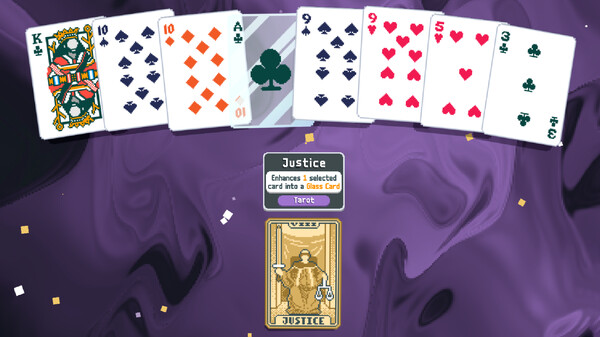 Balatro, which shows probabilities in its card text (Steam store screenshot)
Five: design the excitement and the honesty of the numbers separately. In this study, misreading and feeling likely to win moved together. If you want hype, build it with presentation, not with the wording of the odds. That line protects players’ trust.
How far can we trust it?
Start with the authors’ own caveats. The mediation analyses were exploratory, not the preregistered main analyses, and the tests of whether mediation differed by wording were not significant. The “vulnerability” story is best read as material for new hypotheses. I should also note that, in the portion of the text I could retrieve, I did not find a standalone paragraph summarizing limitations.
From here on, these are points I, Fukai, noticed. No real money was at stake. This was a roughly five-minute on-screen survey asking about a single judgment. Whether the same gap holds over sustained real betting is unknown.
Only one pair of numbers was shown: 90% / 10%. Whether 95% or 50% would produce the same gap cannot be said from this study. Comprehension was measured with a single item, which makes it sensitive to how the options were worded.
The age groups were 18–25 and 65–75, with no one in between (prior work covered midlife). Participants were US online panel members, so the results may not transfer directly to players in Japan.
Finally, this study had no “no information” condition. The finding that payout wording is worse than no display comes from prior work and was not re-tested here. Applying this to games is my own extension.
Fukai’s reading
This part is my opinion. I want to read this result as a point about grammar: the subject of the sentence decides where the reader stands. In the payout sentence, the returned money is the subject, and the reader is placed on the receiving side. In the house-edge sentence, the house is the subject, and the reader looks at the number from the side that pays. The number is the same, but the reader stands somewhere else. In design-critique terms, the honesty of information is not settled by whether the number is correct, but by whether it lands correctly. When I review how a game displays probabilities, I want to look at the sentence’s subject before the number.
What to read next
This paper builds on a series of studies by Newall, Walasek, Ludvig and colleagues. In particular, their Registered Report on how the phrasing of house-edge information affects gamblers’ perceptions and understanding reads well alongside this one.
The same group’s “Nudge versus sludge in gambling warning labels” looks at how a consumer-protection label can stop working depending on its wording. It offers a useful lens: wording as a nudge (a gentle push toward better choices) versus sludge (friction that gets in the way of good judgment).
Among Puzzlebyrinth’s past articles, Nagaya et al.’s study on how “not betting” is presented, from the same journal, is a close neighbour: in both, the wording of options changes how people choose.
Sources
Papers and materials referenced in this article:
Reactions (no login)
Anonymous • one of each per visitor per day
関連シリーズ
Paper Digest第92回 / 全98回