REVIEW · 2022-03-16
TUNIC
Setze Seite für Seite ein Handbuch in einer verlorenen Sprache zusammen
Introduction
A small fox is dropped into an isometric world. You pick up a sword, push through bushes, look for a door — so far, an old-school Zelda-like. But the real star of TUNIC isn't combat or the map. It's the in-game instruction manual you rebuild one page at a time, most of it written in an invented script you can't read. Armed with illustrations and a few stray English words, you decode how the world even works. Made by TUNIC Team, published by Finji, March 2022.
I write this from the Steam review pool. The verdict is 'Very Positive': 16,078 of 17,574 all-language reviews are positive against 1,496 negative (about 92%, snapshot 2026-06-25); the English reviews run 9,918 at 91%, Metacritic 85. It costs $29.99, low of $14.99. Even the last 30 days hold at 91% — the score hasn't slipped in four years.
On the numbers, a flawless favorite. But read closely and praise and complaint keep pointing at the same two things — the manual and the combat. What one reviewer calls 'the best sense of discovery in my life' another calls 'unfriendly' and 'a fixed camera that hides everything.' This piece translates that fork into design terms.
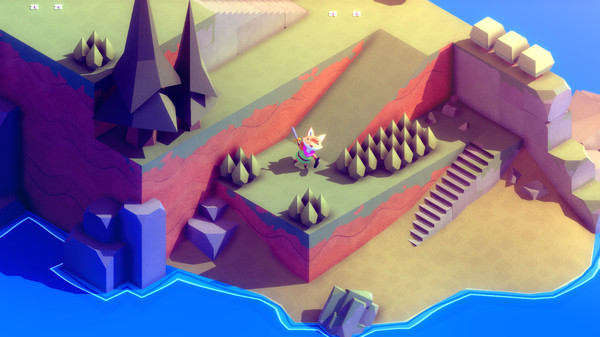 A small fox's adventure, and a manual you slowly rebuild. — Steam store
First Impressions
Line up the helpful positives and the vocabulary rhymes: magical, secrets everywhere, and over and over 'a love letter to old Zelda.' Most praise carving through a world with no neon arrows and no hand-holding tutorial, on curiosity alone. The phrase 'piecing the manual together makes you feel like Sherlock Holmes' recurs across unrelated reviews.
The negatives grab a different set: combat sucks, boss difficulty spikes hard off the rest of the game, the fixed isometric view hides secrets behind walls, and the late puzzles get obtuse enough to stall you. One player flatly writes, 'decent game but nothing more, 6/10.'
What's interesting is how often the same trait is read in reverse. One reviewer's 'freedom to notice for yourself' is another's 'just unfriendly'; one's 'real bite' is another's 'unfair wall.' My job isn't to stage a fight, but to translate where the verdict forks.
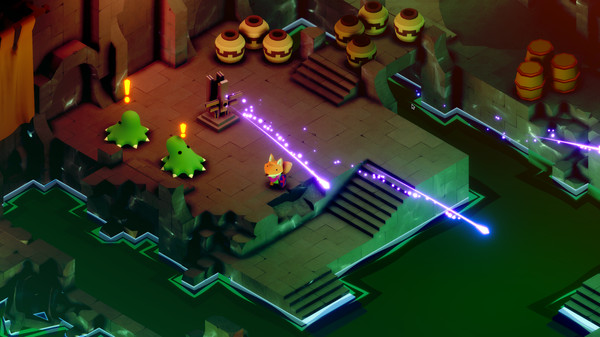 The verdict orbits two things: the manual and the combat. — Steam store
Putting the Mechanics into Words
Nearly every positive names the manual. It mimics the paper booklet that used to ship with games, and you rebuild it from pages scattered across the world — maps, controls, item uses, hidden techniques, even the deepest secret are drawn inside. But most of the text is in an invented script with no translation; all you can read are the illustrations and the rare English word.
In Puzzlebyrinth's terms, TUNIC hands you the grammar table nearly blank. It shares a family with The Witness teaching its glyphs from the environment and Chants of Sennaar inferring a language from context. The twist: here, decoding doubles as the tutorial. Reading the manual is how you learn controls, strategy, and story at once — raise observation resolution and the world opens a line at a time.
The pool often forgets the 'Holy Cross,' an input secret: match a sequence of directions to figures hidden in the manual's margins and the world answers back. Like Fez's language puzzles or Outer Wilds' knowledge-gated progress, TUNIC's real key isn't an inventory item — it's the understanding in your head. That's why so many say the manual reads like a different game once you finish.
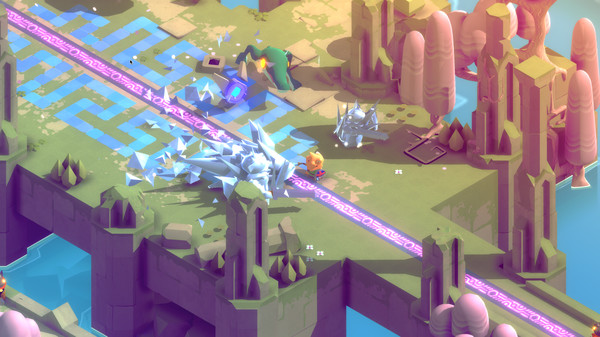 The manual you rebuild teaches controls, strategy, and story at once. — Steam store
The World
Much of what positives call 'magical' comes from how the world is built. The isometric box folds another path behind each screen; a tower glimpsed far off connects back hours later. Lifeformed's score stays calm while you explore and only bares its teeth at bosses. Even the fox's gestures and the small animation of opening a chest are lovingly made — 'the world itself wants to hide secrets,' a reviewer writes.
Tellingly, the fixed isometric camera is exactly the line the verdict splits on. Positives read the locked angle as 'a design that can tuck a path into a screen's corner,' and love how passages hide behind walls on purpose. Negatives call the same angle 'stressful — you can't see what's behind anything.' Not a question of quality but of reach: a treasure trove for those who'll doubt the walls, a wall of invisible walls for those who want signposting.
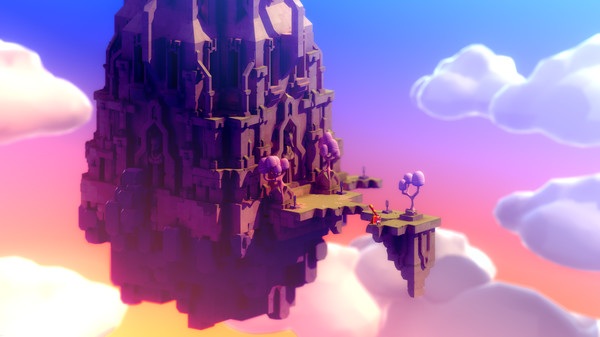 A folded box-world seen through one locked, isometric angle. — Steam store
The Texture of Difficulty
Difficulty is where the pool splits most cleanly, and the stuck-points sort into roughly three kinds. One: combat — stamina is strict and bosses spike hard off the main game. Two: exploration — losing things behind the fixed camera, or failing to find the manual pages at all. Three: the late puzzles — the Holy Cross and meta-secrets get obtuse enough to halt you.
Press and players diverge right here. Rock Paper Shotgun flags the bosses as too hard for the rest of the game; Nintendo Life calls it 'unforgiving and ingenious.' The dev answers with accessibility options like a 'No-Fail Mode' — turn it on and combat deals no damage, freeing you for the puzzles. Some welcome it as 'a rescue for anyone stuck fighting'; others regret that 'invincible-or-full is too binary.'
On the label: I set difficulty to 4. No-Fail can drop combat to effectively zero, but it can't lower the manual-reading or the late meta-puzzles. The real wall here isn't reflexes — it's observation and deduction. Completion runs about 12 hours for the main path, over 21 for the secrets (HowLongToBeat). Read it as a slope whose height depends on what you enjoy, not a uniform wall.
 Three separate walls: combat, exploration, and decoding. — Steam store
Sources
Written by reading the Steam store page and community reviews/discussions as of 2026-06-25. No review text is quoted directly; typical claims are reconstructed.
- Steam: TUNIC (Very Positive — 16,078 of 17,574 all-language reviews positive, 1,496 negative; English 9,918 at 91%; Metacritic 85)
- Read via WebFetch: top helpful positives, negatives attacking the combat and fixed camera, and recent discussions — confirming praise ('magical', 'secrets everywhere', 'feel like Sherlock Holmes') and complaints ('combat sucks', 'fixed camera hides secrets', 'late game is obtuse')
- Context: a Nintendo Life review (unforgiving and ingenious) and a Big Boss Battle review on No-Fail Mode — to compare how press and players weigh it
Closing
Steam reads about 92% positive; my design-critique score is 8.6. I put it nearly level with the number because the invention at TUNIC's center — making 'decode the manual' the very engine of progress — is close to one of a kind. Running a Fez-style language puzzle as the whole signposting layer of an action-adventure is, simply, deft work. Marks come off for the fixed camera it martyrs itself to, and for bosses that float above the rest.
The split itself tells you who it was built for. For anyone who loves the knowledge-gated progress of Outer Wilds and Return of the Obra Dinn, or the decoding joy of Chants of Sennaar, it's a $29.99 that stays with you. For anyone here for clear signposting or combat as the point, the manual's silence and the boss walls stand in the way. No-Fail lowers only the combat wall; it can't hand you the joy of decoding — and that's exactly the heart of this little fox's adventure.
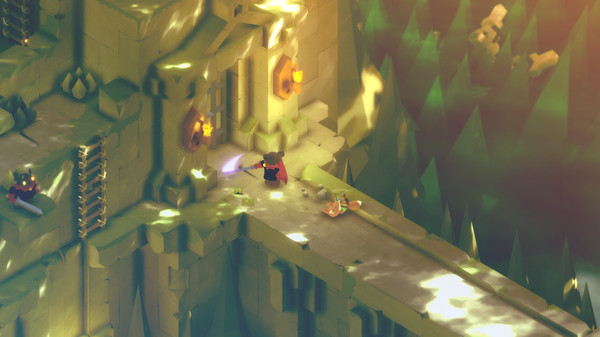 The heart of the fox's quest is observation and deduction, not reflexes. — Steam store
Where are you with this game?
Press one and the game goes on your shelf. You can see it on your account page.
Reactions (no login)
Anonymous • one of each per visitor per day
Read next

Related reviews
Isle of Arrows
Ein pusselnahes Tower-Defense-Spiel: Zufällig gezogene Kacheln werden einzeln auf eine schwebende Insel gelegt, Wege werden verlängert und Türme aufgereiht, um Wellen von Eindringlingen abzuwehren. Unerwünschte Kacheln lassen sich gegen Münzen überspringen. Gridpops Kreuzung aus Brettspiel und Tower Defense.
Hyperbolica
Ein nichteuklidisches Erkundungsadventure aus der Egoperspektive: Man durchläuft eine Stadt, die aus hyperbolischem Raum, in dem sich Parallelen nicht schneiden, und sphärischem Raum, in dem entfernte Dinge größer wirken, besteht, spricht mit den Bewohnern und erwirbt durch Rennen, Skifahren und Schneeballschlachten ein körperliches Gefühl für diese Welt. Ein Werk von CodeParade, der auch die Rendering-Pipeline im Alleingang aufgebaut hat.
Last Call BBS
Einen fiktiven PC aus den 90ern namens „Z5 Powerlance" hochfahren und über eine BBS acht Denkrätsel einzeln herunterladen und spielen – das letzte Spiel von Zachtronics. Vom Logikrätsel Dungeons & Diagrams über das Schaltkreisdesign von ChipWizard bis zum Falling-Block-Spiel HACK*MATCH versammelt es kleine Werke mit ganz unterschiedlichen Verben auf einem einzigen Retro-PC.


