ANALOG · 2026-09-29
The Crew (2019): a ban nobody polices, and a table that keeps it anyway
Cooperative trick-taking rests on one sentence of prohibition and a radio token you may use once. What disappears when it becomes code?
Today's texture: forty oversized cards and one radio token
Today's texture: forty oversized cards and one radio token the size of a fingertip.
The Crew: The Quest for Planet Nine (2019). You are the crew of a spacecraft, and you are going to look for the ninth planet.
The play is ordinary trick-taking. Everyone puts down one card, and the strongest card takes the trick. Winning tricks is not the point, though. The point is that each player has been told which cards they must take, and all of those instructions have to come true.
One sentence in the rulebook does most of the work: "If you know something only because you know your own cards, you are not allowed to talk about this information."
There is no referee. Nobody is checking. The table keeps the rule anyway.
Let us take that apart.
 From the thumbnail of "The Crew The Quest for Planet Nine Playthrough - KOSMOS" (Board Game Empire, YouTube)
What, when, who: a spacecraft that fits in a small box
Designed by Thomas Sing, published by KOSMOS, illustrated by Marco Armbruster. It came out in 2019.
Inside are forty playing cards: thirty-six colour cards numbered 1 to 9 across four suits, plus four rocket cards numbered 1 to 4 as the trump suit. Thirty-six task cards come with them.
Three to five players, with a two-player variant included.
The distinctive part is the campaign: fifty missions in order. The first has a single instruction. Conditions pile up as you go, and eventually you are told to take cards in a fixed order.
On 20 July 2020 it won the Kennerspiel des Jahres, Germany's connoisseur game of the year. The jury noted that being a cooperative trick-taking game already makes it something special. It also has a Deutscher Spiele Preis and an American Tabletop Award.
I could not weigh the box. The only physical quantity I could confirm today is a count: seventy-six cards.
Why the ban holds up in paper and hands
A cooperative game in which you may not confer. That contradiction is almost the whole design.
Let people confer and a cooperative game turns into one strong player issuing orders to everyone else. The Crew stops that with a single sentence of prohibition.
In its place sits the radio token. Once per mission you may lay one of your colour cards face up and put the token on it.
The token's position is the message. At the top: this is my highest card in that colour. In the middle: it is my only card in that colour. At the bottom: it is my lowest.
Three words, and no more. Rocket cards cannot be communicated at all, and the token may never be placed in the middle of a trick.
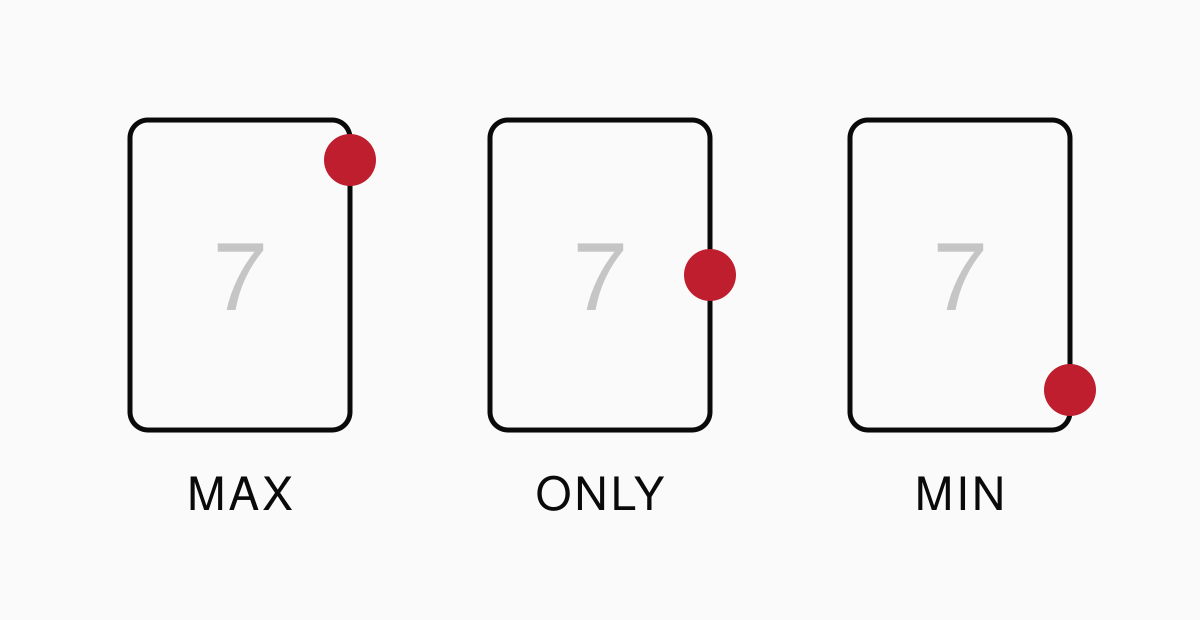 (Diagram) Three words, and nothing else. The height of the token is the meaning.
Now for the harsh part. The ban has a hole in it that cannot be closed.
What is forbidden is speaking on the basis of your own cards. Staying silent is not forbidden. Nor is hesitating, nor how fast you play, nor when you choose to spend your token.
At a real table, that leftover channel is the most talkative one in the room. A five played after a long pause says a great deal more than five.
The rulebook cannot close it. Closing it would require someone to watch every pause and every face. So the game leaves it to the players' own restraint, and it does not pretend otherwise.
Moving it to code: what is lost, what survives, what can be added
Suppose you port that ban straight into code. Three buckets.
What is lost. Faces, and pauses.
How many seconds the other player hesitated. Whether they drew breath. Whether their hand stopped. At the table those were information. Online, most of it falls away.
The other loss is the feeling of having broken nothing you could have broken. At the table, the ban is something you choose to keep. The moment a system enforces it, it stops being a choice, and the sense of keeping it goes with it.
What survives. The asymmetry itself, and a channel you may use once.
"I can see my own hand and not yours" ports unchanged. That is the skeleton of observation and deduction. A relative of it appeared in Hanabi, which I wrote about earlier in this series: there, your own hand is the one thing you cannot see. Inverted, but the same family — what is visible differs by seat.
The token's three words survive cleanly too. As data it is three fields: {colour, number, highest | only | lowest}. As mechanisms go, it is almost ideally portable.
What only code can add. The ability to actually close the channel.
On a table you can only write "please do not talk about it". In a program you can limit the kinds of message that exist to three. Constrain it in the type system and there is nothing left to break.
On top of that: automatic verification of missions, measured difficulty, asynchronous play, statistics. Board Game Arena carries the game, and the site reports over 560,000 plays. No paper table will ever produce that number.
 From the thumbnail of "How to Play The Crew: The Quest For Planet Nine" (Roll For Crit, YouTube)
Some games made the same translation starting from the digital side. Keep Talking and Nobody Explodes physically separates the person reading the manual from the person looking at the bomb. BOKURA shows two players different things on their two screens. Both build a channel by splitting what is visible. There is also an essay on cooperative puzzle design and information asymmetry on this site.
For makers: write a channel, not a ban
One takeaway, and only one.
When you feel the urge to write "no discussion allowed" into your own game, stop for a moment. A ban needs policing. If you cannot police it, it is not a ban; it is a request.
Write a countable set of sendable messages instead. That is what The Crew does: one line of prohibition and a vocabulary of three.
Fewer words is better. Whether three is enough is something playtesting answers quickly. When it is not enough, move the number of uses before you add words. The Crew never grew its vocabulary — it varies how often and when the token may be spent.
In closing
A ban nobody can police looks like a weak rule. This game chose to leave it weak.
You could break it, and you do not. I suspect the designer knew that this moment is the interesting one. Enforce it in code and the game becomes correct, and a little less fun. Which of the two you want is your call.
In your game, would you leave the job of staying quiet to human hands?
Sources
"The Crew The Quest for Planet Nine Playthrough - KOSMOS" (Board Game Empire, YouTube) ↗
"How to Play The Crew: The Quest For Planet Nine" (Roll For Crit, YouTube) ↗
Reactions (no login)
Anonymous • one of each per visitor per day
Part of these series
Solved by HandEpisode 9 of 10
Read next
Related reviews
The Centennial Case: A Shijima Story
A mystery adventure told in live action, following a chain of killings that has haunted one family for a century. You collect clue words from each scene and slot them into hypothesis sentences, tying four cases across four eras into a single thread. From Square Enix.
GNOSIA
A single-player take on Werewolf: find the Gnosia hiding among the crew using nothing but discussion and votes. Up to fifteen crew members are redealt into different roles each loop, and a time loop sends you through the same voyage again and again. From Petit Depotto.
Phoenix Wright: Ace Attorney Trilogy
A courtroom adventure in which you play defense attorney Phoenix Wright, matching one line of testimony against one piece of evidence to break a lie. Capcom's collection gathers all fourteen episodes of the three games first released between 2001 and 2004, with the art redrawn frame by frame.


