ANALOG · 2026-09-26
Tabletop Simulator (2015) — They Ported the Table, Not the Games
No victory conditions, no scorekeeping / what stayed is physics and human adjudication / enforcement can be added later, in Lua
Today's texture: pick it up, let go, and it falls
Today's texture: pick it up, let go, and it falls.
Tabletop Simulator is not a port of board games. What got ported is the table.
It was made by Berserk Games. It arrived on Steam on June 5, 2015. The engine is Unity.
The store page says almost everything about it: "There are no rules to follow: just you, a physics sandbox, and your friends."
No victory conditions. No score counting. No automatic dealing. What you get instead is the ability to flip the table.
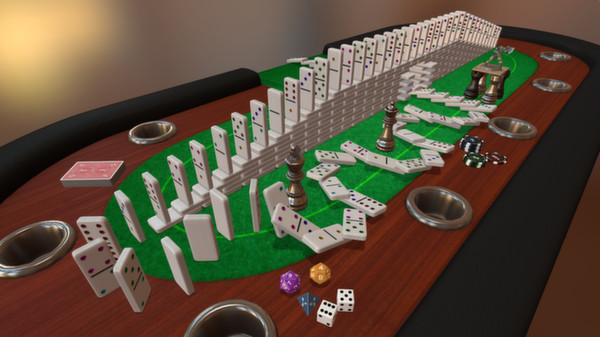 Image: Tabletop Simulator (Berserk Games), from its Steam store page
When analog moves to digital, the first thing automated is usually adjudication: counting points, blocking illegal moves, enforcing turn order. This is the one thing the game flatly refused to automate. That refusal is what I want to take apart today.
Instead of a box: 15 classics and 3,000-plus community games
It began on Kickstarter: thirty days, February 11 to March 13, 2014. The goal was $3,000. It raised $37,403 from 1,822 backers.
The pitch read: "Online tabletop sandbox game with multiplayer physics. No rules, endless games, and freedom to play just like in real life." Twelve years on, the product still matches that promise almost exactly.
The game ships with 15 classics — chess, poker, jigsaw puzzles, dominoes, mahjong and more. Up to ten people can sit at the same table. It supports VR on HTC Vive and Oculus Rift.
The official description of how you play is just a list of verbs: "pick up, rotate, shake, and throw any object." Not one of them is a ruling. They are all handling.
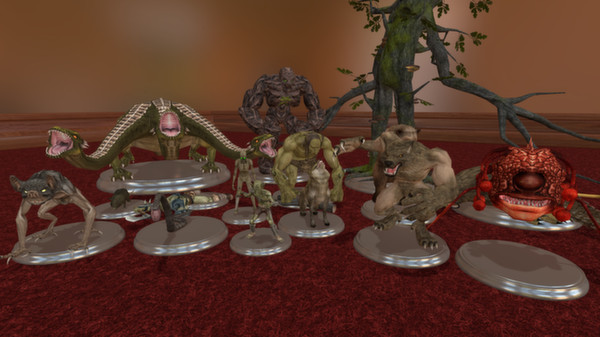 Image: Tabletop Simulator (Berserk Games), from its Steam store page
Supply also comes from outside. Wikipedia reports that over three thousand games and custom assets are shared on the Steam Workshop. There is officially licensed DLC too — Zombicide, Superfight, Cosmic Encounter Connector, Xia: Legends of a Drift System and others.
Whenever I meet a new component, I weigh it first. This time I could not. I do not own a scale that a piece on a screen will sit on.
It was never the paper enforcing the rules. It was people
At a table, who is it that enforces the rules? Not the box. Not the paper.
A rulebook is text that only works when it is read. Skip a turn and the paper will not stop you. Over-count your score and the board will not light up.
So an analog table always has an adjudicator. Even with no dedicated referee, the players take that job in turns — and whoever learns rules fastest usually carries more of it.
What Tabletop Simulator ported is exactly this structure. It did not put judgement inside the game. It left it with the people at the table.
Physics did not vanish, though. It became an input. The official scripting docs list, per object, mass, bounciness, static_friction and dynamic_friction, drag, angular_drag, and use_gravity.
A weight you cannot measure, set by typing a number. Instead of shaving a wooden piece until it feels right, you fill in a field. From the analog side, this is the strangest part — and the part I envy most.
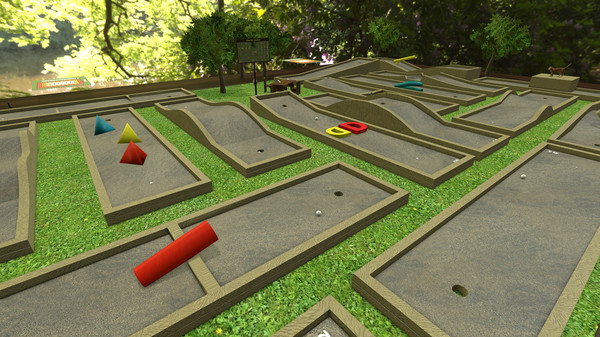 Image: Tabletop Simulator (Berserk Games), from its Steam store page
Now a harder word. "We do not enforce the rules" is an honest design. It is also a design that outsources every rules hole to the humans at the table.
With one experienced player present, it works. Without one, the first thirty minutes become a group reading of the rulebook. That is usually where the bill for all that freedom arrives.
Moving it to digital — what is lost, what stays, what can be added
What is lost. Thickness in the hand, first. The curve of a fanned hand of cards, the balance point of a gripped piece, the difference between wood and paper. On screen it all rounds down to the same "holding".
Presence goes too: the moment an opponent's hand stops, the finger that starts toward a different card. That is table information the rules never wrote down. As I put it in the Hanabi piece, information like that lives in the places the rulebook does not decide.
What stays. Physics stays. Dropping, toppling, shuffling, throwing. So does the tolerance of "roughly there" — a board that does not snap to a grid is surprisingly comfortable.
And adjudication stays a human job. That is the whole point. The first thing a port usually deletes is here kept as a specification.
What only digital can add. Rewinding the table (save and load), a table surface with no edge, and ten people seated at zero distance from each other.
The other addition is Lua. Officially, a game is composed of "one Global Script and zero to many Object Scripts". Enforcement can be bolted on afterwards. You can automate the dealing and still count points by hand.
It is not a binary between enforcing and not enforcing. The author picks how much enforcement each table gets. I think that is the cleverest thing about it.
Digital puzzles that use physics as their raw material are collected under Physics Simulation in our lexicon (World of Goo, Poly Bridge). But there, physics is the thing to be solved. Here it is table physics, and nothing about it is meant to be solved. One word, two different objects.
While I am here: "who does the judging — the machine or a person" is an axis the lexicon does not have yet. From the analog side it is a very thick axis indeed.
For makers: add one mode that refuses to judge
One thing to take home. Build a mode that does not judge into your own puzzle.
Stop lighting up the instant the solution is touched. Say nothing until the player declares "done". That is all.
What changes is not difficulty. It is feel. Give people back the time to check their own work and the same board becomes a different problem.
One caution: hand over judgement, not labour. Even this game automates physics and network sync without asking. Nobody needs shuffling returned to them by hand.
The same line showed up when I read the Portal board game (Portal, the board game). What belongs in human hands is whatever makes the handling visible.
Closing
I can think of no other game that advertises the ability to flip the table.
What that feature signals is not violence. It is a declaration: this game will not stop you.
A design that will not stop you is picky about its players. In exchange, things happen at that table that happen nowhere else — renegotiating a rule out loud, spotting a mistake and winding the game back. Both live on analog tables, and both are the first to disappear in a port.
So, today's question. In your game, will you leave the judgement of right and wrong in human hands?
It does not have to be all of it. If you could pick one place, which one would you keep by hand?
Sources
Reactions (no login)
Anonymous • one of each per visitor per day
Part of these series
Solved by HandEpisode 8 of 10
Read next

Related reviews
Crayon Physics Deluxe
A 2D physics puzzle where shapes drawn in crayon become real objects. You build your own way to roll a ball to the stars, from Petri Purho.
Mushroom 11
A 2D puzzle-platformer in which a green fungal mass is moved by erasing it: whatever you delete grows back somewhere else, so choosing what to cut is how you travel. Untame's descent through an emptied ruin, scored by The Future Sound of London.
4D Golf
A first-person mini-golf puzzle set in a space with a fourth spatial axis on top of the usual three. You turn through it, compare cross-sections, and read hidden routes and shifting gravity on the way to the cup. Over 120 holes and a 4D course editor, from CodeParade, who made Hyperbolica.


