REVIEW · 2015-10-15
Mushroom 11
The only way forward is to destroy
First Impressions
Across the helpful positive reviews the opening sentence is nearly identical: I have never played anything like this. "One of a kind." "The most original platformer ever made." "Genius." What they are praising is not the art or the story. It is the way the creature moves.
The negative side starts from the same place. "It is an interesting mechanic." "The first 45 minutes are genuinely fun." Most negative reviews concede the first three chapters before they begin complaining. The split is not about the idea. It begins at chapter four.
The numbers, as of 2026-09-23: 578 of 685 reviews positive across all languages, or 84%, labelled Very Positive. In the English pool it is 442 of 532, or 83%. Roughly one review in six is negative, and it is worth finding out where that sixth review turned.
Putting the Mechanics into Words
There is one verb: erase. No jump, no walk, no grab. All you can do is delete cells with the cursor, and locomotion happens as a side effect. In Puzzlebyrinth terms this is verb subtraction taken to its limit — the verb for movement has itself been deleted.
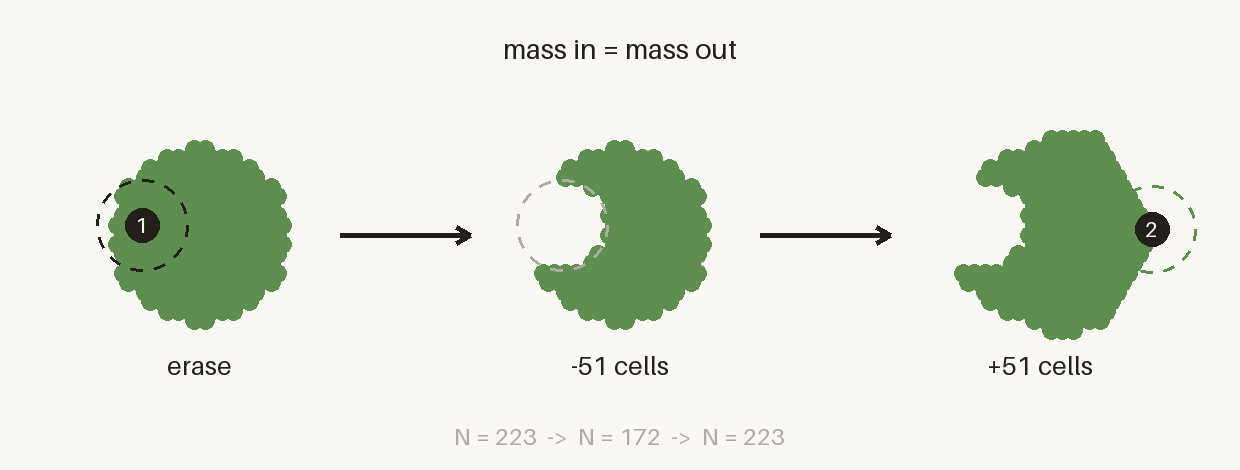 Erase on the left, and the same number of cells regrows on the far side; the total does not change (diagram)
Whatever you remove regrows elsewhere on the mass, and the total holds constant. So "to go right, erase the left" is the entire grammar. The two erasers, large and small, are not two verbs — they are two grain sizes of one. Reviewers who write that the controls are simple are being exact.
Against that thin vocabulary sits a continuous physical world: slopes, gears, water, ropes. One positive review reaches for World of Goo, and the comparison is about kneading analogue quantities rather than about looks. One verb, a continuous result space — that is where the combinatorial explosion lives.
Feel of the Controls
This is where the split happens. You choose what to erase. You do not choose where it regrows; the simulation decides that from the shape you left behind. The same cut does not return the same mass twice.
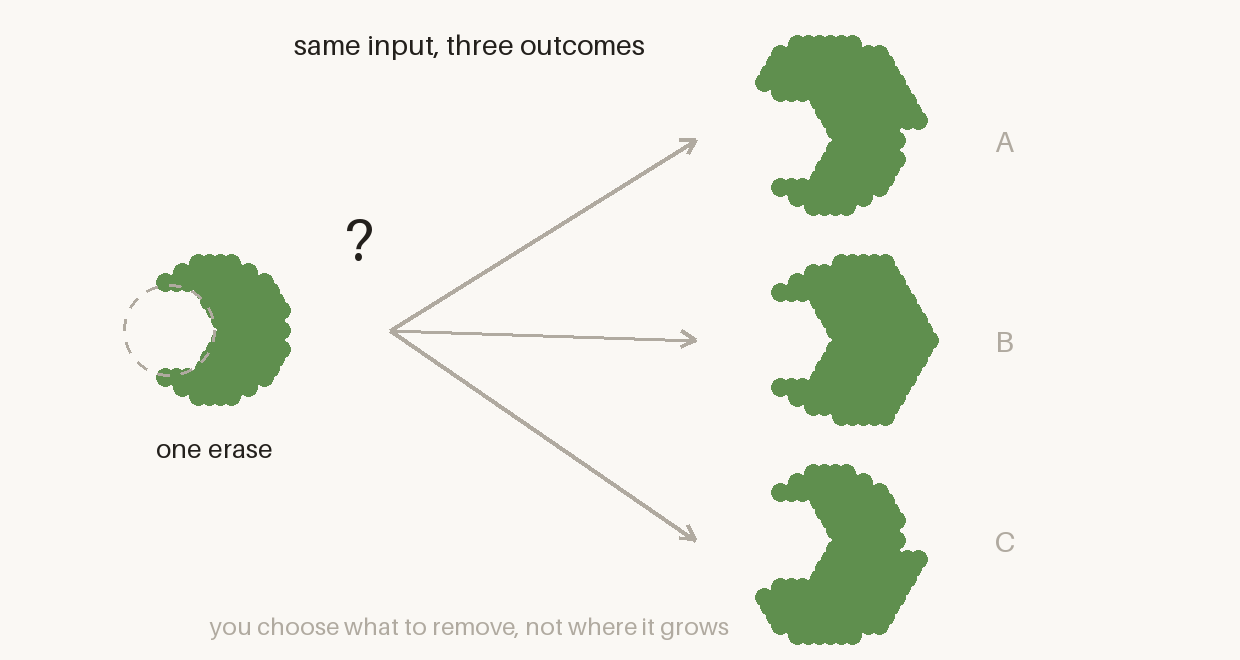 One identical erase branching into three outcomes, the regrowth leaning a different way in each (diagram)
The negative vocabulary clusters here: luck-based, trial and error, not precise enough. One reviewer calls the creature RNG slime. Their claim is consistent — clearing an obstacle returns the feeling of having got lucky rather than of having solved something.
The positive side names the same behaviour differently: playing with physics, sculpting slowly, flying once it clicks. One long review advises stepping away and coming back when you are in the mood to play with physics. They treat the mass as something to negotiate with, not to command.
Read as design, the game cuts the verb loose from its result on purpose. Semblance made conception easy and execution costly; Mushroom 11 makes the outcome of execution itself probabilistic. What you have to read is not the level but your own mass distribution — a different order of difficulty from a fully deterministic puzzle like Stephen's Sausage Roll.
The Texture of Difficulty
Seven chapters. The reviews agree on the shape: chapters one to three are easy and take about 45 minutes, chapter four climbs sharply, and chapter seven spikes. Even admirers describe shouting at the screen near the end.
Three kinds of difficulty are tangled together here: reading what shape is needed, sculpting that shape quickly and precisely, and waiting for a favourable regrowth. Sort the reviews by which one a player met most and you have sorted them into positive and negative almost exactly.
Checkpoints are dense. The positive side calls that the reason it is forgivable; the negative side answers that cheap retries and fair design are different things. The fourth boss and the rocket sequence are named repeatedly by the dissenters. One negative review claims only 3.5% of owners finish — his own figure rather than a verified one, though several reviews agree that most people leave in the first hour.
The World
On one point the two camps agree. The backgrounds are good. Even hostile reviews compliment the art and the sound before they start cutting.
The setting is a ruin with no people left and no text to explain it. Backdrops change chapter by chapter and carry whatever story there is. Some reviewers write that there is no story; others write that the story is visual. They are describing the same thing.
The store credits the soundtrack to The Future Sound of London. The ambient electronics suit a collapsed world, and that is said on both sides of the split — one long review calls presentation the game's strongest aspect outright.
Sources
This article was written by reading the Steam user reviews as of 2026-09-23. No review text is quoted directly; typical claims are reconstructed.
・Steam: Mushroom 11 (Very Positive: 578 of 685 across all languages = 84%; 442 of 532 in the English pool = 83%)
・Read the top 10 helpful positive reviews, the top 10 helpful negative reviews, and 6 recent ones — 26 in all. Aggregate figures come from Steam's appreviews API.
・Facts about the game itself (Untame as developer and publisher, released 2015-10-15, soundtrack by The Future Sound of London) come from the store page.
・Note: this session could not reach Steam's image CDN, so the official screenshots could not be viewed and verified. Rather than caption pictures unseen, the figures in this article are two diagrams of my own; the listing thumbnail is the store header image.
Closing
Steam's verdict is 84% positive; my design score is 7.5, and the two do not diverge much. Cutting the verb down to one, then handing that verb's result over to a simulation, is a nerve nobody else has matched in ten years. I dock it for parking some of its difficulty in the time you spend waiting for a favourable regrowth.
Completion times cluster around four to six hours in the reviews. Some call that short; others argue it could not sustain more. I lean toward the second. For a design with a single line of grammar, seven chapters is already long.
Who it suits is clear enough. Anyone who wants difficulty to live purely in thought, as in Stephen's Sausage Roll, is outside its range, and so is anyone after the small clean touch of ElecHead. For players who enjoy the act of kneading a physical mass, there is no substitute.
That the split has barely moved in ten years is itself the measure of the thing. Recent reviews are short and warm — great atmosphere, you fly once you get used to it — written by people who never saw the original argument. A work whose maker fixed a stance early goes on choosing its readers slowly.
Where are you with this game?
Press one and the game goes on your shelf. You can see it on your account page.
Reactions (no login)
Anonymous • one of each per visitor per day
Read next
Related reviews
Portal Stories: Mel
A free unofficial campaign for anyone who owns Portal 2. Mel, a test subject who wakes in a 1952 Aperture Science, is guided by a maintenance core named Virgil through 22 test chambers toward AEGIS, the facility's defence system. Prism Game Studios built it over roughly four years and released it in 2015.
Please, Don't Touch Anything
You are covering a colleague's bathroom break in front of an unmarked console with a single red button, and you have been told not to touch anything. A pixel-art point-and-click puzzle by Four Quarters about reading the clues hidden in the posters and the wiring to dig out its 25 endings.
Escape Goat 2
A 2D puzzle platformer about escaping a trap-filled stronghold with a goat and its mouse companion. Each room is a single screen, solved with jumps, an immortal mouse that crawls walls and stands on switches, and a magic hat that swaps the goat's position with the mouse's. Over a hundred rooms across ten zones, from MagicalTimeBean in 2014.


