BLOG · 2026-08-17
Air Fortress (1987) — The Shoot’em Up That Finishes on Foot, Inside the Fortress
Today Is Release Day #30 — August 17, 1987, published by HAL Laboratory. You shoot in the first half and fly by recoil in the second. A 5,300-yen Famicom cartridge, five years before HAL collapsed
August 17, 1987: a 5,300-yen air fortress
Hello, this is Toki. Episode 30 of "Today Is Release Day." What I dug up today is Air Fortress, released for the Famicom by HAL Laboratory on August 17, 1987. That makes it exactly 39 years ago today.
Published by HAL Laboratory, priced at 5,300 yen, product code HAL-AI. The genre on the box says shooter — and yet, if you play the thing to the end, roughly half of what you actually do on screen is not shooting at all. That is the interesting part.
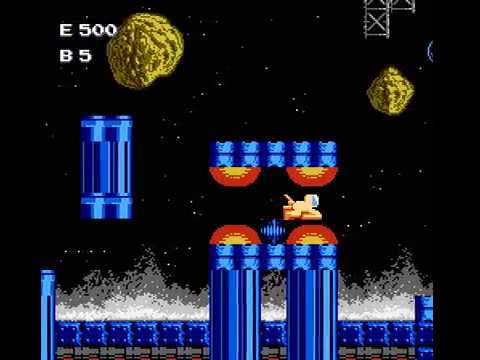 From the thumbnail of "NES Longplay [819] Air Fortress" (World of Longplays, YouTube)
HAL Laboratory is known today as the Kirby company. In 1987, though, there was no sign of Kirby yet (the first Kirby’s Dream Land came in 1992). The HAL of that year was a company building HALNOTE, an integrated environment for the MSX, while also putting out Famicom cartridges under its own label.
What kind of game it was — you shoot, and you get pushed back
The structure comes in two layers. The first half is a side-scrolling shooter: you fly a small lightship toward the outer wall of the air fortress, dodge enemies and reach the airlock. So far, this is a shape you saw often on the Famicom in 1987.
The second half is where it gets strange. Once you are inside, the screen changes and your character makes his way through the interior on foot and on a jetpack. Hold up to rise, release to fall. You thread through maze-like corridors, destroy the core at the deepest point and get out before it detonates. The energy and items you picked up in the first half carry straight over — which means it is entirely possible to burn through the fuel you needed for the way home.
And the great quirk of the interior sections is that firing pushes you backwards. Both the normal shot and the bomb send you drifting the other way. Once you get used to it, that becomes a means of travel: fire in the opposite direction to where you want to go and you move faster. The weapon doubles as a thruster. Deliberately putting that near-weightless feel into a 1987 Famicom cartridge still looks like a sharp decision today.
There were eight stages, plus a second set of eight. The director and programmer was Hiroaki Suga, and the music was by Hideki Kanazashi (credited in the Japanese version as "Jumper Kanagushi"). The password for the final fortress being "SUGA" reads rather like a staff signature left in the code.
How it was received at the time
More contemporary criticism survives from North America and Europe than from Japan. The North American release went out through HAL America in September 1989, after a very small test run of 385 copies in 1987. Because of that two-year gap, read what follows as "how it was received in 1989."
Nintendo Power rated it highly across visuals and sound, control, challenge and fun. VideoGames & Computer Entertainment’s Andy Eddy, meanwhile, granted the originality of mixing arcade and adventure elements, but pointed out that the music felt repetitive and the palette thin.
Computer Entertainer praised the graphics, then noted that the difficulty climbs sharply once you are past the first fortress, and that the fortress exploration is more engaging than the shooting sections. Of the two halves, in other words, the second one won. In Germany’s Play Time, Oliver Menne singled out the smooth, flicker-free scrolling and commended HAL’s work on graphics and music.
So even at the time, this cartridge sat in the position of "an interesting idea, not an unqualified masterpiece." Praise and reservation living inside the same review — that is the shape of its reception.
Looking back from 39 years later
On video, the two-layer structure reads clearly. The screen you were flying across turns, the moment you pass the airlock, into a screen you walk and search. That switch was the selling point of this cartridge in 1987.
What made me pause while laying out the sources was a date five years after release. HAL Laboratory, the company that published this game, completed a development centre in Yamanashi in April 1991 — and the interest on the loans behind it weighed the company down until, on June 22, 1992, it filed for composition. Total debts came to roughly five billion yen. In March 1993, with Nintendo’s backing, Satoru Iwata took over as president and the rebuilding began.
Air Fortress belongs to the stretch before that slope — back when HAL was still putting out whatever oddly structured Famicom cartridge it liked under its own label. The 1987 that produced a hero who gets pushed backwards when he fires, and the 1990s that raised Kirby while paying down debt, are continuous strata of the same company. Seen that way, a 5,300-yen shooter looks a little different.
In closing
August 17, 1987. Without writing the year down, I never quite feel an article is finished. The Famicom itself launched in 1983, so this arrived in the summer of its fourth year.
You bought it as a shooter, and before you knew it you were on foot inside a fortress looking for the exit. That experience of a game turning into a different game partway through still happens now and then. Which title, and which moment, first surprised you that way?
Until tomorrow’s release day, then.
Reactions (no login)
Anonymous • one of each per visitor per day
Read next

Comments (no login)
No comments yet. Be the first to say something.