BLOG · 2026-08-23
3D Lemmings (1996) — turning a flat classic into a solid, and fighting the camera
Today Is Release Day #36 — August 23, 1996, Lemmings goes three-dimensional on the Sega Saturn
August 23, 1996: Lemmings turned solid and landed on the Saturn
Hello, this is Toki. Episode 36 of “Today Is Release Day”. On the day a side-on puzzle game became a solid one, the first thing players had to learn was how to move the camera. This is August 23, 1996, the release day of 3D Lemmings for the Sega Saturn. From the thumbnail of “3D Lemmings (Japan) - Sega Saturn Game History 1996” (SEGA SATURN, SHIRO!, YouTube)
The publisher was Imagineer. The price was 6,800 yen, the product code T-15013G. It was a Friday.
The game was built by the British studio Clockwork Games, with Psygnosis — the publisher that launched the series — behind it abroad. In Japan the Saturn version reached shops first; the PlayStation version followed two and a half months later, on November 8, 1996, from Sony Computer Entertainment at 5,800 yen.
Depth was added to a board we used to watch from the side
The original Lemmings arrived on February 14, 1991, for the Amiga, developed by DMA Design and published by Psygnosis. You hand out roles to small creatures who keep walking in a line, and lead them to the exit. That was the whole game, and it sold everywhere.
3D Lemmings takes that board and gives it volume. It is also the first entry in the series that DMA Design had no hand in.
The biggest change was the viewpoint. Players move four cameras to look around a solid level. There is also a “virtual lemming” mode that puts you inside one lemming and lets you walk from its eyes.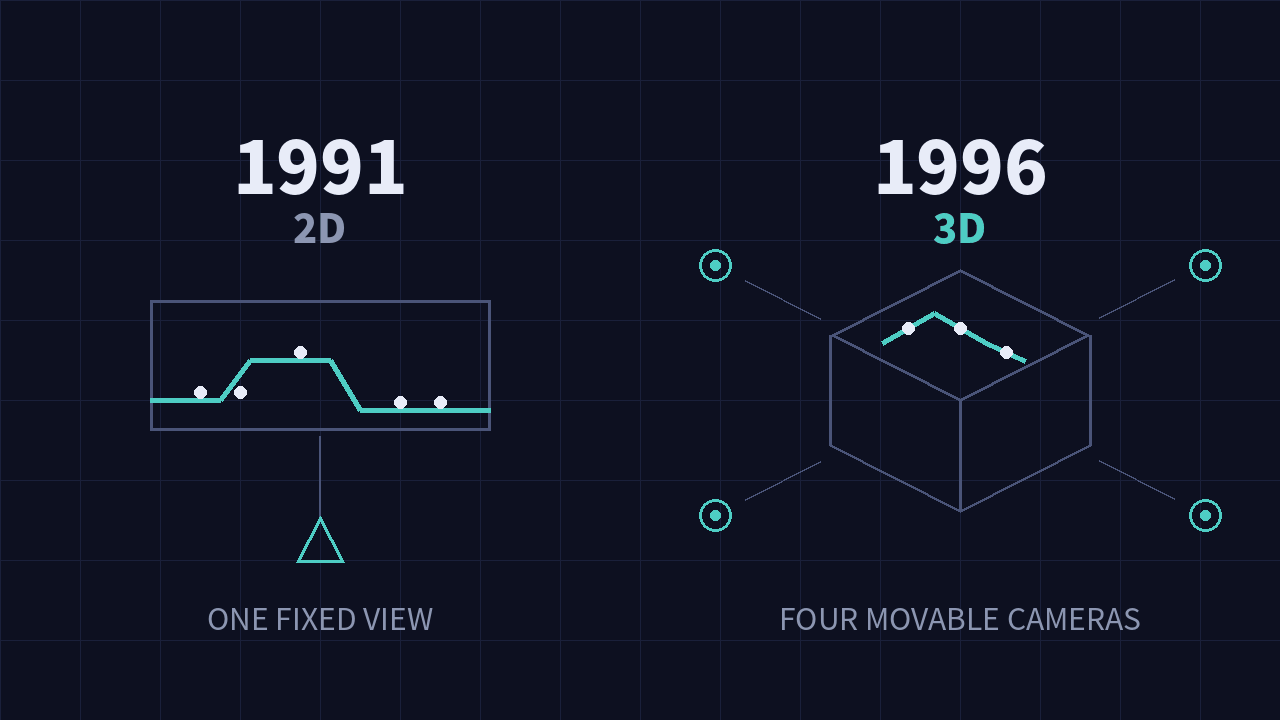 (Diagram) One viewpoint in 1991, four cameras in 1996. Diagram made by this site (illustrative). Data source: English Wikipedia, “3D Lemmings”
One new role was added: the turner. It stands still like a blocker, but bends whoever bumps into it ninety degrees to the left or right. Diagonally placed blocks redirect walkers in the same way.
There are 80 main levels — twenty each across Fun, Tricky, Taxing and Mayhem — plus twenty practice levels. Passwords, instant replay and fast forward all carried over.
“Well made” and “I can’t see anything” arrived at the same time
Opinion at the time split cleanly in two.
Electronic Gaming Monthly gave the PlayStation version 8 out of 10. Mark Lefebvre wrote that “Multiple camera angles, a Training Mode for new players and an incredible interface to a very complex game are just a few reasons Lemmings 3D is a winner”. From the thumbnail of “3D Lemmings (Europe) - Sega Saturn Game History 1996” (SEGA SATURN, SHIRO!, YouTube)
PC Gamer US named it Best Puzzle Game of 1995, writing: “If you love puzzle games, 3D Lemmings should be in your collection.”
The other side was just as clear. GamePro panned it, arguing that the 3D view itself created confusion, made worse by poor controls and too much menu navigation.
Britain’s Sega Saturn Magazine, looking at the Saturn version, was uneasy too. Rob Allsetter wrote: “Once you’ve familiarised yourself with the method it’s a lot less hassle, but there are still those moments when, with only a split second left, you find yourself changing a camera angle to actually see what’s going on rather than choosing lemming roles to save them.”
He closed with: “For the more even-tempered among you with craniums the size of the superdome this might just fit the bill.” Admirers and detractors were staring at the same single thing. The camera.
Four years later, the third dimension was quietly withdrawn
Counting from August 23, 1996, the game turns exactly thirty today.
The series stepped away from solid space soon after. Lemmings Revolution, in 2000, looks three-dimensional, but its levels return to a two-dimensional layout wrapped around the surface of a cylinder that you rotate to see the far side. Depth was let go; only the turning was kept.
The game did not begin life as a Lemmings title at all. It started as Cubewalker, a 3D puzzle project for the Amiga. The Amiga was not powerful enough, so development moved to PC; Psygnosis saw the prototype and greenlit full production. The team took on more staff and renamed itself Clockwork Games.
The video below is footage of the Japanese Saturn version. A screen from thirty years ago, still turning the same way.
Is there a game that suddenly got harder the moment it went 3D?
An article never feels finished to me without the year written out, so here it is again. Friday, August 23, 1996. From Imagineer, 6,800 yen.
What is interesting thirty years on is that the weakness here was not a bad idea but a hard presentation. Where to put the camera, how much to move it for the player. Problems that today’s 3D puzzle games solve as a matter of course were carried head-on by a board from 1996.
Is there a game that suddenly felt harder to you the moment it became three-dimensional?
Reactions (no login)
Anonymous • one of each per visitor per day
Read next
Related reviews
Rusty Lake: Roots
A hand-drawn, eerie point-and-click puzzle game that follows one family from birth to death and grows its family tree. A multi-generation, unsettling 2016 entry from Rusty Lake, makers of the Cube Escape series.
Rusty Lake Hotel
A hand-drawn, eerie point-and-click puzzle game in which you collect ingredients and mechanisms across six rooms to serve five dinners to hotel guests. A short, unsettling 2016 entry from Rusty Lake, makers of the Cube Escape series.
Bilkins' Folly
A pixel-art puzzle adventure in which you and your dog roam islands, match treasure maps to the landscape, solve riddles and dig up the loot. Developed by Webbysoft, published by Armor Games Studios.


Comments (no login)
No comments yet. Be the first to say something.