BLOG · 2026-08-27
Astronōka (1998) — the same trap never works twice, and the praise arrived twenty years late
Today Is Release Day #40 — August 27, 1998, PlayStation
August 27, 1998: an enemy that remembers what you did
Hello, this is Toki. Episode 40 of “Today Is Release Day.” Today’s game is about growing vegetables in space. The catch is that the pest raiding your field learns your traps and evolves.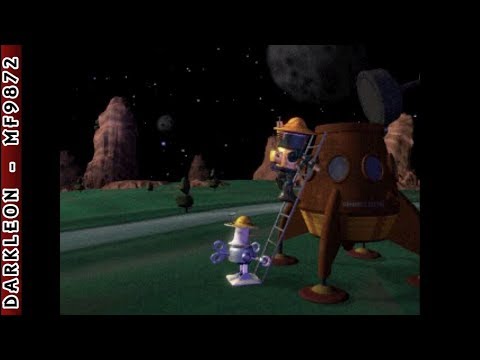 From the thumbnail of “PlayStation - Astronoka (1998) - [Intro]” (The Video Game Museum, YouTube)
Astronōka, released by Enix for the PlayStation in Japan on August 27, 1998, at 6,800 yen.
It was developed by MuuMuu and System Sacom. Game design and AI were handled by Yukihito Morikawa.
Your goal is to become the best farmer in the universe: grow vegetables, enter them in contests, and keep a pest called Baboo out of your field.
Crossbreed the vegetables, lay the traps, and still fall behind
Vegetables are improved with a crossbreeding machine. According to Famitsu, you can shift attributes such as weight, pattern, nutrition, flavour and even tone, and create new varieties.
The judging criteria for each contest can be checked on the calendar in advance, so you grow backwards from the vegetable the next contest wants.
The trouble comes at night. Baboo arrive and carry off what you grew. You answer with a layout of traps.
This is the heart of the game. Catch a Baboo in the same trap often enough and it adapts: fall for a pitfall too many times and its legs get stronger, or it grows wings.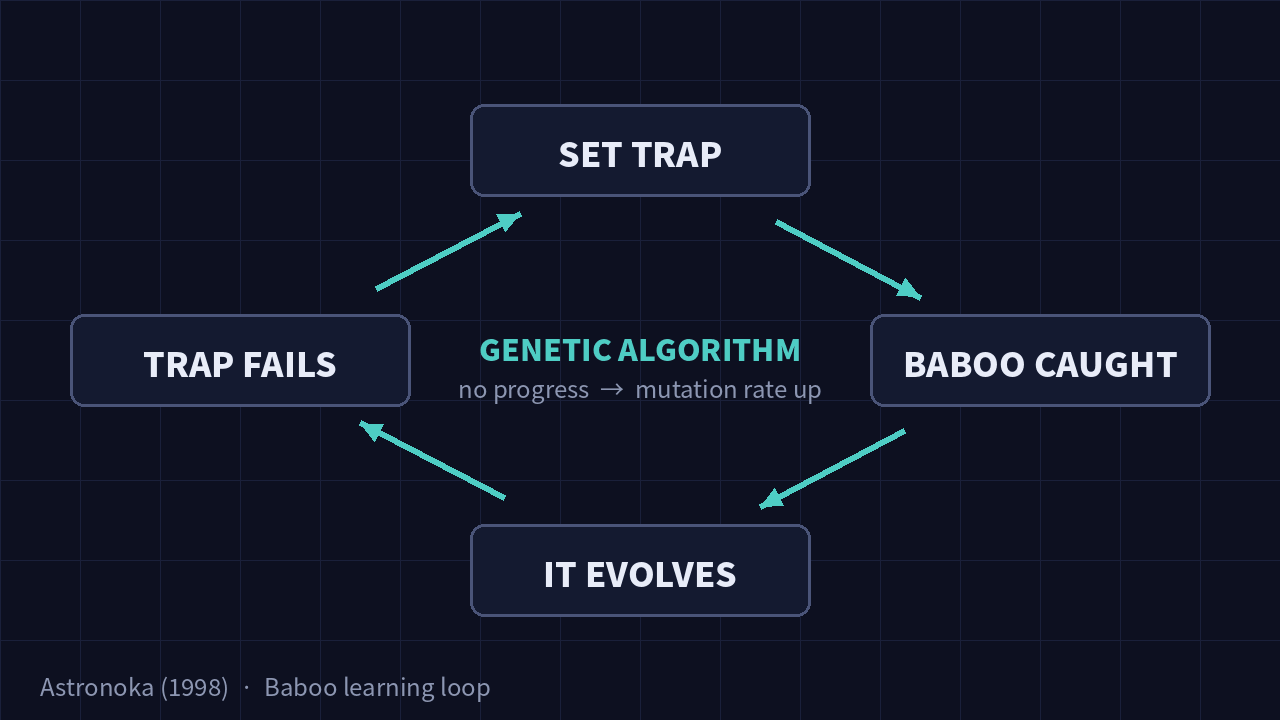 (Diagram) The Baboo learning loop. The more they are caught, the more resistant they become, until the same trick stops working.
In other words, the better you do, the stronger your opponent gets. Your winning strategy becomes the enemy’s textbook.
A genetic algorithm runs underneath. Morikawa has explained that although only one Baboo appears per day on screen, at least ten generations turn over internally, and the fittest individual is the one you meet.
There was also a rule that raised the mutation rate whenever evolution stalled, so the player could not find one strong trap and settle there.
The AI worked. Almost nobody praised it at the time
The idea came from Yumenoshima in Tokyo. As Morikawa told an interviewer in 1998: “There is a artificial island in Tokyo built from a waste landfill called Yumenoshima, and at the time it was having a problem with flies. Each time the flies appeared they would spray them with insecticide, but eventually they became resistant to it.”
That, he thought, is monster evolution. The whole system grew out of it.
On building a game around AI he said: “making a game with AI is much more like a free-for-all, no-rules cage fight.” From the thumbnail of “Astronoka [Psx] - Trailer” (Old Dusty Games, YouTube)
The response, though, was quiet. Morikawa later recalled his shock: the AI was working properly, and nobody was giving it credit. Of the reception at the time he has said it “sobered me up.”
Academia called; the games industry did not. GAME Watch, reporting on the 20th anniversary event, quoted him saying that in the games industry “nobody praised it.”
Famitsu, writing on the 25th anniversary, put it differently: the game’s design “made many enthusiasts groan with admiration at the time and became an instant talking point.” Where it landed, it landed hard.
Twenty-eight years on, an AI researcher called it the best in the world
From August 27, 1998, to August 27, 2026 is exactly twenty-eight years. An article never feels finished to me until the years are written down, so there they are.
On June 25, 2008 the game was re-released on the PlayStation Game Archives, priced at 600 yen.
In January 2019 a 20th anniversary talk event was held. There the AI researcher Yoichiro Miyake called it the best game in the world made with a genetic algorithm.
Producer Yousuke Saitou said that the hidden theme of the game is coexistence with the Baboo. They were never something to wipe out; they were something to live alongside.
There were spin-offs, too. The anime Baboo Factory aired on TV Asahi from 2001 to 2002, and the online game Cosmogurashi launched on March 28, 2003, closing its servers on April 25, 2005.
Would you play against something that memorises your best move?
Most games get easier as you improve. This one worked the other way: the better you got, the better your opponent got.
A strategy that felt perfect this week is useless the next. Is that unfair, or is that the fun?
The answer in 1998 was silence. The answer in 2019 was “the best in the world.” Same game, twenty years apart.
So: would you rather play something that learns your tricks, or something that keeps falling for the same trap forever?
Reactions (no login)
Anonymous • one of each per visitor per day
Read next
Comments (no login)
No comments yet. Be the first to say something.