BLOG · 2026-09-23
Dragon Quest I & II (1999) - a book you can save in anywhere, which vanishes the moment you resume
Today Is Release Day #64 - September 23, 1999, on the Game Boy
The day a 1986 role-playing game arrived in your palm, thirteen years late
Hello, Toki here. Episode 64 of "Today Is Release Day". Today's game had its biggest new feature in the save system.
Enix released Dragon Quest I & II for the Game Boy on September 23, 1999. Tose handled development. Today makes it exactly 27 years. From the thumbnail of "[DQ I-II] Dragon Quest GB version: events and boss fights" (KaogeCh, YouTube)
Inside are Dragon Quest from 1986 and Dragon Quest II from 1987. More precisely, it is the two-in-one Super Famicom edition of 1993, moved once more onto a handheld.
Making a thirteen-year-old role-playing game portable. What had to be added, and what had to go. That is where this port gets interesting.
Two games on one cartridge - which is why some towns grew a second floor
A Game Boy cartridge holds less than a Super Famicom one, and the screen is narrower. The same game does not simply fit.
Text came first. The dialogue window shrank to two lines. Reading through the same scene now took more button presses.
Then the towns. The Game Boy can only show so many characters at once, so townspeople had to be spread out - and several towns gained a second floor that had never existed before.
The commands were tidied up too. Talk, Search and Door left the menu and were folded into the B button.
Cut what will not fit, then add it back in some other shape. A port is usually a record of that subtraction and addition.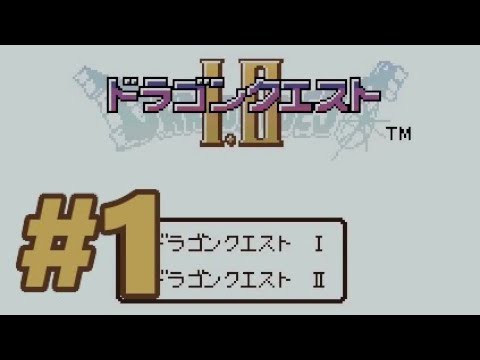 From the thumbnail of "[GB] Game Boy Dragon Quest I-II [#1 Dragon Quest I]" (Game Funkyu Channel Akatsuki, YouTube)
The Book of Suspension - written anywhere, gone the moment you open it
The biggest addition was the Book of Suspension.
The Book of Adventure can only be written in front of a king or a priest. On a console at home that is enough: you switch off when you are in your own room.
A handheld is different. The train arrives and you stop. Someone calls you and you stop. So the port gave you a book you could write in anywhere.
But this book works once. Resume, and the suspension save is deleted. If you wrote it inside a dungeon, you restart at the entrance.
"Stop whenever you like - but you cannot come back to exactly where you stopped." A oddly conscientious compromise, born from the condition of being carried around.
About 740,000 copies in Japan, and a 9.6 abroad
Shipments in Japan are recorded at roughly 740,000 copies - some tallies say 760,000. The 1993 Super Famicom edition did 1.2 million, so the two together come to about 1.96 million.
By the numbers alone it did not reach the earlier version. Then again, this is a port of games that were already thirteen and twelve years old.
The reviews ran especially high overseas. GameSpot gave it 9.6, IGN and Nintendo Power 8 each, and the GameRankings average settled at 82%.
GameSpot and RPGamer both named it their Game Boy Color game of the year.
A port scoring higher than the game it came from. That sort of thing happened that year.
The day the North American version dropped "thou" - and Erdrick went back to Loto
Dragon Warrior I & II reached North America on September 27, 2000.
Enix had closed its North American arm at the end of 1995. In 2000 the company rebuilt it, and this Game Boy release was part of that restart.
The translation changed as well. Earlier entries in the series had been written in a deliberately archaic English full of "thou" and "thy". This one let that go.
One reason was the screen. The Game Boy window is narrow, and the text had to be cut down. Ornamental phrasing is the first thing to fall away.
Names changed too. The legendary hero went from "Erdrick" to "Loto", back to the Japanese reading. The Dragonlord became "DracoLord".
Opinions on that retranslation are still split. What is clear is the chain of cause: a narrow screen decided the way the game speaks.
Twenty-six years later, in 2025, the two became one again
On October 30, 2025, the HD-2D version of Dragon Quest I & II was released.
Here too, I and II are bundled together. After the 1993 Super Famicom edition and the 1999 Game Boy one, this is the third time the pair has travelled as a single release.
The video below is the official final trailer from Square Enix. Set beside that two-line window of 1999, it shows just how much screen the same story eventually won.
Nineteen ninety-nine, for the record
September 23, 1999. If I do not write the year down like this, a piece never feels finished to me. Today, September 23, 2026, makes it exactly 27 years.
The largest thing this port added was not a new town or a new monster. It was the single idea that you may stop anywhere.
In exchange, the record is allowed only once, and a dungeon sends you back to its entrance. The condition of being carried around changed the shape of the play, if only a little.
Has a game ever sent you back to the entrance because you switched off on the train?
Reactions (no login)
Anonymous • one of each per visitor per day
Read next
Comments (no login)
No comments yet. Be the first to say something.