DESIGNER-STUDY · 2026-09-29
Inside Josh Wardle's Philosophy — Three Minutes a Day, Then Let Go
Wordle / The Button / r/place / Parseword
The man who did everything you are not meant to do
The creator of Wordle explains his success as the result of doing what you are not supposed to do. His 2022 GDC talk was literally titled "Doing the Opposite of What You're Meant To" (source ↗). From "Config 2024: Opting for the opposite" (YouTube: Figma)
Josh Wardle is the software engineer who made Wordle: one puzzle a day, one five-letter word, six guesses. He is the person behind those green and yellow squares (source ↗).
Why now? In March 2026 he released a new game, Parseword, which tries to make British-style cryptic crosswords approachable for newcomers (source ↗).
I brewed a pot of hot bancha and lined up his public statements from 2022 to 2026. Behind the smallness of "three minutes a day," a clear way of thinking comes into view.
From a Welsh farm to Reddit's lab
Wardle grew up on a farm in South Wales. He studied media arts at Royal Holloway, University of London, and earned an MFA in digital art at the University of Oregon (source ↗).
In 2011 he joined Reddit as an artist and later became a product manager. There he made "The Button" (2015) and "r/place" (2017) (source ↗).
r/place was a canvas of one million pixels. After placing one tile, a user had to wait 5 to 20 minutes before placing another. For about 72 hours, people around the world fought over single squares (source ↗).
He calls these "social experiments" that playfully explore how people interact online (source ↗). He has also said: "My background is in art, and I'm just interested in making interesting things. The business side of things is not super interesting to me." (source ↗)
People trust things that want nothing from them
Across his interviews, one claim comes up most often: "I think people have an appetite for things that transparently don't want anything from you." (TechCrunch, 2022) (source ↗)
He says the same thing in other words: "I just wanted a game that was just three minutes of your time a day, and that's it." (GDC 2022) (source ↗) No login, no personal data, no ads (source ↗).
The one-a-day format grows from this. "If you can only play once a day and if it was the same word for everyone, there was suddenly this social aspect to the game," he recalls (source ↗). Because "if you tell someone the solution, you ruin it," the limit brings people together (source ↗).
In his words, "I kind of deliberately did what you're not meant to do if growth is your goal" (TechCrunch, 2022) (source ↗). I read a consistent stance here: earning trust by not holding on to the player.
Let players reach the answer with words they already know
His recurring obsession is never letting a player lose just because they don't know a word. Wordle's answer list was re-chosen together with his partner, Palak Shah (source ↗).
There are about 13,000 five-letter words in English, and many of them are "really bogus." He says the two of them filtered the list down to about 2,500 (source ↗). A list full of unfamiliar words, he says, "feels bad for people" (TechCrunch, 2022) (source ↗).
Interestingly, the filtering itself became a small game. He reportedly built a tool that showed the 13,000 words one by one, so his partner could sort each into "know," "don't know," or "maybe know" (source ↗).
He explains the aim: "What's fun about Wordle is that you can tease the answer out from what you know about language." (source ↗) The material for deduction is already in the player's head. A word outside it breaks fairness.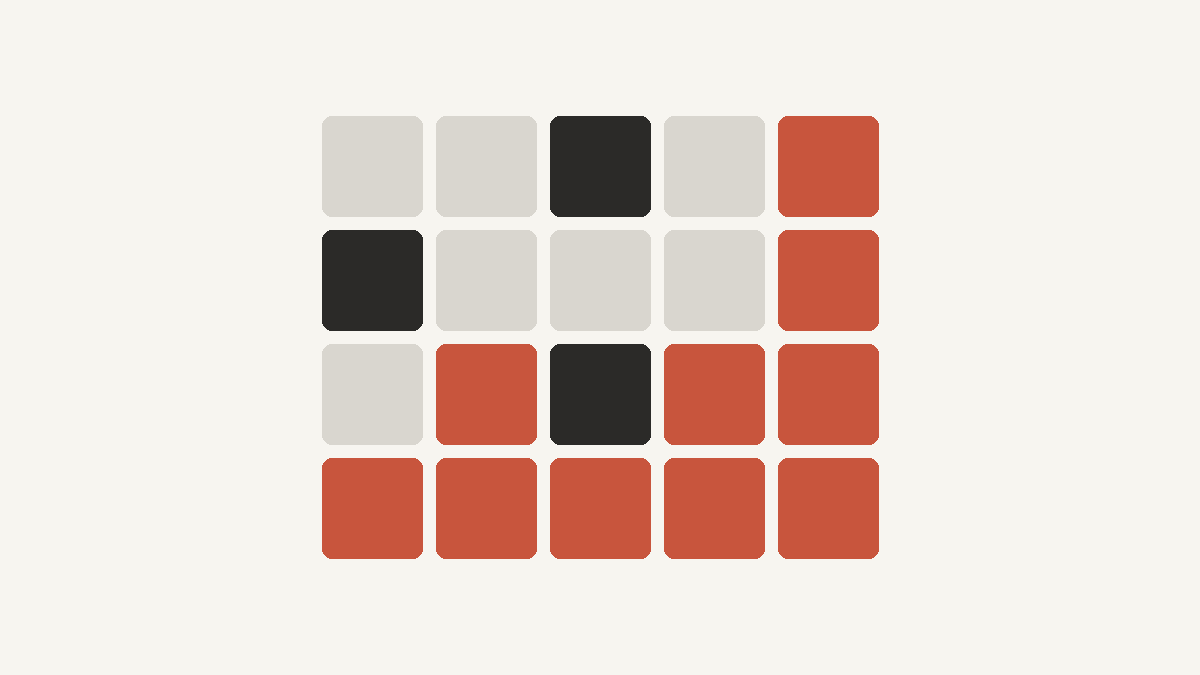 (Diagram) Even without letters, the path to the answer is readable. Grey = absent, ink = wrong spot, vermilion = correct
The 2013 prototype "looked like garbage"
Wordle had a 2013 prototype. In his words, "I took Mastermind, and I mashed it up. I said, what if you were guessing words instead of coloured sequences." (source ↗)
That version failed. It picked answers at random from about 13,000 dictionary words. He admits that "if you were trying to guess a word that you'd never heard of, the game became more like Mastermind" (source ↗).
He also tried to make it an Android app. At GDC he recalled that it "looked like garbage" and that he was "terrible" at Android coding. Then he "lost interest in the game" (source ↗).
What got him past it was not technique but deciding who it was for. In 2021 he rebuilt it for his partner, who loves word games (source ↗). That is also when he dropped endless play for one puzzle a day (source ↗).
Wanting it to spread, not wanting to push it
One dilemma he has described is the share button. He felt uncomfortable with a game that has an agenda to get you to share: "why am I encouraging people to share?" (GDC 2022) (source ↗)
The answer came from players. An early player in New Zealand began sharing results by typing out the grid with emoji (source ↗). He adopted it, and noted that adding a link "kind of looks crappy" (source ↗). The grid shows only the path, never the answer.
The second dilemma arrived after success. He had "no interest in running a games business" (source ↗). Yet seeing others profit from copies "literally hurt me. Like, I just woke up feeling dreadful about that stuff." (source ↗)
In January 2022 he sold Wordle to The New York Times. His feeling right afterward: "My biggest sense, actually, right now, isn't joy. It's relief." (TIME, 2022) (source ↗) He also said he did not want to pay a lawyer to send cease-and-desist letters for a game he wasn't making money on (source ↗).
Mastermind and the newspaper puzzle page
The first influence he acknowledges is the board game Mastermind. As we saw, Wordle began as "Mastermind with words" (source ↗).
At GDC he explained that the one-a-day format was inspired by New York Times games (source ↗). His statement at the sale said: "New York Times Games play a big part in its origins, and so this step feels very natural to me." (source ↗) From "POPDuo: Will Shortz … Interviews Josh Wardle" (YouTube: ChicagoToyAndGame)
On the podcast My Perfect Console (2023), he put The Witness and the New York Times crossword on his dream console (source ↗). The episode notes do not give his reasons, so I record only the fact that he chose them.
Parseword starts from cryptic crosswords. He reportedly told The New Yorker, "I didn't know how to begin" (source ↗). His own failure to solve became the seed of the next game.
Kizuki's reading — gathering people through scarcity
From here on, this is my interpretation. Line up Wardle's works and each one gathers people through scarcity. The Button is a single button. r/place is one tile every few minutes. Wordle is one word a day.
In ordinary design, scarcity is a hook to keep you playing. For him it is not about holding on. It exists so that everyone carries the same puzzle on the same day. That, I think, is why he disliked pushing a share button on players.
There is also a gap I cannot help pointing out. At GDC 2022 he said, "If I set out with the goal of trying to make something popular or viral, it's often an abject failure" (source ↗). In 2026 he says "Releasing Parseword is happening more on my own terms, instead of happening to me" (source ↗). I read this not as a contradiction but as the same person choosing again where to let go.
Where to start
Start by solving today's Wordle, just once. Then look at your grid. Your hesitation is still there in the colors, even without letters.
Then open Parseword, and you can see the same person building from the side of someone who could not solve. I have not played it deeply yet, so I will not judge it. According to reports, you select parts of a clue and try anagrams or reversals one step at a time.
Will Shortz's philosophy talks about fairness from the same newspaper-puzzle side. Zach Gage remakes games we already know. Jonathan Blow and The Witness are worth reading alongside, as one of the games Wardle picked.
Sources
Primary sources referenced in this article:
・PocketGamer.biz: "GDC: Josh Wardle shares his incorrect tips for Wordle's success" (2022) ↗
・Thumbsticks: "Wardle on Wordle" (Daniel New, 2022-04-26) ↗
・TechCrunch: "A conversation with Josh Wardle, creator of viral hit Wordle" (2022-01-12) ↗
・TIME: "How Wordle's Creator Feels About Selling His Viral Game" (Karl Vick, 2022-02-01) ↗
・Syntax #430: "Creator of Wordle - Josh Wardle" transcript (2022-02-09) ↗
・My Perfect Console with Simon Parkin: "Josh Wardle, creator of Wordle" (2023-01-24) ↗
・University of Oregon News (2022-02-04) — quoting his statement on the sale ↗
・NME: "'Wordle' creator launches new puzzle game 'Parseword'" (Ali Shutler, 2026-03-11) ↗
・PuzzCulture: "Meet Parseword" (2026-03-12) ↗
・Wikipedia: "Josh Wardle" — biography ↗
・Wikipedia: "r/place" — 2017 details ↗
・YouTube: Figma, "Config 2024: Opting for the opposite (Josh Wardle)" — thumbnail only ↗
・YouTube: ChicagoToyAndGame, "POPDuo: Will Shortz … Interviews Josh Wardle" — thumbnail only ↗
Note: I could not retrieve The New Yorker article itself, so quotes from it come via Nieman Lab and PuzzCulture. The YouTube videos were not used as sources for quotes.
Reactions (no login)
Anonymous • one of each per visitor per day
Part of these series
The Designer's PhilosophyEpisode 68 of 70