SOUNDTRACK · 2026-09-02
Soundtrack: Tetris Effect: Connected — every rotation adds a note to the song
Hydelic (composed by Noboru Mutoh and others)
Why does Tetris Effect: Connected’s music line up before you even notice you’re listening to it?
Tetris Effect: Connected is a Tetris supervised by Tetsuya Mizuguchi. As Komugi’s review notes, the rules are ordinary Tetris — stack the falling blocks, clear the lines. What’s different is that almost nothing you do goes unanswered by sound.
The music comes from Hydelic, Enhance’s in-house music team, built around composer Noboru Mutoh and singers Kate Brady and Takako Ishida, among others. What struck me first wasn’t that they’d written songs — it felt more like they’d wired a circuit. Rotate a block, and a single vocal-like note fires. In tracks that sit around 4/4 time at roughly 135 BPM, that one note always lands inside the song’s own chord progression, built on the Bb Phrygian mode. Nothing you trigger ever sounds wrong. Light and sound answer every line clear together in Tetris Effect: Connected
Clear twelve lines, and a drum layer joins the song — music written as a system
What makes this score interesting isn’t the songwriting so much as how it accumulates. Your first line clear is close to a single percussive hit. Clear more, and it becomes a chord; clear twelve lines, and a whole layer of electronic drums joins in. The track doesn’t start full — it grows only as far as your own play carries it.
Time itself is staged, too. Thirty seconds in, sustained pads enter; at fifty seconds, a shaker starts marking the beat; by a minute twenty, eighth-note subdivisions come forward. An intro–verse–chorus shape emerges, but it’s your own time in the level that builds it.
Enter the Zone — the game’s near time-stop mode — and the sound narrows by one notch. A low-pass filter pulls the vocals back, leaving piano and mallet synths in front, and the stingers shift from single notes to full chords. I like that the choice here isn’t to raise the tension — it’s to sharpen the focus.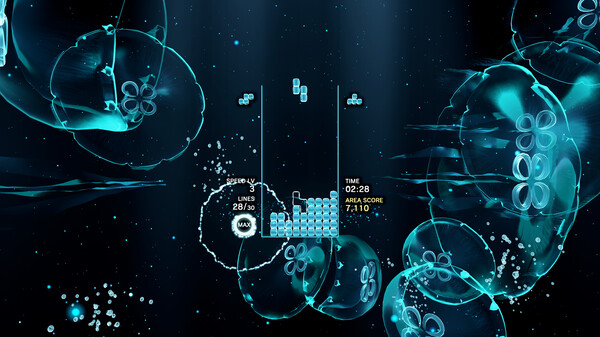 Entering the Zone shifts both the screen and the sound a notch
The speed the blocks fall at, and the speed the music grows at, share the same hands
Tetris moves at a far faster solving tempo than most puzzle games. There’s barely time to think — your fingers do most of the deciding. So the music doesn’t give you room to think either. The instant you place a block, a sound answers, and the speed of that answer is itself the feeling of “I’m stacking this well.”
Earlier in this column I wrote about Mini Metro, another score where your own actions change the chords. That one moves at the slow pace of drawing a line and waiting; the music drifts along with it. Tetris Effect: Connected sits at the opposite end — the sound answers at the same speed as your fingers. Same design principle, “your input writes the song,” handed a completely different tempo.
Hydelic themselves said they leaned on 4/4 time around 135 BPM for the exciting moments, and 6/4 at 100–120 BPM for the calmer ones. Stack a fast tempo under fast play, and a player starts to feel like their own fingers are the ones performing the backing track. I think that’s what the word “Effect” in the title is actually describing.
Tracks worth hearing
First, “Connected (Yours Forever)” from the Deep Sea stage. Hydelic has said this was a collaboration with vocalist Kate Brady they’d wanted to do for a long time, and it’s the most vocal-forward track on the album.
Then “World of Colors” from the Mermaid stage — a track Hydelic themselves named as closest to their own style, and the clearest example of how the game lines up sight and sound.
Closing — what I’d steal for my own work
What I’d steal is the idea of designing the order in which sound gets added. Instead of writing a finished song and playing it back, build it after the fact — single note, then chord, then drum layer — keyed to what the player has actually accomplished. Decide how the piece grows, not what its finished shape is.
If you’re replaying anything, make it the instant you enter the Zone: the vocals pull back, and for a few seconds only the piano is left. One sip of black coffee. It’s worth checking, again, that moment where the speed of your fingers and the speed the song is growing at land exactly together.
Sources
・Steam: Tetris® Effect: Connected Original Soundtrack (official OST DLC)
・Hydelic on Bandcamp: Tetris Effect: Connected Original Soundtrack
・tetriseffect.game official blog: Hydelic interview (reprinted from Splice)
・Game Developer: Game audio analysis - Tetris Effect
・PlayStation Blog: Inside the creation of Tetris Effect’s original soundtrack
Reactions (no login)
Anonymous • one of each per visitor per day
Part of these series
Puzzle SoundtracksEpisode 86 of 86
Read next
Related reviews
Tetris Effect: Connected
The falling-block game you already know, with its rules left exactly as they were. Across thirty-odd stages the music and light move in step with every piece you drop, and two things sit on top: a Zone that freezes time so you can clear more than four lines at once, and a three-player co-op mode that joins the boards together. Made under Tetsuya Mizuguchi's Enhance.
FRACT OSC
A first-person musical-exploration puzzle set in a vast synthesizer-built ruin, where you actuate glowing nodes and sound rigs to wake dormant machinery and music back to life. There's almost no instruction; working out what is even interactive is itself the puzzle. Phosfiend Systems, 2014, winner of IndieCade's audio design award.

