ESSAY · 2026-08-12
Designing the Overworld — Where Puzzle Games Let You Be Stuck
The grammar of level selects, from Braid's hub to The Witness's quantity gate to A Monster's Expedition's world-as-board
Introduction
I was stuck in the quarry of The Witness for three days. One eraser panel refused to be read, and I circled the same room dozens of times. What finally solved it was not the panel but the island. I gave up, walked toward the shore, finished a different sequence, came back, and the same panel fell in minutes. What saved me was not a hint system or a difficulty setting. It was the shape of a world that let me stay stuck and still go somewhere.
Discussions of puzzle design tend to focus on individual levels, but the structure that connects them — level selects, hubs, overworlds — is itself plumbing for difficulty. Where does the pressure of being stuck drain to, and where is it finally settled? In this essay I want to trace how that plumbing evolved, from Braid to A Monster's Expedition: the outer vessel, so to speak, of the teaching design covered in the learning curve series.
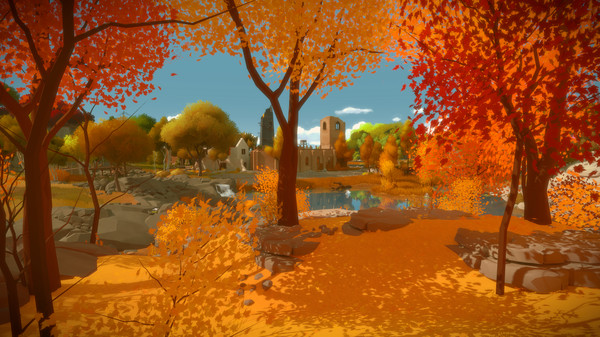 The Witness (from the official Steam screenshots)
Separating Traversal from Solving — The Grace Period Braid's Hub Invented
Start with the linear structure as a control. Portal, in 2007, lined up nineteen test chambers in a single corridor. Because the order is fully managed, you get unmatched precision in shaping the learning curve: every new concept arrives in exactly the right sequence. The price is that being stuck has no exit. A player stopped at chamber 18 has nothing but chamber 18. A short game survives this; the taller the conceptual walls grow, the more this structure leaves quitting as the only door.
In 2008, Braid answered with a hub. Rooms in a house open onto Worlds 2 through 6, and crucially, you can walk through any level without solving its puzzles. Traversal and solving are separated. A jigsaw piece you cannot reach can simply be left behind. As long as you keep walking the game moves forward, and the unsolved puzzle stays in the world as a deferral. That was the moment being stuck turned from a full stop into a debt.
But Braid never cancels the debt. The ladder to the final world is only restored by completing all five paintings, which requires every piece from Worlds 2 through 6. The structure is grace and settlement: you need not solve it now, but you will pay everything in the end. Players repay in whatever order suits their strengths, so felt difficulty is smoothed while the total amount of thinking demanded never shrinks. Most puzzle-game world structures since read as variations on this prototype.
Seven of Eleven — The Witness and the Quantity Gate
In 2016, The Witness scaled grace-and-settlement up to an entire island. Nearly every area is walkable from the start, and the lasers activated at the far end of each area number eleven in all. Opening the door at the top of the mountain takes only seven. This N-of-M quantity gate is the spine of the game's world structure.
The real virtue of a quantity gate is that players choose which areas to abandon. Some are stopped by panels that ask them to distinguish colors; others by a grove that asks them to listen. Which area is hard varies by person, and per-level tuning cannot absorb that variance. The four in eleven-minus-seven is a set of exemption tickets the designer issued in advance, valid for anyone. Individual differences in difficulty are absorbed not inside levels but by the shape of the world.
There is a byproduct: leaving becomes part of learning. The panel vocabularies of The Witness are independent by area, so walking elsewhere starts a different lesson, and the observational resolution gained in a distant lesson often unlocks the original jam. My three days in the quarry were exactly this. In my essay on hint systems I wrote about how hard it is to move a player's gaze without handing over the answer; The Witness has no explicit hints, and walking does the work of drawing one.
A Branching Map — Counting the Escape Routes in Baba Is You
In 2019, Baba Is You chose not an open world but a classic map-style level select. The map, though, is no corridor. Each area opens the next after a set number of clears rather than all of them, and the branches keep offering somewhere else to go. Stuck? Step sideways. I think this simple detour system is the foundation that makes the game's extraordinary difficulty viable.
As I wrote in my essay on learning curves, Baba's levels stand as vertical walls rather than gentle slopes. The height of the walls and the number of detours on the map are complementary. If you want taller walls, you must add escape routes; conversely, fix the number of escape routes first and the permissible cruelty of each level follows automatically. For a game with no hint system, the branching map is the de facto hint system.
The inequality — required clears smaller than total levels — is a letter of delegation from designer to player: you decide what to abandon. The delegation works because abandoned levels do not disappear; they stay lit on the map, sitting at the edge of your vision like Braid's unfinished paintings, a debt you eventually want to come back and repay. An escape route, it turns out, is another name for a way back.
When the World Becomes the Board — From Stephen's Sausage Roll to A Monster's Expedition
In everything so far, the line between levels and the space connecting them still held. In 2016, Stephen's Sausage Roll began dissolving it. Each solved puzzle reshapes the island: towers right themselves, blocked paths connect. The overworld is a level select, a record of progress, and a narrator all at once. Even while you are merely walking, the world keeps saying something.
In 2020, A Monster's Expedition erased the line entirely. Knocking down a log to make a bridge is at once the solution to a puzzle and the means of travel. Where a level ends and movement begins can no longer be told apart. Stuck? Cross, literally, to another island; rafts carry you to distant clusters. I touched on the game's scarcity of verbs in the subtractive design essay, but seen from the world-structure side, this is the extreme where everything in the world is an escape route.
In 2024, Isles of Sea and Sky layered Zelda-like keys and quantity gates over this grammar, bringing order back to the sea of islands. A world that is itself the board is beautiful, but it has a cost. When level boundaries vanish, so does the signal that says you may stop thinking here. Every step taken as mere travel might be creating a dead end, so the player stays faintly on guard forever. If you dissolve the boundary, you must rebuild, somewhere, a time when it is safe to relax.
Closing
Laid out in order, the lineage is clear: Portal's corridor, Braid's grace and settlement, The Witness's quantity gate, Baba Is You's branching map, and A Monster's Expedition's world-as-board. All of them answer the same question — where do you let a stuck player walk? However precisely you carve difficulty inside a level, jams will happen. Whether a jam becomes a reason to quit or an excuse to wander is decided by the design outside the level.
If I were to make my next puzzle game, I would fix the number of escape routes before building a single level. How many deferrals can a player hold at once? Where is settlement demanded? Where does the N sit in N of M? These numbers set the ceiling on how boldly each individual level can be made difficult. I will leave the question with you as well. Think of a puzzle game you actually finished. Was it the quality of the levels that carried you to the end — or the shape of a world that kept you walking while you were stuck?
Reactions (no login)
Anonymous • one of each per visitor per day
Learn — Curriculum
LearnPart 4 Difficulty — Designing the Learning Curve and FailureChapter 11 Hints, Undo, Dead Ends5 / 10
Part of these series