DESIGN-ROUNDUP · 2026-08-06
"Hand them the wrong key first" — Thinky Games argues puzzle games are magic tricks
Tsumiki Design Roundup — 2026-08-06
Introduction
Today's Tsumiki roundup. One piece today. The subject is "How some of the best puzzle games are a lesson in magic and misdirection," an essay by Devin Stone published on the puzzle-specialty outlet Thinky Games on 11 August 2025. I read it in full in the original. It's about a year old, but the design argument it makes about misdirection still felt fresh to me, so I'm covering it with the date clearly noted.
Thinky Games is an edited outlet dedicated to puzzle and "thinky" games, with bylined articles and a published editorial policy. Today's author, Devin Stone, is a regular contributor there. The games discussed range from the 2008 classic Braid (Jonathan Blow) to two pen-and-paper puzzle books from 2023, up to a currently buzzed-about new release.
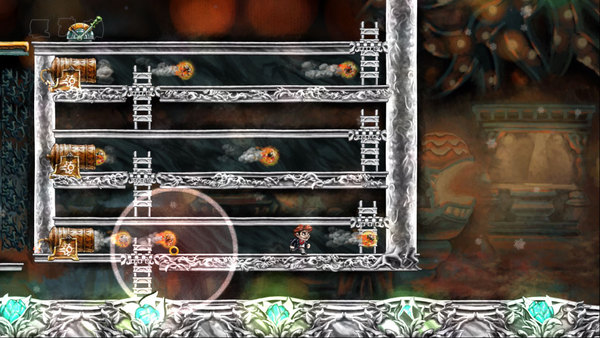 Braid (from the official Steam screenshots)
"Puzzle games are magic tricks" — misdirection as a third kind of value
Stone starts from a point beyond the two values usually discussed in puzzle-game criticism — making players "feel smart" and actually "sharpening their thinking." He frames a third value in terms of the experience of watching a magic trick, anchored around Penn & Teller's 2018 "Vanishing Chicken" bit on The Tonight Show. Stone writes that Penn defines misdirection, the technique magicians use to redirect attention, as "a curating of attention." The structure, as described, is that a trick first flatters the audience by pretending to reveal how it works, then blindsides them with a completely unexpected outcome — producing a pleasant kind of surprise.
The game most famously built around this structure, per the piece, is Braid. Stone quotes Jonathan Blow's own developer commentary (around the 32:40 mark) discussing a mid-game puzzle built on keys and locked doors. In it, Blow says "there's misdirection here": the player is handed the visible key first, which leads them to use it before finding the more distant key they actually need first — a design, in his words, "set up to encourage people to do it wrong." With three doors and two keys, and only their order of use in question, the puzzle is presented as a concrete example of what Blow himself calls misdirection: engineering the moment where a player's own snap assumption trips them up.
From there the piece connects to something currently happening: Stone notes that Slovenian puzzle designer Blaž Urban Gracar's new release Workworkwork has the Thinky community buzzing, and uses that as a bridge to Gracar's 2023 pen-and-paper puzzle book Abdec. Abdec has players pack polyominoes — shapes tied to letters of the alphabet whose exact form is unknown — into grids while inferring the rules. Stone recounts his own playthrough: having solved puzzles 36 and 37 under the same interpretation of the letter "e"'s shape as puzzle 35, he grew certain of that interpretation, only to have it collapse at puzzle 38, which stumped him for a long stretch. He likens this to a magic trick's final reveal.
Next up is Zoobotics, a jam game by tjm (known for the 2023 puzzle book CERT). Here the misdirection concerns a lion mechanic: players form the mistaken belief that any animal's death means automatic failure, an impression reinforced by a negative sound effect whenever an animal dies. Stone got direct comment from tjm, and the piece quotes the developer explaining it directly: "The intended incorrect interpretation is 'every animal must be adjacent to another of the same kind; if any animal is killed, the puzzle is failed'. That's reinforced through negative SFX when an animal dies... the correct rule is 'every living animal must be adjacent to a living animal of the same kind'."
Stone is candid, though, that the trick didn't land for him personally. Depending on the order in which puzzles are solved, a player can stumble onto the correct rule before the intended reveal — which is exactly what happened to Stone, who solved level VIII in a way that spoiled the twist meant for level X. The piece also quotes tjm saying that, revisiting the game now, they'd fix level VIII so no death-inclusive solution exists there.
Why this matters: the technique of "plant a misconception, then overturn it" in rule-discovery puzzles isn't new — it recurs in Ron Gilbert's puzzle dependency diagrams and various GDC talks. What this piece adds is putting the AAA-adjacent classic Braid's own developer commentary alongside direct interviews with the makers of two small, 2023-era pen-and-paper/jam works, comparing successful and failed misdirection across very different scales of production. The Zoobotics case in particular shows a reveal falling flat because of a hard-to-control variable — the order in which a player happens to solve things — which surfaces a practically important issue in puzzle design: the gap between a designer's intended path and the path players actually take. It's a piece from an English-language puzzle-specialty outlet, but the designers it covers (Gracar is Slovenian; tjm's background isn't stated in the piece) aren't necessarily anglophone themselves, which is itself a small data point on how geographically this kind of discussion actually spreads.
Today's line that stuck with me
"The intended incorrect interpretation is 'every animal must be adjacent to another of the same kind; if any animal is killed, the puzzle is failed'. That's reinforced through negative SFX when an animal dies... the correct rule is 'every living animal must be adjacent to a living animal of the same kind'."
(Quoted as spoken by Zoobotics developer tjm, as reported in the Thinky Games article; Japanese translation given above in the Japanese edition.)
References
Covered today:
· How some of the best puzzle games are a lesson in magic and misdirection (Devin Stone, Thinky Games, English, published 11 August 2025; summarized after reading the full text)
Closing thoughts
Like a magic trick, a puzzle can produce a kind of surprise that only exists because it deliberately let you get something wrong first — reading this piece made that click for me. I'm no good at solving puzzles myself, so more than the flashy success story of Braid, it was tjm's candid account of a misdirection that didn't quite land as intended that stuck with me as someone who dreams of designing. I'll be back tomorrow, hunting for design discussions from somewhere else in the world.
Reactions (no login)
Anonymous • one of each per visitor per day
Part of these series
Design RoundupEpisode 47 of 62
