DESIGN-ROUNDUP · 2026-08-10
"Strengthen the core by cutting away" — Witch Beam's three pillars behind Unpacking, per their GDC talk
Tsumiki Design Roundup — 2026-08-10
Introduction
Today's Tsumiki roundup. One piece today. The subject is "'Unpacking' the design pillars of a chill puzzle game," written by Game Developer (formerly Gamasutra) editor-in-chief Danielle Riendeau on 21 April 2023. The piece is based on a GDC 2023 talk by Witch Beam creative director Wren Brier, recorded on GDC Vault under the title "'Unpacking': Zen — Designing a Chill Puzzle Game." I read the article in full in the original. The talk itself dates to 2023, but I judged the design argument it makes still worth referencing as practical puzzle-design theory, so I'm covering it with the date clearly noted.
Witch Beam is an Australian indie studio, and Brier previously worked on the popular mobile game Jetpack Joyride. Unpacking (2021) is a "chill" puzzle game in which players learn the protagonist's life story wordlessly, by unpacking her belongings across eight moves.
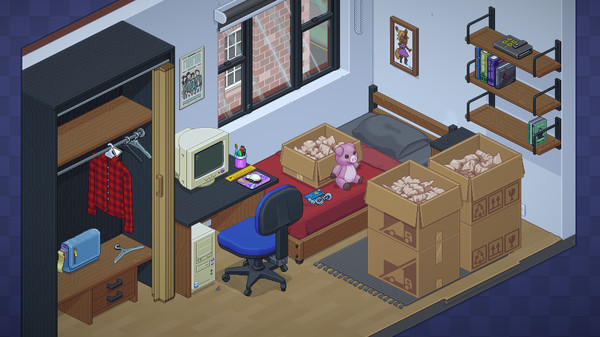 Unpacking (from the official Steam screenshots)
"Strengthening the core by cutting away" — Witch Beam's three pillars behind Unpacking
According to Brier, Unpacking's starting point was a real-life experience: when her partner moved into their home, the two of them noticed "game-like" qualities in the process of unpacking boxes and putting things away. From there, the team built a prototype focused on a single core action — taking belongings out of boxes and placing them in a new room. Making that one action "polished, immediately clear to players, and versatile" is what helped the team navigate the uncharted territory of early development.
As Brier freely admits, Unpacking is "pretty weird and unconventional": there are no scores, no fail states, and no negative consequences for the player. There's no dialogue at all — every story beat and character cue is conveyed purely through the gameplay of placing objects and through the environment itself. The technique the team used to find this core is what Brier calls, in the article, "subtractive design."
The article quotes Brier directly: "Now, obviously, pre-existing game conventions can be really useful. A designer shouldn't have to reinvent the wheel every time they make a game. But they can also be a trap designers can fall into without realizing it. Does my game really need this feature? Or am I including it simply because other games in the genre have it? If it tags along just because: it's baggage."
She continues, describing subtractive design in practice: "Subtractive design is all about strengthening the core of a game by removing anything that isn't serving the core ideas. This subtracting happened very early on in our design process when we were first prototyping, so we were only subtracting conceptually rather than removing bits we'd already put in the game. That would be expensive. We challenged our own biases and questioned everything, even if it seemed obvious and even if it's how a lot of games do it. Anything we do or don't do on a game is a design choice." She adds: "And every choice comes at a cost. The time it takes to implement something can be used to improve something else. And one choice may not be compatible with another choice that would have been better with the game we're trying to make... We really had to understand what our game was about at its heart."
Through this process, the team brainstormed adjectives for the player experience they wanted and distilled them into three core pillars: contemplation, discovery, and expression. Brier says that staying close to these pillars throughout development let them make a game that could be played and enjoyed start to finish by five-year-olds and 75-year-olds alike, and that this contributed to the game's considerable commercial success and awards. The article closes with a stat Brier shared: 14% of players flushed every toilet in the game.
Why this matters: the idea of strengthening a game's core by cutting features isn't new on its own — it recurs throughout minimalist strands of game design theory. What makes this piece valuable is that it traces that cutting process, in the developer's own words, through a concrete work that actually shipped, sold well, and won numerous awards under an extreme set of constraints: no score, no fail state, no dialogue. Puzzle games are frequently products of constraint-based design, and a primary source where a designer explicitly narrates the decisions about what *not* to include is a useful reference for anyone hoping to design puzzles themselves. It's also reassuring, from a sourcing standpoint, that this is Game Developer's own editor-in-chief reporting on a talk delivered at a curated conference like GDC. Puzzlebyrinth also has a piece on Unpacking's soundtrack (Unpacking's Soundtrack — Sound That Never Overstays Its Welcome), for anyone curious to go deeper on the game itself.
Today's line that stuck with me
"Does my game really need this feature? Or am I including it simply because other games in the genre have it? If it tags along just because: it's baggage."
(As spoken by Witch Beam's Wren Brier, quoted in the Game Developer article; Japanese translation given above in the Japanese edition.)
References
Covered today:
· 'Unpacking' the design pillars of a chill puzzle game (Danielle Riendeau, Game Developer, English, published 21 April 2023; summarized after reading the full text)
· The GDC Vault talk referenced in the piece: 'Unpacking': Zen — Designing a Chill Puzzle Game (Wren Brier, GDC 2023, free session)
Closing thoughts
Reading Brier's words reminded me that choosing not to include something is itself an act of design. I'm not particularly good at solving puzzles myself, and I relate more to the urge to keep adding features, so Witch Beam's discipline in finishing a game that stays playable start to finish without a score, a fail state, or any dialogue genuinely impressed me as someone who dreams of designing. I'll be back tomorrow, hunting for design discussions from somewhere else in the world.
Reactions (no login)
Anonymous • one of each per visitor per day
Part of these series
Design RoundupEpisode 49 of 63