DESIGN-ROUNDUP · 2026-08-15
"Verbs Made of Smaller Verbs" — Andrew Plotkin's Zoom-Out Design Pattern, from ThinkyCon 2025
Tsumiki Design Roundup — 2026-08-15
Introduction
Today's Tsumiki roundup. One piece today: "Towers of Pen: puzzle experiences that zoom out and out" by Andrew Plotkin, presented at ThinkyCon 2025, the free online conference for puzzle game developers held November 5–7, 2025. I consulted both the YouTube recording and the written essay version published at eblong.com.
Andrew Plotkin (pen name: Zarf) is a veteran interactive fiction designer active since the 1990s, best known for Spider and Web, Shade, and Hadean Lands. He has long maintained a design-focused blog, Zarf Updates, and has spoken at ThinkyCon on multiple occasions. I'm not great at actually solving puzzles, so I especially enjoy reading voices from the design side rather than the solving side.
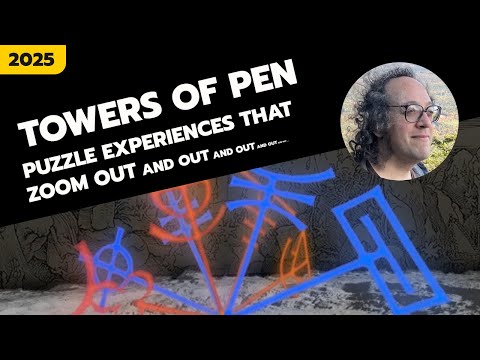 "Towers of Pen: puzzle experiences that zoom out and out" (Andrew Plotkin, ThinkyCon 2025, YouTube)
"Verbs Made of Smaller Verbs" — Plotkin's Theory of Zooming Out in Puzzle Design
What Plotkin sets out to describe in this essay is a particular design pattern: puzzle games where, as you play, you gradually discover that a larger game lies hidden within the one you've been playing. He calls this structure "verbs made of smaller verbs."
His own work Hadean Lands is the central example. In its early stages, the game is a puzzle of discovering alchemical recipes, executing each step one by one. As the story progresses, however, the player gains the ability to treat an entire sequence of recipe-execution as a single move toward some larger goal — the system compresses a recipe into a single command through automation. What was once a puzzle (discovering the recipe) has become the foundation for a higher-level game in which recipes are pieces to be moved.
Baba Is You is read through the same lens: solved map puzzles become tools — a key, a block — usable as single moves in the larger world map. "Words are commands, or parts of commands," as the essay puts it. COCOON is similarly mentioned, and this structure — where a solved level literally becomes a component of the next level — connects closely to the recursive nesting explored in "Making Recursion a Puzzle." Other games cited as exhibiting the pattern include SOLAS 128, Robot Odyssey, Turing Complete, The Fool's Errand, and Carto.
According to Plotkin, three conditions must hold for this structure to work. First, hidden layer discovery: the player must actively realize, through play, that a deeper or broader game exists. Second, automation of lower-level actions: the player must be able to execute the lower layer's operations as a single command. Requiring manual repetition of earlier steps every time would create exponential overhead and make the game unplayable. Third, maintained access to the lower level: the lower layer must not fully disappear. Occasionally, the player needs to go back in and adjust low-level elements.
What makes the essay particularly sharp is its discussion of failure. Myst is presented as a game that almost achieved this pattern but didn't quite: the books that served as portals to other worlds were always there, but they couldn't be picked up and used as game-board objects in their own right. A small interface constraint prevented the lower layer from ever becoming a move in a higher-level game. Plotkin also draws a connection to the feeling of metroidvania discovery — the realization that something was always available, hidden in plain sight — arguing that puzzle games can produce this same emotional quality through entirely different mechanics. That parallel reminded me of what I wrote in The Lineage of Meta-Puzzles: the special delight of designs where the rules themselves become the object being manipulated.
Today's line that stuck with me
"You start playing one game, and then slowly realize that there's another game inside it."
(Andrew Plotkin, from "Towers of Pen." Japanese translation given in the Japanese edition above.)
References
Covered today:
・Towers of Pen: puzzle experiences that zoom out and out (Andrew Plotkin, eblong.com, English, published November 2025; summarized after reading the full essay)
・YouTube recording: Towers of Pen: puzzle experiences that zoom out and out — Andrew Plotkin (ThinkyCon 2025)
・Blog announcement: Zarf Updates — Towers of Pen (Andrew Plotkin, 12 November 2025)
Closing thoughts
"Verbs made of smaller verbs" is a phrase that stayed with me long after I finished reading. Even without being able to solve puzzles, there are moments when you watch from the outside and suddenly understand: so that's what this game is really about. Plotkin's essay gives that feeling a name. ThinkyCon 2025 had 37 talks in total, and I've barely scratched the surface. Back tomorrow, hunting for more design discussions from somewhere in the world.
Reactions (no login)
Anonymous • one of each per visitor per day
Learn — Curriculum
LearnPart 1 Introduction — Play and PuzzlesChapter 2 Words for Talking About Puzzles6 / 6
Part of these series
Design RoundupEpisode 50 of 63
Read next
Related reviews
The Magic Circle
A first-person meta-puzzle set inside a fantasy game that has been in development for twenty years and is still unfinished. You steal behaviours from creatures and objects, paste them onto other things, and rewrite your way toward the exit. Puzzles have no single intended answer. Released in 2015 by Question, a studio whose members are credited with work on Thief and BioShock.
There Is No Game: Wrong Dimension
A meta point-and-click in which a narrator insists there is no game while you drag and click the furniture of the game itself — title screen, menus, cursor. Each chapter jumps into a parody of a different genre. Made by Draw Me A Pixel.
OneShot
A top-down puzzle adventure: guide a child through a world whose sun has died, carrying a single lightbulb toward the top of it. Between the item-combining, a handful of puzzles reach out into the player's own computer. From Future Cat.


