REVIEW · 2025-08-07
Öoo
What 6,442 Steam reviews call a grammar built from one bomb
First Impressions
Öoo launched on 7 August 2025: an exploration puzzle platformer with not a single word of text in it. The store credits NamaTakahashi, tiny cactus studio and Tsuyomi. You play a caterpillar made of bombs, shedding a segment of your own body onto the ground and detonating it from a distance to open a way through. I am writing this from the Steam review pool exactly one year after release.
As of the 2026-08-10 snapshot the tally is 6,400 positive against 42 negative out of 6,442 reviews in all languages, labelled Overwhelmingly Positive — 2,655 in Simplified Chinese, 2,024 in English, 768 in Japanese, 273 in Korean. The last 30 days hold at 99% across 248 reviews. A pool with under 1% negative is normally not worth reading: the praise just repeats itself in the same words.
Öoo's 42 dissenters do something else. They take the exact property the positive side celebrates and write it down inverted, as a complaint. Two camps, one design trait, two names for it. That naming is what I want to follow here.
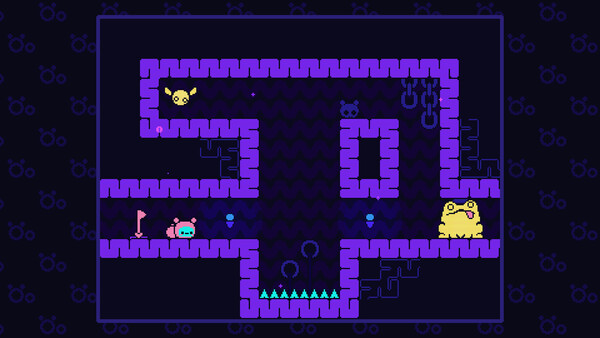 A single-screen room walled in purple blocks: the pink caterpillar and a pink flag at lower left, a large yellow frog at lower right, cyan spikes along the floor — Steam store screenshot
Putting the Mechanics into Words
Across the helpful positive reviews the recurring sentence shape is "all you can do is X, and yet". In English: one button places a bomb, the other detonates it, that's it. In Japanese: all you can do is move, place, detonate. In Chinese: just one caterpillar who knows how to use bombs. Counting the verbs and being surprised by the total is a reaction that repeats in every language.
In Puzzlebyrinth's vocabulary this is a textbook case of subtracting verbs. Subtraction only pays off when the board gains nouns as the verb list shrinks, and Öoo's blast carries three effects at once — break, push, launch yourself — with the moment of detonation left entirely to you. Two inputs, and the combinatorial space opens anyway.
The negative side questions that purity. Japanese dissenters read certain behaviours — a bomb sliding off a ledge, a bomb that will not go off in acid — as bolted on to pad the move count. Thinky Games presses the same spot from the critic's side, arguing the teleporters and green switches never grow out of the movement verb. Advertise subtraction and you will be asked where every remaining part came from.
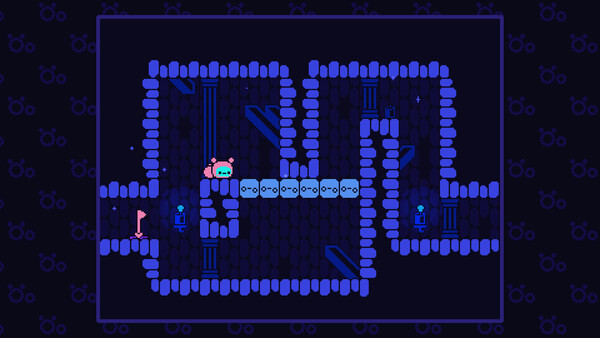 A blue room of pillars with a horizontal row of pale blue blocks marked o-o across the middle, the caterpillar at left and a pink flag at the far left — Steam store screenshot
How It Teaches
The second most common word on the positive side is teaching. The level design is the tutorial; the guidance is impossibly smooth; the level design is basically art. Praise for explaining a ruleset using nothing but the shape of a room, with zero words on screen, sits at the top of every language's pool.
The structure the reviews collectively describe runs like this: hit a dead end, learn one technique on the way back because the room's shape all but hands it to you, and find on your return that the dead end was never one. English speakers call it knowledge-gated — a metroidvania whose keys are things you know. In terms of learning-curve design, it folds the teaching room and the testing room into the same room, deleting the idea of a tutorial section altogether.
The negative side attacks that exact structure. The whole game feels like a series of tutorials teaching you mechanics, and then it just ends. Fold teaching into testing and you are left with no exam to set afterwards. One camp reads that as nothing wasted; the other reads it as nothing after the lesson. Same sentence, two faces.
 A green room: two glowing green orbs hang from vines, a green block wearing an o_o face sits at the left, and the caterpillar stands at right of centre — Steam store screenshot
The Texture of Difficulty
Testimony about difficulty splits three ways. One group never gets stuck: when they stall, experimenting with whatever is new about the room always lands the answer. A second group finds the puzzles trivial — nothing left to solve, an appetiser at best for anyone who came for puzzles. A third hits a wall, but only out in the optional hidden stages.
That third group is the interesting one. The main line tunes difficulty as a question of observation resolution, but a Japanese reviewer writes that the harder side content leans on solutions that feel forced, leaving them unsure the answer was intended. Several reviews note that breakable floors are not visually distinguishable, so being stuck degenerates into bombing every surface. The two halves of the game are difficult in different ways.
The other recurring complaint is the map, which can only be opened at a warp terminal — carried over from the same team's previous game. Late backtracking becomes guesswork about which way you came. That is not difficulty so much as friction manufactured by subtracting the wrong thing: time saved inside the board leaks back out beside it.
 The map screen: explored rooms in purple over a dark concentric-ring background, the current room boxed in white, coordinates [16,06] at the top — Steam store screenshot
Reviews I Read
This piece was written from the Steam user reviews as they stood on 2026-08-10.
· Steam: Öoo (6,400 positive / 42 negative out of 6,442 in all languages, labelled Overwhelmingly Positive; the last 30 days hold 99% over 248 reviews)
· Read: the top 10 positive and top 10 negative by all-time helpfulness, the top 10 English reviews by helpfulness, and the 10 most recent.
Closing
The developer's own words on the store page are "a dense experience that can be enjoyed in just 2-3 hours" and "no text — enjoy the game without language barriers". Positive reviewers keep quoting the joke of a UI localised into 103 languages for a game with no words in it. Here the developer's claim and the players' experience barely diverge; what diverges is whether those 2-3 hours read as exactly right or as not enough.
Completion times cited in the pool run roughly 1.5 to 3 hours, stretching to 4-6 with the hidden content. A year on, the last 30 days still sit at 99% over 248 reviews. Japanese and Chinese reviewers often mention arriving via a streamer or a collaboration, so the trickle of new players continues. Several dissenters downgrade to a conditional recommendation: fine, but on sale.
Steam's overall is 99%; my score is 8.8. Building a grammar out of subtracted verbs and teaching all of it with room shapes alone is a clear step up from ElecHead. The deduction is the one point I concede to the dissenters: once the teaching is done, almost no space is left in which you assemble the grammar yourself. What Patrick's Parabox spends a long second half proving, Öoo declines to prove at all. Not a matter of which is right, but of who each was designed for.
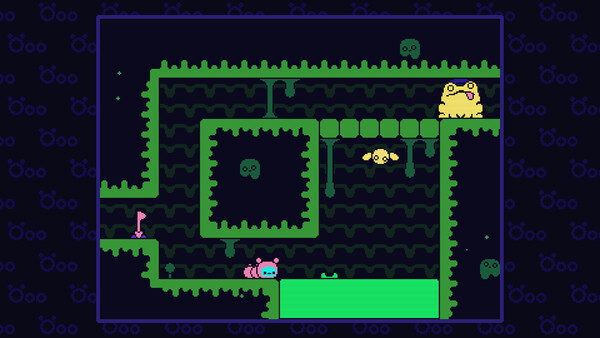 A green room: a large bright green rectangular block at lower right, a yellow frog at upper right, a small winged yellow creature near the middle and a pink flag at left — Steam store screenshot
Where are you with this game?
Press one and the game goes on your shelf. You can see it on your account page.
Reactions (no login)
Anonymous • one of each per visitor per day
Read next

Related reviews
Is This Seat Taken?
A 2D logic puzzle in which you seat a cast of little shapes — in a cinema, a bus, a taxi, a wedding reception, a diner — pulling them one at a time out of the queue and settling them where they want to be. Someone refuses to sit behind a big hat, a child wants to stay next to their parent, a nose objects to the coffee two seats over; you look for the one arrangement nobody complains about. Poti Poti Studio, published by Wholesome Games Presents in 2025.
Wilmot Works It Out
A puzzle-building game: open the weekly package, pull out square pieces, assemble the pictures, and hang the finished ones on your walls. Each package mixes pieces from several pictures, so sorting comes before building. The sequel to Wilmot’s Warehouse, from Hollow Ponds and Richard Hogg.
World of Goo 2
A sequel to the physics-building puzzler: grab black goo balls, link them into bridges and towers, and route them to the exit pipe. New goo species that stretch, shrink and explode join liquid that runs downhill and pools, across five chapters and sixty-plus levels. From 2D BOY and Tomorrow Corporation.


