REVIEW · 2025-08-07
Is This Seat Taken?
“Too easy” and “just right” are pointing at the same line
Introduction
There are seats. There are people. Everyone has an opinion. That is the whole board of Is This Seat Taken?. A cinema, a bus, a taxi, a wedding reception, a diner: the furniture changes, the task does not. You pull one waiting shape in at a time and settle it somewhere nobody complains about. Poti Poti Studio made it; Wholesome Games Presents released it on 7 August 2025 — a year ago today.
I read a year's worth of its Steam reviews. As of 2026-08-07 there are 9,016 across all languages: 8,775 positive, 241 negative, labelled Overwhelmingly Positive. The last 30 days run 95% positive of 399. The numbers look settled. Read further and you find that the people praising it and the people dismissing it are pointing at exactly the same property.
The positive side says it never once irritated them. The negative side says it never once made them think. Both are describing one line: a learning curve deliberately kept flat. What follows is an attempt to translate that line out of review vocabulary and into design vocabulary.
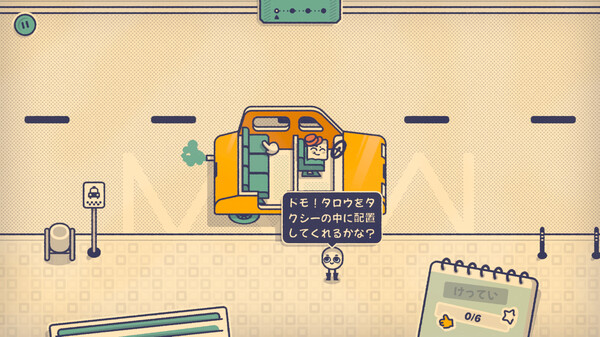 A yellow taxi drawn in cutaway, with a character on the pavement asking for someone to be seated inside; a notepad in the corner tracks the count — Steam store screenshot
First Impressions
On first impressions the two camps agree almost word for word. The positive vocabulary is cute, cozy, polished, soothing. The negative reviews open the same way: most of the highly-rated ones begin by granting that the game is beautifully made, that the art is charming, that a small team shipped something complete — and only then explain why they cannot recommend it.
Nothing here divides anyone in the first five minutes. Rounded shapes, a pale ochre ground, thin hand-drawn lines, a default volume already set to half so it does not blow out your ears on launch. One much-upvoted review gave the game top marks for that volume setting alone.
What is interesting is that this absence of friction later becomes the negative case. A frictionless opening promises a frictionless middle. The positive side reads the smooth first five minutes as craft; the negative side reads it as foreshadowing.
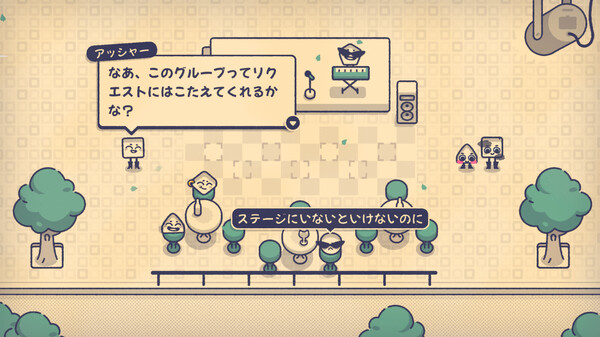 An outdoor concert: a performer on stage, dotted outlines marking empty seats, and a long bench ringed by trees — Steam store screenshot
Putting the Mechanics into Words
There is exactly one verb: pick a shape out of the queue and put it in a seat. The grammar lives in the request cards — no sitting behind a big hat, stay next to my parent, keep me away from the coffee — displayed as checkboxes at the corner of the board. Every condition is local: adjacency, front-and-back, sightline, smell, noise. It is close to the minimum viable constraint-satisfaction puzzle, and a clean case of the subtraction described in When Fewer Verbs Make a Richer Game.
The positive reviews call this instantly legible and free of tutorial. The negative reviews call it matching shapes to holes. They are describing one thing. Because every requirement is shown up front, no work is needed to raise your observation resolution; all you do is resolve collisions between conditions already on screen. Removing that reading step is the central design choice of the game.
One concrete complaint recurs on both sides of the split: there is no button to clear everyone off the seats, restarting throws you back to the top of the level, and you cannot stop mid-level. It appears again and again in highly-rated positive reviews too. In design terms, the granularity of undo does not match the granularity of the verb. If you place one at a time you should be able to peel back one at a time; without that, thinking with your hands gets expensive. The player is pushed to solve in their head, and placing shrinks into checking the answer.
 A green bus in cutaway. A character's request card is open at bottom left, its conditions listed as checkboxes — Steam store screenshot
The Texture of Difficulty
Difficulty is where the reviews split hardest. Some positive reviews describe a sweet spot — enough challenge to stay interesting, never enough to drive you mad — while others report being surprised by how tricky it gets. The negative side is consistent: zero challenge, a flat curve, the last level solved the same way as the first. Even a puzzle-focused curator who recommended it listed difficulty as its single failing.
It helps to separate three kinds of difficulty: search (which of the possible arrangements is right), observation (working out what the conditions even are), and execution (the answer is known but carrying it out is laborious). This game pins observation at zero, has no execution cost, and uses only search — at a few characters per round. The combinatorial explosion is shut down before it can start.
That is a choice of scope, not a failure. As argued in Carving the Learning Curve, where you bend the curve is the author's decision, and this game elects not to bend it. It returns the same small relief every time everyone is finally content, rather than the spike of a solved puzzle. For players who came for that, nothing is missing; for players hunting a wall, there is no wall. The same fork appeared around A Little to the Left.
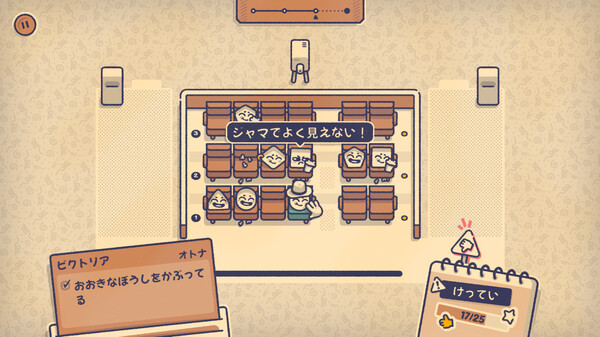 Three rows of cinema seats. From behind a character in a large hat, a speech bubble complains about the blocked view, and a warning mark lights up on the notepad — Steam store screenshot
Pacing
Only the negative side raises length, but it does so precisely. One review counts 32 levels including all bonus content; another counts five districts of six levels each and notes that settings are reused three or four times. Recorded playtimes in the reviews run from 0.7 to 13.4 hours, with a median around five. Against a $9.99 price, several negative reviews land on the same figure of speech: a $3 game, an iPad game.
The positive reviews concede the same length — with a different ending. Too short, I want more. I wish there were a level editor. Give me an endless mode. The same 32 levels are counted as a shortfall by one camp and as regret at the credits by the other. The verdict flips; the measurement does not.
Revisiting a setting is standard curve craft: introduce, then rehearse. The trouble starts when the rehearsal level feels easier than the level that introduced the idea, because the player reads that as being sent backwards rather than forwards. That is what the negative shorthand "nothing gets added" is pointing at. The press ran the other way — Metacritic aggregates to 79, and one major outlet praised the game for iterating on its premise consistently and creatively. The same repetition, read by critics as consistency and by disappointed players as stasis.
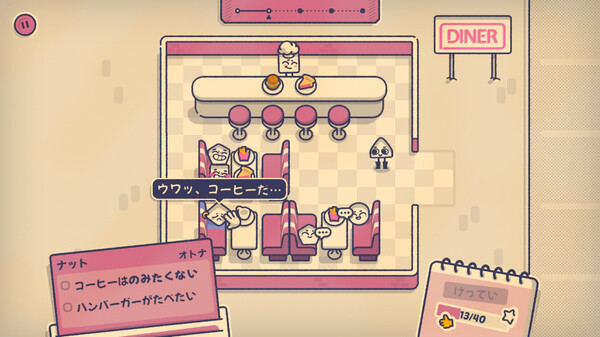 A pink diner with counter stools and booth seating; a request card at bottom left lists a dislike of coffee and a wish for a burger — Steam store screenshot
Sources
Written by reading the Steam store page and the community review listing as of 2026-08-07. No review text is quoted directly; typical claims are reconstructed.
- Steam: Is This Seat Taken? (Overwhelmingly Positive; 8,775 positive and 241 negative out of 9,016 across all languages, about 97%. The English view shows 97% of 5,477; the last 30 days, 95% of 399)
- Read: the top 10 helpful positive reviews (all time), the top 10 negative, and the 10 most recent. Recorded playtimes range from 0.7 to 13.4 hours, median around five
- Also consulted: the store's own description (a cozy, no-pressure logic puzzle game), the $9.99 price, the Steam Deck Verified rating, and the Metacritic score of 79 shown on the store page
- Press: GamesRadar+ and Game Informer, read to compare the professional reading against the user reviews
Closing
Steam sits at about 97%; my design score is 7.5. Credit for cutting down to a single verb, for the nerve to display the entire grammar on request cards, and for tying the fiction of each setting to its constraints — hats block sightlines in the cinema, smells travel in the diner. Two deductions: the granularity of undo never catches up with the granularity of the verb, and the learning curve is never bent. The first is a finishing problem, the second a choice of scope. Almost all of the gap between the two numbers lives there.
Who is it for. Not for players who want a puzzle to mean getting stuck, staying with it, and breaking through; nearly every negative reviewer is from that group, and their complaints are accurate. For someone who wants fifteen minutes of a small, certainly-solvable placement problem at the end of a day, it is built with unusual precision. When a positive review calls it a good way to wake the brain up in the morning, that is exactly the right compliment.
A year on, the verdict has not moved. The last 30 days at 95% sit essentially where the lifetime 97% does, with no sign of content changing anyone's mind. The game judged its own reach correctly at launch. The lesson for designers is what a game owes you once it decides not to bend the curve: here, a single undo button would matter more than another hour of story.
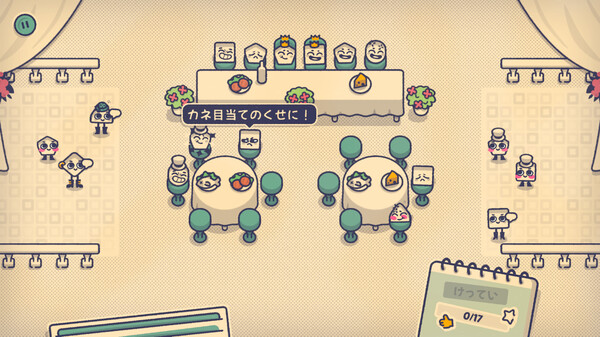 A wedding reception: six figures along the head table, two round tables in front, and a crowd still standing — Steam store screenshot
Where are you with this game?
Press one and the game goes on your shelf. You can see it on your account page.
Reactions (no login)
Anonymous • one of each per visitor per day
Read next

Related reviews
Öoo
A wordless exploration puzzle platformer in which a caterpillar sheds a segment of its own body as a bomb and detonates it from a distance - one verb that opens an entire underground, where the keys are things you know rather than things you carry. From NamaTakahashi, who made ElecHead.
Wilmot Works It Out
A puzzle-building game: open the weekly package, pull out square pieces, assemble the pictures, and hang the finished ones on your walls. Each package mixes pieces from several pictures, so sorting comes before building. The sequel to Wilmot’s Warehouse, from Hollow Ponds and Richard Hogg.
Röki
A point-and-click adventure through a snowbound forest drawn from Nordic folklore, following Tove as she gathers and combines objects to search for her sister. Polygon Treehouse's game has no combat and no fail state, carried instead by hand-drawn landscapes and a story about loss.


