REVIEW · 2016-10-27
Orwell: Keeping an Eye On You
The complaint that it is not a detective game is correct
First Impressions
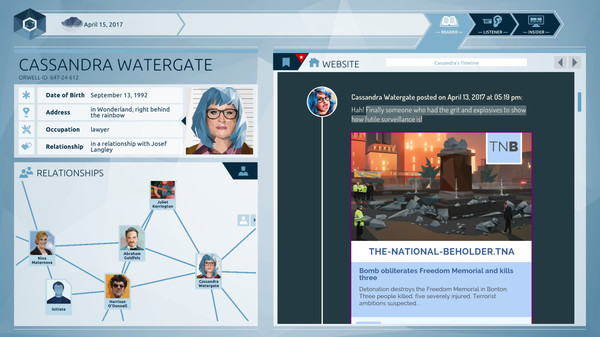
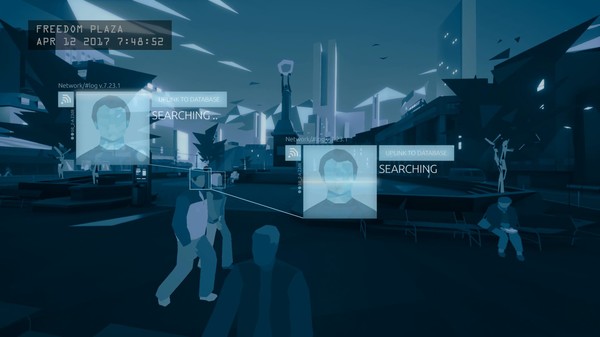
Orwell: Keeping an Eye On You is a surveillance game from 2016, developed by the German studio Osmotic Studios and published by Daedalic Entertainment. Steam lists the release as October 27, 2016; it originally arrived as five weekly episodes that wrapped that November. You are an outside operator for Orwell, a monitoring system newly installed by a fictional country called The Nation, reading citizens' posts, news articles, private messages and call logs and dropping fragments of them into personal profiles.
As of my 2026-08-15 snapshot the Steam aggregate is 90% positive — 14,020 up against 1,511 down out of 15,531 reviews across all languages — labelled Very Positive, with a 77 on Metacritic. Steady numbers; but read the bodies and the two sides are plainly discussing different things.
What the helpful positives repeat is not craft but recognition: that a 2016 game keeps being overtaken by the news. One cites the UK's online safety legislation, another an EU proposal, another writes only 'fiction that isn't fiction'. The negative side does not dispute this. The argument is never about the subject — it is about what the game asks you to do with it.
 Orwell: Keeping an Eye On You — Steam store screenshot
Putting the Mechanics into Words
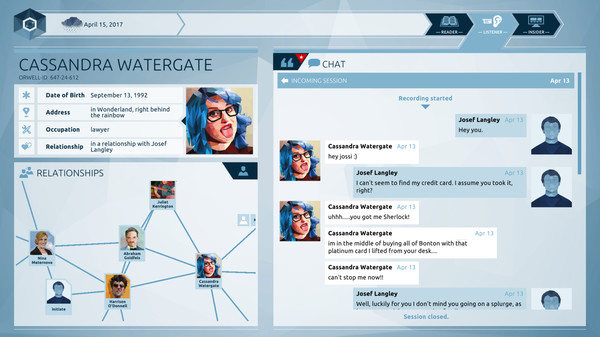
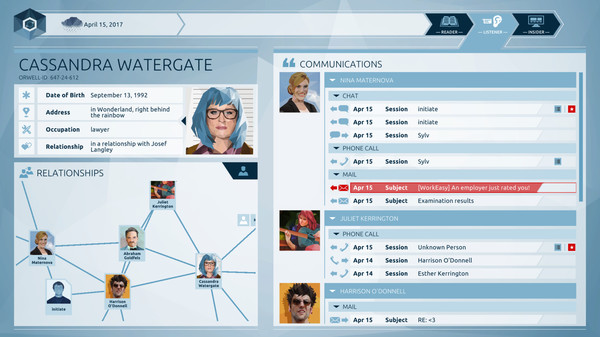
Boiled down from the reviews, there is effectively one verb: drag a pre-underlined fragment — a datachunk — out of the text on screen and drop it into someone's profile. That is the move. The word the negative side reaches for most often is spoon-feed, followed by 'just clicking highlighted text' and 'following instructions rather than solving something'. One review says flatly that advertising this as a detective game is misleading, because there is very little to detect or deduce.
In Puzzlebyrinth terms, what this design subtracts is not the verb but the resolution of observation. Detective play normally runs in four steps: read, decide what matters, extract it, connect it. The highlighting performs steps two and three on your behalf. What is left in your hands is not even step four — only the final choice of whether to hand a fragment in or hold it back. The complaint that there is no point reading the rest is an accurate description of that structure.
The interesting part is that positives describe the same structure approvingly: not hard because everything is highlighted, chill, the game that got me into text-driven games at all. The same automation reads as removed friction to one group and removed thinking to the other. Subtraction is judged less by what was cut than by who it was cut for.
One long negative notes a further side effect. Datachunks also gate the story, so withholding a mandatory one stalls progress — and the game never says which ones are mandatory. Players who actually exercise the freedom to withhold get stuck; players who hand in everything glide. Choice and progression are drawing on the same resource, and one of them is quietly killing the other.
 Orwell: Keeping an Eye On You — Steam store screenshot
The Feel of the Story
The story runs as five days of investigation. The positives keep saying twists, choices matter, and 'an absolute mind warp', and a lot of them announce a replay for the other endings. Both sides agree, implicitly, that the engine here is plot rather than deduction.
The cleanest split in the pool is Symes, your handler. One positive calls him opinionated and a little funny — he becomes your work friend. The negatives write that he interrupts every single time you file a fragment to summarise what it means, leaving nothing to think about and, as one puts it, nothing that needs reading. The same character, described as a companion and as a narrator of your own conclusions.
As design, Symes stands in for a learning curve. The finished inference is handed over before you can assemble it, so difficulty never gets off the ground. But delete him and the game becomes silent data entry, which makes him a patch over the same wound: once you commit to highlighted datachunks, something like Symes is structurally required.
There is also a complaint about the political reach. The top negative — thirty helpful votes — calls the game interesting, compelling and flawed, then lands on the line that Orwell treats 1984 as the only book on the shelf. Another is blunter: put up a banner reading CONTROL = BAD, FREEDOM = GOOD and save everyone a few hours. Set against Papers, Please, which puts you in the position of an accomplice and lets that do the arguing, Orwell is read as having settled its verdict in advance.
 Orwell: Keeping an Eye On You — Steam store screenshot
Place in the Lineage
Four names come up constantly in the pool: Papers, Please; Beholder; Do Not Feed the Monkeys; Hypnospace Outlaw. One negative coins the genre label 'authoritarian minion simulator', says the concept is genuinely interesting, and then says Orwell simply bored him. Having such clear neighbours makes this an unusually well-articulated case of what a game is missing.
The difference sits in who holds the resolution of observation. In Do Not Feed the Monkeys you decide which overheard scrap is worth writing down and which is worth searching; in Her Story the search term itself is the verb. Orwell fixes that resolution on the author's side. It is a game of submitting rather than observing — and a good share of the friction in the reviews comes from the word detective on the box rather than from the design underneath it.
Critics and users also ran at different temperatures. Polygon gave 9/10 and GameSpot 8/10, both crediting the balancing act between liberty and safety; Game Informer gave 6/10, dismissing it as a restatement of themes novels and films have handled more eloquently. Metacritic's 77 sits between them. The professionals scored a narrative device, the users argued about what they were being asked to do — which is more or less the whole breakdown of that 90%.
 Orwell: Keeping an Eye On You — Steam store screenshot
Sources
This piece was written from the user reviews on the Steam store page as of 2026-08-15. No review text is quoted verbatim; typical claims are reconstructed.
・Steam: Orwell: Keeping an Eye On You (Very Positive, 90% of 15,531 reviews — 14,020 up, 1,511 down)
・Read via WebFetch: top 12 helpful positive reviews, top 12 helpful negative, 10 recent
・Metacritic's 77, the Polygon / GameSpot / Game Informer scores and the five-episode weekly rollout were referenced via Wikipedia's Orwell (video game) entry
Closing
Two currents run through the recent page. One is a slow upward drift — the sense that reality caught up, written in several languages. The other is a handful of reports of the story becoming unfinishable near the end. Not many, but 'four hours and I could not reach the ending' is worth knowing before buying today.
Against Steam's 90% I land at 7.0. The prescience of the subject, the craft of a UI that conjures a state's gaze out of nothing but text and notifications, and the discipline of a five-hour running time are all worth crediting. Measured as a puzzle, though, this is a game that uses deduction as material without ever handing the deduction to the player. Whatever difficulty exists is not the difficulty of thinking but the length of the pause before you file a fragment. Call that difficulty and my 7 becomes an 8; refuse to, and it becomes a 6.
Recommended if the subject interests you and you want a short, dense story; finishers in the pool report roughly three to eight hours, and it discounts often. If you arrived expecting to draw the lines yourself, the way Shadows of Doubt or The Case of the Golden Idol let you, you will notice inside the first hour that the lines are already drawn. Whether that reads as a betrayal or simply as a different game is the whole verdict.
 Orwell: Keeping an Eye On You — Steam store screenshot
Where are you with this game?
Press one and the game goes on your shelf. You can see it on your account page.
Reactions (no login)
Anonymous • one of each per visitor per day
Read next

Related reviews
Event[0]
A first-person narrative exploration game aboard a retrofuturist spaceship, where you type your own sentences into the ship's terminals to talk with its AI, Kaizen-85, and look for a way back to Earth. Free text rather than dialogue options is the central mechanism, and how you speak changes the AI's attitude and your ending. A 2016 work by Ocelot Society.
Pony Island
A meta-puzzle in which you are trapped in a deliberately shoddy arcade cabinet built by the devil, alternating between a pony side-scroller and puzzles that reorder instruction blocks inside the machine itself. Daniel Mullins's first commercial release turns the window and the UI into the mechanism.
OneShot
A top-down puzzle adventure: guide a child through a world whose sun has died, carrying a single lightbulb toward the top of it. Between the item-combining, a handful of puzzles reach out into the player's own computer. From Future Cat.


