REVIEW · 2016-11-09
Sethian
A constructed language that handed the learning over to its own journal
First Impressions
Across the helpful positive reviews, the recurring word is the moment of understanding. It reproduces the click. It is thought-provoking. A reviewer who says they study linguistics recommends it to anyone who likes language, or even just puzzles. One review is three lines long: get a pen, get a notebook, dive in.
The negative side keeps coming back to procedure. Linear. A rigid track. A guessing game about exact phrasing. No thinking involved. Lifeless.
What is unusual is that these two vocabularies are not in separate reviews. Of the ten top positive reviews I read, close to half spend their second half making the negative side's complaint — the journal holds your hand far too much — and then give a thumbs up anyway.
So this is not a game the reviewers disagree about. They agree about it almost completely, and then split on the verdict. That is the part worth reading.
 Sethian in play — image 1 as listed on the Steam store page (Steam store screenshot)
Putting the Mechanics into Words
The store page says Sethianese is not a one-to-one substitution for English but a language with its own grammar and vocabulary, borrowing elements from Chinese and American Sign Language. The positive reviews bear that out: what they celebrate is grammar, not vocabulary. One reviewer's favourite moment is noticing how a genitive particle works.
And yet the game has exactly one verb. You type a sentence into a terminal. In Puzzlebyrinth's vocabulary this is subtraction of verbs taken to its limit. Chants of Sennaar keeps several — look, write, cross-check. Sethian kept only input.
Subtraction has a price. One verb tends to mean one kind of answer. The terminal either responds to your sentence or says it does not understand. The negative reviews' complaint — that only the developer-approved phrasing passes, that everything else returns the same confused line — is a description of that binary.
The result is a mismatch between combinatorial explosion and observational resolution. The space of possible sentences is large. The feedback on a wrong one is a single line that never says which part was wrong. The search is wide and nothing narrows it. Calling it a guessing game is not an insult; it is accurate.
 Sethian in play — image 2 as listed on the Steam store page (Steam store screenshot)
Where the Teaching Happens
The store page puts it this way: your handwritten journal and dictionary assist your investigation and ease you into the game's bizarre language. In the developer's framing, the journal is support.
The review pool reads it differently. The journal holds your hand far too much. The journal is effectively a walkthrough. The character dictates the exact sentence to type. The same claim shows up on both sides: one positive review calls the early game satisfying and fun, then says it becomes frustratingly linear.
As design criticism: once the teaching was handed to the journal, the solving went with it. The learning curve stopped running through the player's head and started running along the journal's page numbers. If turning a page gives you the next sentence, what you are climbing is a table of contents, not a curve.
That is why "get a pen, get a notebook" should be read as evidence. The reviewer who wrote it has eleven hours in and built their own tables by ignoring the journal. It records a player doing the work the game did not ask for. 7 Days to End with You hands you a glossary with the meanings left blank and keeps the right of interpretation with the player. Sethian filled the blanks in first.
 Sethian in play — image 3 as listed on the Steam store page (Steam store screenshot)
Place in the Lineage
In 2016 this shelf was close to empty. Heaven's Vault arrived in 2019, 7 Days to End with You in 2022, Chants of Sennaar in 2023. A commercial game whose subject was deciphering an invented language had almost nothing to be compared against.
Sorting by recent makes that decade visible. Negative reviews written lately almost always name a successor: play Chants of Sennaar or Heaven's Vault instead. Even the positive ones now qualify — shorter and easier than Chants of Sennaar, but worth it.
The same weakness used to be forgiven because there was nothing else. Now that the shelf is full, it simply costs points. The game did not get worse; the scoresheet was replaced. A five-dollar release made at something close to one-person scale will lose against later studio work on the same sheet.
Still, respecting the order is not the same as waiving the deductions. Coming first is not an argument. What Sethian showed first is that a seriously constructed language can carry a commercial puzzle game — and later games took that and went further with it.
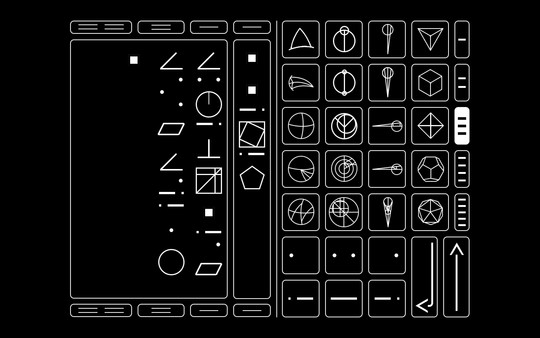 Sethian in play — image 4 as listed on the Steam store page (Steam store screenshot)
Reviews Consulted
This article was written from the user reviews on the Steam store page as of 2026-09-24.
・Steam: Sethian (113 positive of 170 across all languages = 66%, label "Mixed")
・Read: top 10 positive and top 10 negative by helpfulness, plus 8 most recent (28 in total)
・The store description (the developer's own text) and Warpdoor's write-up (2016-11-14)
・The images here use URLs returned by Steam's appdetails API verbatim. This session could not open the image files themselves, so the captions state only each image's position on the store page, never what it depicts.
Closing
I give it 6.5. Two things earn credit: the language was built from grammar rather than letter-swapping, and that grammar is granular enough to make reviewers write about the moment they noticed a particle. Two things cost: the teaching was handed to the journal and the solving went with it, and the terminal's binary verdict never says why a sentence failed.
Steam sits at 66% and "Mixed", but from what I read the reviewers do not actually disagree about the game. Nearly all of them describe the same weakness. They split on whether it is still worth five dollars. That 66% looks less like a dispute and more like a spread of price judgements about one shared conclusion.
It suits someone who came for the constructed language itself, and someone who has already played Chants of Sennaar or Heaven's Vault and wants to see what stood near the front of that lineage. Recorded hours cluster between one and four, with a median around two.
It does not suit someone who wants the texture of decipherment. Here, the thing doing the deciphering is the journal, not you.
 Sethian in play — image 5 as listed on the Steam store page (Steam store screenshot)
Where are you with this game?
Press one and the game goes on your shelf. You can see it on your account page.
Reactions (no login)
Anonymous • one of each per visitor per day
Read next
Related reviews
Pony Island
A meta-puzzle in which you are trapped in a deliberately shoddy arcade cabinet built by the devil, alternating between a pony side-scroller and puzzles that reorder instruction blocks inside the machine itself. Daniel Mullins's first commercial release turns the window and the UI into the mechanism.
The Turing Test
A first-person sci-fi puzzle on a moon of Jupiter: redirect energy orbs between sockets to open doors and cross a series of test chambers, wrapped in a story about machine and human judgment.
Event[0]
A first-person narrative exploration game aboard a retrofuturist spaceship, where you type your own sentences into the ship's terminals to talk with its AI, Kaizen-85, and look for a way back to Earth. Free text rather than dialogue options is the central mechanism, and how you speak changes the AI's attitude and your ending. A 2016 work by Ocelot Society.


