ANALOG · 2026-09-22
Turing Machine (2022): a machine that returns a verdict while nobody knows the answer
Stack three punched cards and one hole survives. What is lost when this paper computer becomes code?
Today's texture: a few-millimetre hole punched in cardstock
Today's texture: a few-millimetre hole punched in cardstock.
There are no batteries. No wiring either. And yet this box will tell you whether your answer is right.
Turing Machine (2022). You stack three cards, then slide one more underneath. Either a check mark or a cross shows through the hole. That is the entire apparatus.
Here is the interesting part. The verdict happens without anyone at the table knowing the answer. There is no quizmaster. Everyone is equally in the dark.
And it is done with paper. Let us take it apart.
 From the thumbnail of “Turing Machine - Game presentation by Le Scorpion Masqué” (Scorpion Masqué, YouTube)
What, when, who: a proto-computer with no electricity in it
Designed by Fabien Gridel and Yoann Levet. Published by Le Scorpion Masqué in 2022. One to four players, twenty minutes, ages 14 and up. Art by Sébastien Bizos.
The publisher's own page calls it a “proto-computer, working without electricity or electronics, to find secret codes.” The name points at Alan Turing, and so does the premise.
What you are hunting is a three-digit code. Each digit is a number from 1 to 5.
In the box: 48 criteria cards, 95 verification cards, 45 punched cards (three colours of 15, giving three sets of 1 to 5 per colour), a central tile, a card holder, 50 note sheets, screens and a marker.
The verification card count does not agree across sources: the official rulebook says 95, retail listings say 96. I would have liked those two numbers to match.
I could not weigh a copy, since I do not have one to hand. A German-language retailer lists the boxed weight as 990g.
In 2023 it was nominated for the As d'Or at Cannes, in the Expert category.
 From the thumbnail of “Turing Machine - Vidéo-règle officielle par le Scorpion Masqué” (Scorpion Masqué, YouTube)
Why paper and hands are enough to render a verdict
The procedure is simple. Pick one punched card of each colour, numbered 1 to 5, and stack all three. That stack is your proposal: the code you want to test.
Stack them and only the positions where every hole lines up stay open. Exactly one does.
Slide a verification card underneath. If a check shows through the hole, your proposal satisfies that criterion. A cross means it does not. That is the whole answer.
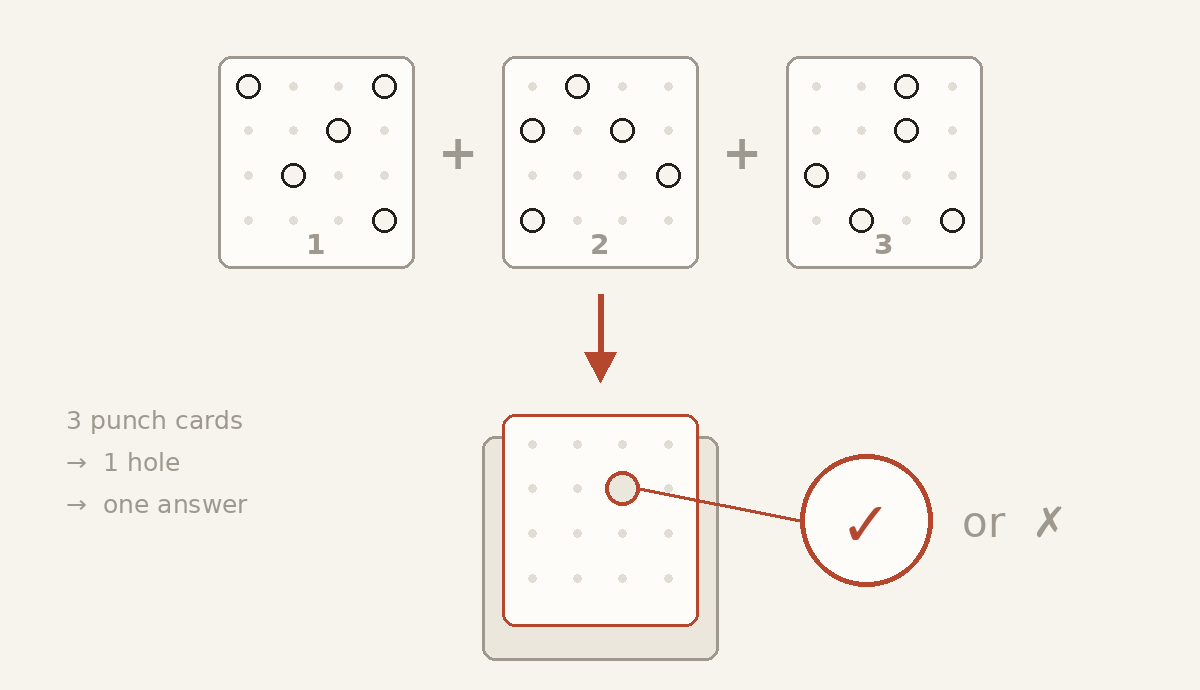 (Diagram) Stack three cards and exactly one hole survives. The verification card underneath shows the answer through it.
The criteria cards sit face up. So everyone can see that “this verifier is looking at whether blue is bigger than yellow.” The verification cards stay face down, and nobody ever looks inside them.
That is the crux. The answer is sealed inside an object, not held in anybody's memory. No quizmaster is needed. No referee either. The paper takes the job.
The shape of a question matters too. In one round you may query at most three verifiers, and you must keep the same proposal throughout. Want to change it? Wait for the next round.
Every question means restacking cards, sliding one under, leaning over to look. That round trip stays in your hands as effort. The effort is what information costs here.
Porting it to code: what is lost, what survives, what only digital can add
What is lost. The effort of asking, first of all. Take away the stacking, sliding and peering and a question becomes free. Free questions invite brute force. A good share of this game's tension comes from questions being annoying enough to ration.
The other loss is the feeling of something sealed. On the table, everyone can see the answer is physically face down. On screen, the answer is just a value on a server. The basis of trust moves from touch to promise.
What survives. The guarantee of a single solution survives intact. The rulebook states plainly that “only one code respects all the criteria.” Not a character of that is lost in code.
So does the scoring. When two players are right at once, the one who asked fewer questions wins. This actually gets stronger when ported, because counting becomes automatic.
The logical skeleton does not move either. Lining up constraints and shaving down candidates sits comfortably in deduction and logic grid deduction.
What only digital can add. First, volume. turingmachine.info, linked from the publisher's own page, claims more than seven million generated problems and hands out a daily challenge. The box holds 95 verification cards. That much does not fit in cardboard.
Second, the end of misreading. Misread a hole and the paper says nothing. It simply tells you twenty minutes later that your code is wrong. A machine reading the card never has that accident.
Third, the ability to fix things. The first printing had production problems, mostly with the cardboard insert, and in January 2023 the publisher announced that files had been reviewed with the factory for future printings. That fix never reaches the boxes already shipped. Only digital can patch what is already out.
For close relatives on screen: 14 Minesweeper Variants, which guarantees boards that need no guessing, and The Case of the Golden Idol, where a machine quietly judges the answer you filled in.
Now something harsher. The rulebook makes it obligatory “to write down on your note sheet your proposals and the answer to ALL the questions you ask.” The apparatus checks none of that.
All it answers is whether this proposal satisfies this criterion. Whether you copied the result correctly. Whether your proposal stayed the same. Whether you stopped at three verifiers. It sees none of it.
So this computer has no memory. It verifies, but it does not record. That trust holds because the session is over in twenty minutes.
Port it, and the trust turns into enforcement automatically. It is not that players start following the rules. They stop being able not to. Whether that is a gain is the designer's call.
For makers: if you make questions cheap, move the win condition too
One thing to take away. If you lower the cost of asking, move the win condition at the same time.
At the table, effort was the brake. On screen it drops to zero. Leave it at zero and keep “first correct answer wins” and brute force becomes optimal. Trying is faster than thinking.
Two options. Cap the number of questions, the way a round caps you at three. Or remove the cap and surface the fewest questions as a record. The first makes tension, the second makes replays.
Turing Machine already had the seed of the second. Its tie-break is the question count. The part that grows under porting was written into the rules from the start. It is usually a line like that one which repays a re-read before you start implementing.
In closing
Take the job of judging away from people. That alone changes the air at the table. Not because nobody can lie, but because nobody needs to.
Yet this paper apparatus only judges. The recording stays in human hands from beginning to end.
In your game, would you leave the writing-down to human hands?
Sources
Le Scorpion Masqué blog (25 Jan 2023) — As d'Or 2023 nomination in the Expert category ↗
Milan-Spiele product page — boxed weight of the German edition (990g), player count, length, age ↗
turingmachine.info — the problem generator linked from the official page ↗
Reactions (no login)
Anonymous • one of each per visitor per day
関連シリーズ
Solved by Hand第7回 / 全7回
Read next
Related reviews
The Centennial Case: A Shijima Story
Une aventure policière en prises de vues réelles, sur une série de meurtres qui hante une famille depuis un siècle. On ramasse des mots-indices dans chaque scène et on les place dans des phrases-hypothèses, reliant quatre affaires de quatre époques en un seul fil. Signé Square Enix.
GNOSIA
Un « loup-garou » en solo où il faut démasquer, par la seule conversation et le vote, la « Gnosia » infiltrée dans un vaisseau spatial. Jusqu'à 15 membres d'équipage se voient réattribuer un rôle différent à chaque boucle, revivant sans cesse le même voyage au fil d'une boucle temporelle — une aventure signée Petit Depotto.
Phoenix Wright: Ace Attorney Trilogy
Une aventure judiciaire où l'on incarne l'avocat Phoenix Wright, confrontant une ligne de témoignage à une pièce à conviction pour faire tomber un mensonge. La compilation de Capcom réunit les quatorze épisodes des trois jeux parus entre 2001 et 2004, avec des graphismes redessinés image par image.


