RETRO-REVIEW · 2026-07-17
The Legend of Zelda (1986) — The Grammar of Exploration Set by Treasure and Labyrinth
How disk-capacity constraints on the Disk System gave rise to the treasure-lock design
Introduction
On 21 February 1986, The Legend of Zelda was born as the launch title for Nintendo's Family Computer Disk System add-on. Its producer was Shigeru Miyamoto and its director Takashi Tezuka. In this game, Link, sword and shield in hand, roams the vast land of Hyrule and nine labyrinths; at release it was not even given a clear genre label. Within the feel of a top-down action game, the skeleton of what would later be called the 'action RPG' was quietly built in.
The subtitle etched into the title logo reads 'THE HYRULE FANTASY.' The grammar this single game established, exploring a labyrinth, obtaining a treasure, and having that treasure open new ground to advance, remains the backbone of the series forty years on. What I wish to trace in this piece is the single point of how this invention of 'treasure and labyrinth' became a distant ancestor of today's exploration-based puzzle games.
 A sword, a shield, and a door swinging open (illustration, AI-generated)
The Context of the Era
The timing of the Disk System's February 1986 launch has its own context. The previous September, Super Mario Bros. had been a massive hit, already cementing the Famicom's status as a home console. The Disk System was a peripheral built around magnetic disks, offering roughly three times the capacity of ROM cartridges along with save functionality. Priced at 15,000 yen for the hardware and 2,600 yen for the software, it undercut contemporary cartridge software (around 5,000 yen) by a wide margin, and in-store 'Disk Writer' kiosks could rewrite a disk to a different game for just 500 yen, a distribution model built around a child's pocket money.
Taking advantage of that capacity, Hyrule's field spanned a full 128 screens, and each of the nine labyrinths ran to dozens of screens, an extravagant volume for its time. How walkthrough information reached players reflects the era too. Beyond the included manual, the official magazine Family Computer Magazine ran a Q&A column in which Miyamoto and Tezuka themselves gave hints, and dialing a region-specific phone number connected players to a recorded telephone hint service voiced as Zelda's nursemaid Impa. In an age when information could not be shared instantly online as it is now, the mechanism for rescuing a stuck player was built atop the era's own infrastructure of magazines and telephones.
 Disks and telephones, the information infrastructure of the era (illustration, AI-generated)
Mechanics
At the core of the dungeon design lies Miyamoto's own boyhood memory. As a child at his family home in Sonobe, Kyoto, he got lost in a complex layout of sliding doors, and that experience is said to be reflected in Hyrule's labyrinths, in their hidden doors and rooms that look like dead ends but open further inward. It is a striking example of a personal spatial memory translated into the grammar of game design.
The mechanical skeleton is simple yet resilient. Obtain a treasure in a labyrinth; a place that was previously impassable without that treasure now opens; proceed to a deeper labyrinth. It is a one-directional chain. A boomerang knocks down a target out of reach, a raised arrow drops an enemy overhead. The key to any puzzle is always 'the tool you just obtained,' and this design turned exploration itself into part of the puzzle-solving.
A byproduct emerged from constraint as well. While fitting the data of nine labyrinths onto the disk, Tezuka is said to have made a mistake that used only half the available capacity; rather than reprimand him, Miyamoto decided to use the leftover space to build a high-difficulty post-clear mode, the 'Second Quest.' That constraint and chance could give rise to new content speaks to the atmosphere of the development team at the time.
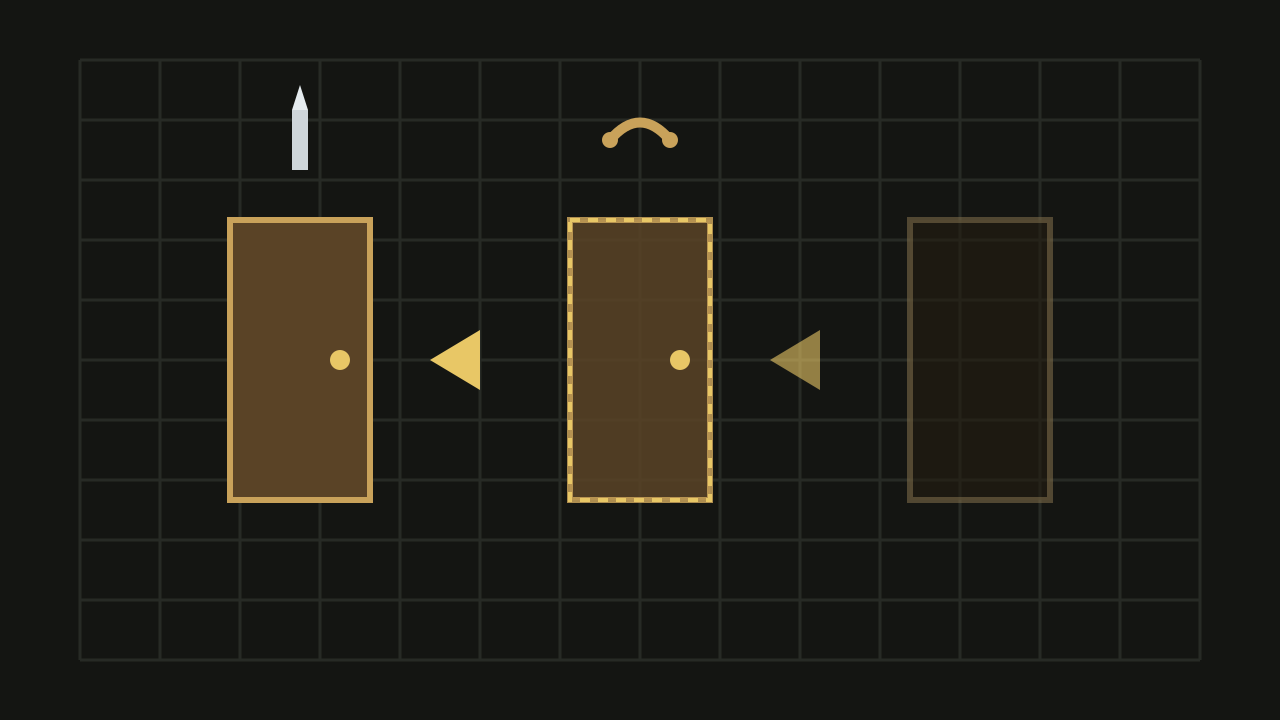 A door opened by a tool, labyrinths linked like a chain (illustration, AI-generated)
Lineage to the Present
The one-directional chain structure of 'obtain a treasure, and a path opens' connects, alongside Metroid, born from Nintendo the same year, to a lineage that would later crystallize into the genre name 'Metroidvania.' The idea that the range of exploration is defined by the abilities the player holds was already nearly complete at this point.
The thread to present-day exploration puzzles can be traced not by speculation but by the developers' own words. Andrew Shouldice, who made Tunic (2022), has said in multiple interviews that his childhood experience of playing the Famicom version of The Legend of Zelda (1986) without fully understanding the context of its manual is the very source of the feeling of 'a world full of discovery and mystery' at the core of his own work. A puzzle-adventure of the current era has redesigned the very bewilderment of an age when strategy information could not be obtained instantly; this is evidence that a single game from forty years ago is not merely an object of nostalgia but a textbook of design thinking that contemporary game designers still actively consult.
 A thread linking the treasure-lock design onward (illustration, AI-generated)
References
Sources referenced in this article:
・Wikipedia: The Legend of Zelda (video game)
・Wikipedia (Japanese): The Legend of Zelda
・MobyGames: The Legend of Zelda (1986)
・Zelda Dungeon: Tunic Creator Cites Zelda As An Influence In Recent Interview
Closing
What I take from this single 1986 game is the fact that the act of 'solving a puzzle' was not confined to the single genre we call puzzle games. The riddles of the labyrinth, the exploration of the field, the uses of tools, all of these dissolved into one shared grammar. The very boundary line called 'genre' was still loose in that era, and this game is a product of that looseness.
Forty years ago, the world of Hyrule rose up to the sound of a magnetic disk loading, and it can still be played on current hardware today. Tracing the marks left by the constraints of the era, limited capacity, and an information infrastructure of magazines and telephones, is a reliable historical record that reveals what today's exploration-based puzzle games have inherited, and what they have left behind.
 A dungeon door opening after the disk finishes loading (illustration, AI-generated)
Reactions (no login)
Anonymous • one of each per visitor per day
関連シリーズ
Retro Revisited第20回 / 全37回