REVIEW · 2022-04-07
Chinatown Detective Agency
Le détective qui enquête hors de l'écran — cybernoir à Singapour, 2037
First Impressions
Singapore, 2037. In a near-future where the global economy has nearly bottomed out, ex-INTERPOL officer Amira Darma opens a small detective agency — that is the hook of this cybernoir point-and-click, made by General Interactive Co. and released on April 7, 2022. I wrote this piece by reading the user reviews stacked up on Steam.
The store label is Mixed: 68% of 116 reviews are positive (2026-07-16 snapshot), nudging up to 74% of 110 among English reviews only. Metacritic sits at 66. Not high numbers. Yet across the helpful reviews on both sides, praise and complaint converge on one feature: the game makes you open a browser outside the game and look up real-world facts.
So the split here is not really about whether a feature works; it is about who it is for. The positive side calls this mechanic 'becoming a real detective'; the negative side calls it 'being handed homework.' That gap reads, to me, as a question of design radius.
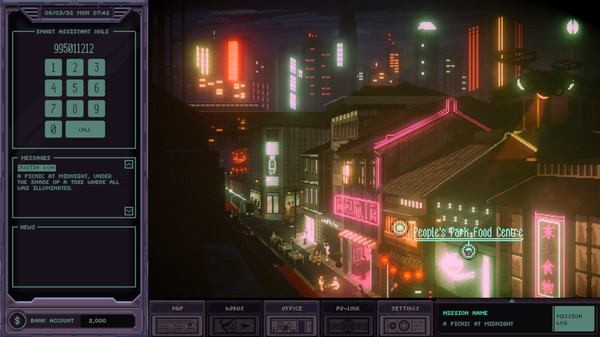 A rain-slick Singapore alley; the story opens in the near future of 2037 — Steam store
Putting the Mechanic into Words
What the helpful positive reviews return to is the concrete texture of the research: Googling Greek quotes, converting DMS coordinates, cracking substitution ciphers, reading up on Sumerian numerals and the Enigma machine. Their shared phrase is that this beats 'rubbing two inventory items together until they fit' — a vocabulary that praises the act of looking things up itself.
In design terms, the game externalizes the final step — clue to answer — from an in-game knowledge base to the real web. Most detective games tune observation resolution inside the frame; this one extends it outside, folding your real search skills into the resolution. It does openly, on the live web, what The Roottrees are Dead reproduced with a fake search engine.
The negative side dutifully records the side effect: search a clue and the top result is often a walkthrough with the answer pulled out in bold. Even positive reviewers advise appending '-chinatown' to searches. Fold the real web into your resolution and a second resolution — spoilers — flows in with it.
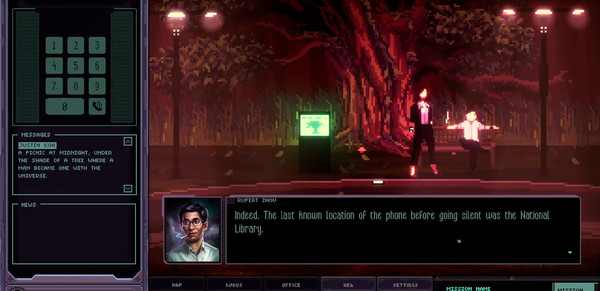 Faced with a clue, you end up opening a browser outside the game — Steam store
The World
On art and atmosphere, the two camps rarely disagree. Low-res pixel art, neon in rain-slick streets, cities from London to Cairo to Istanbul, day/evening/night variants, a multinational voice cast with Singaporean accents. A Singaporean reviewer proudly notes 'that's my station'; even negative reviewers open with 'the art and music are faultless' before listing grievances.
When a game divides opinion, I first look for the floor everyone stands on. Here it is the world. With the art and sound this stable, likes and dislikes about the mechanic can pile on top without collapsing the whole. The heat in the reviews is not about the mood — it is about what you are asked to do inside it.
Many single out the little info panels for each city — history and near-future lore — as worldbuilding, and the reading is dense. But it sits flush against the 'research,' which is part of why the line between admiring the world and doing chores gets blurry.
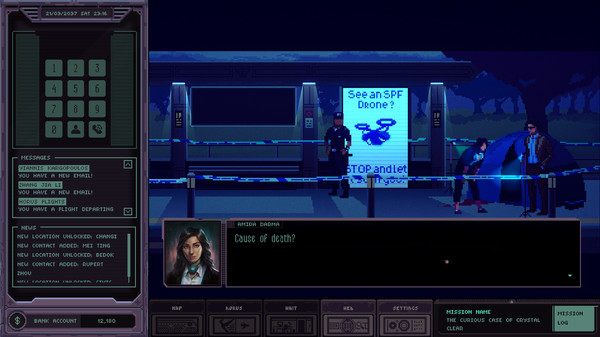 Pixel-art scenes that shift across day, dusk, and night per city — Steam store
The Texture of Difficulty
Nowhere does the game split more cleanly than on difficulty. One negative review sighs that 'every answer is one Google deep — I wanted a Wikipedia rabbit hole and got one layer.' Another complains the opposite: 'counting in cuneiform, brute-forcing five related languages — needlessly obtuse.' Too shallow and too deep share the same review page.
That is a learning curve outsourced to the player's real-world knowledge. When difficulty rests on 'do you happen to know Sumerian numerals' rather than on board logic, the feel spikes discontinuously from person to person. Instead of a consistent gradient, the designer used the ungraded terrain of the real world as the difficulty.
A third texture is the punishment for failure: miss a timed puzzle and you replay the whole case. If I sort difficulty into kinds — depth of real knowledge, how guessable the search is, and the cost of a redo — most complaints cluster on the third. Which leads straight into the design.
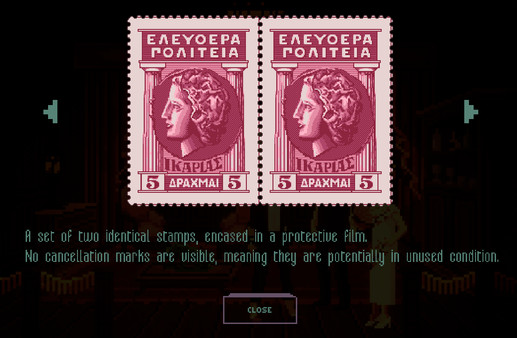 Ciphers and minigames — the texture of difficulty wavers case by case — Steam store
Design Craft
The most-upvoted negatives are not about puzzles or art; they are about three peripheral systems: saving, money, and time. 'No manual save — it only saves when a case ends' is the top helpful review from launch; one refunder quit after 40 minutes to find only 'New Game.' 'Money is so plentiful it is meaningless — I finished with $30k' and 'booking a flight and waiting is just dull' are staples.
In design terms, this is subtraction left half-done. The game boldly subtracts the in-game knowledge base and swaps in the real browser — I respect that nerve. But the old adventure scaffolding of money, time, flights, and rent was never subtracted. The central verb (search) is sharpened; the peripheral verbs (travel, wait, pay) stay dull, and the two sit side by side.
Saving is the clearest failure: it turns difficulty from a quality into wasted time. Return of the Obra Dinn could leave failed deduction unpunished because you could stop and resume anytime. Here, each failure re-stages steps you already know. Reviews from 2025-2026 repeat the same complaint — four years on, the hole is still a hole.
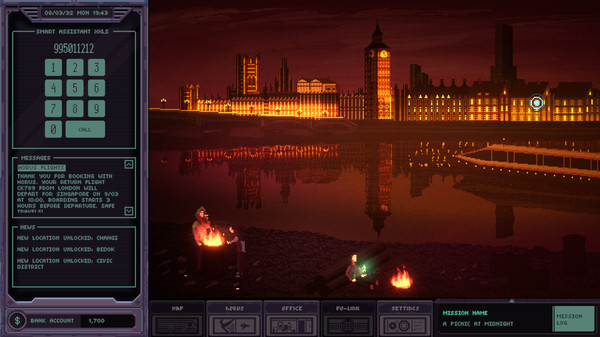 Global flights and the management of time and money form the peripheral systems — Steam store
Sources
This piece was written by reading the user reviews on the Steam store page as of 2026-07-16. No review text is quoted directly; typical claims are reconstructed.
- Steam: Chinatown Detective Agency (Mixed, 68% of 116 reviews positive; 74% of 110 among English reviews only)
- Read via WebFetch: the top 15 helpful positive reviews, the top 12 helpful negatives, and 8 recent reviews, tracking sentiment from launch (April 2022) to recent (2025-2026).
- Press: Metacritic 66, OpenCritic 'Fair' (~70, 35% recommend), plus reviews such as PC Gamer.
Closing
What is left after reading: Chinatown Detective Agency actually played a move that is hard to copy — externalizing the detective's final step onto the live web. On that one move, helpful reviewers on both sides agree it is new, whatever their verdict.
So the fit is clear. If going outside the frame to look things up is itself the fun — the Her Story kind of 'find it yourself' player — this is unlike anything else. If you want logic that closes inside the board, or the comfort of stopping anytime, the dull periphery and the punishment weigh heavily. The split is about which side of that radius you stand on.
Steam leans Mixed, and on the numbers alone it is hard to push hard. Still, I give it 7 out of 10 for the nerve of the design. The deductions land on execution — saving, bugs, un-subtracted peripheral verbs — not on the idea; which is another way of saying the central move is that strong. If the same studio ships 'make them research the real world' again, subtracted all the way to the edges, the score will jump.
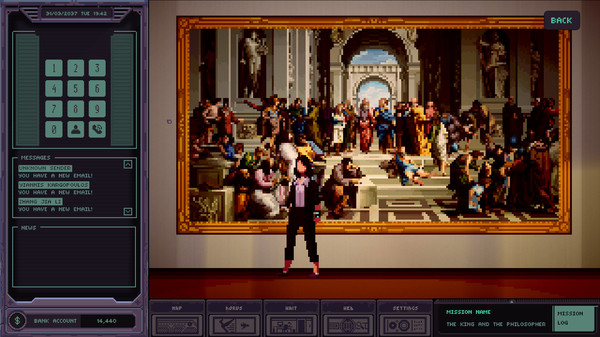 Detective Amira Darma's journey branches toward three endings — Steam store
Reactions (no login)
Anonymous • one of each per visitor per day
次に読む

関連レビュー
The Case of the Golden Idol
静止した犯行現場を観察して手がかりの言葉を集め、空欄を埋めて事件の真相を組み立てる推理ゲーム。18世紀を舞台にした連続する謎を解き明かす。
IMMORTALITY
消えた女優マリッサ・マルセルが遺した、公開されなかった3本の映画のフィルム。映像の中の顔やモノをクリックして別の場面へ『マッチカット』で飛び移り、断片をつなぎ合わせて彼女の失踪を追う実写(FMV)アドベンチャー。『Her Story』のサム・バーロウが、検索という動詞をテキストから視覚へと作り替えた一作。
Return to Monkey Island
1990年代に途切れた海賊コメディの続きを、シリーズ創始者 Ron Gilbert が30年ぶりに引き受けたポイント&クリックアドベンチャー。画面下の動詞メニューを捨てた一体型の操作と、答えを段階的に開く劇中のヒント本を備え、Guybrush Threepwood がふたたび「モンキー島の秘密」を追う。


