REVIEW · 2011-11-25
English Country Tune
Lecture du verdict partage d'un casse-tete abstrait et deliberement obscur
Introduction
Stephen Lavelle, better known as increpare, released this in 2011 as his first commercial puzzle game. You roll a single small cube edge-over-edge through an abstract 3D space of pale colour planes, across 17 worlds and more than a hundred levels. Each world introduces a differently behaving mechanic, and the later levels combine them.
I write this from the Steam review pool. The label is 'Very Positive,' 92% of 183 Steam-purchaser reviews. With the filter off, all 447 reviews break down to 361 positive and 86 negative (snapshot 2026-06-22). The number is high. But the character of this game lives in where those 86 negatives point.
One more fact to set down first: the store genre tag is 'Casual.' Yet the words the pool uses most are 'hard,' 'gave up,' or, on the other side, 'beautiful,' 'unforgettable.' There is a wide gap between the label the developer attached and what players actually felt, and that gap is what I want to read.
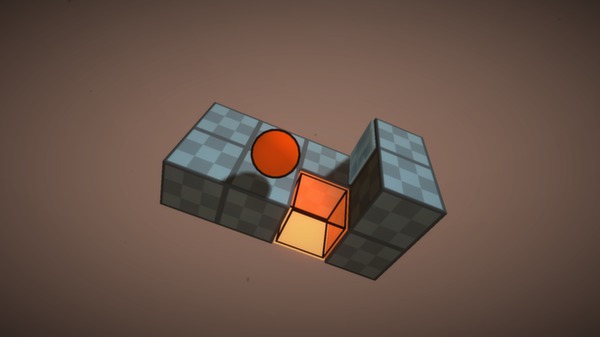 English Country Tune header art -- Steam store
First Impressions
The first thing the top helpful reviews say, almost in unison, is 'I had no idea what to do.' There is no real tutorial; the only control is rolling the cube edge-over-edge; almost no text states a goal. Positive and negative reviewers alike report stalling somewhere in the first few levels.
In my vocabulary, this is a design that deliberately hides the start of the learning curve. A normal puzzle teaches one verb per early level. This one hands you a single verb -- roll -- and withholds the rules. You have to raise your own observation resolution and reverse-engineer them. Positive reviews call this 'the joy of discovery'; negative ones call it 'unfriendly.' They point at the same thing.
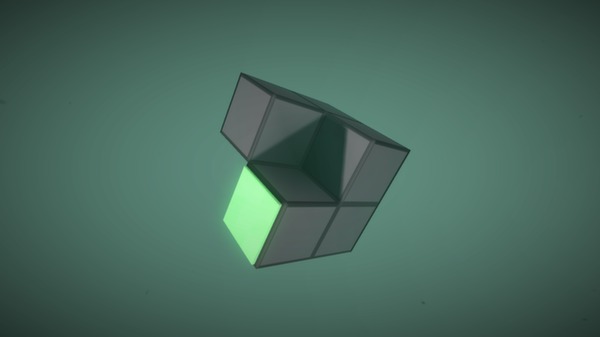 A view of English Country Tune -- Steam store
Putting the Mechanics into Words
What the pool agrees on is that 'the rules change with each world' and 'nothing moves the way it looks.' One world has you drawing lines, another ferrying larvae, another inverting gravity. Positive reviews praise this as 'never getting stale'; negative ones complain of 'no consistency, constant relearning.'
It is more accurate to read this not as adding verbs but as rewriting the grammar of a single verb -- roll -- world by world. The combinatorial explosion Puzzlebyrinth talks about usually comes from multiplying a few verbs. This game also widens the state space by swapping out the grammar itself. The 'relearning load' the negatives describe is the price that design pays.
Where Lavelle's later Stephen's Sausage Roll drills one verb to its limit, this game keeps replacing the grammar. It is kin to Baba Is You in the lineage of paring verbs down, but it is more unfriendly and more pure: it never verbalises the rules, it makes your body learn them.
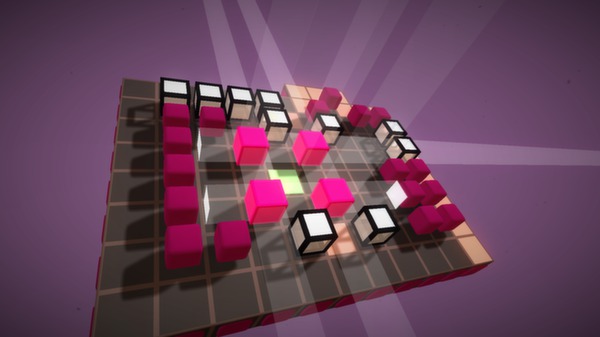 Mechanics that rewrite themselves per world -- Steam store
The Texture of Difficulty
Difficulty is where the verdict splits hardest. The negative template: 'I hit a wall, there are zero hints, and I couldn't go on'; 'unfair'; 'a waste of time.' The positive template: 'hard but never unfair'; 'the rush when it finally clicks is unforgettable'; 'the solution arrives just before sleep' -- close to PC Gamer's 85, where solutions come at night.
Collect the sticking points and the difficulty sorts into two kinds. One is being stuck because you haven't yet verbalised the rule -- a problem of observation resolution, and it turns to pleasure once solved. The other is being stuck because you know the rule but the move count is huge -- a problem of combinatorial explosion that drifts toward brute force and toward pain. Most of the negative complaints, I read, point at the second.
By withholding hints, the game maximises the first kind of pleasure. The price is that it offers nothing to rescue those who drop out at the second. That is not a flaw but a choice of range. Despite the store's 'Casual' tag, this is built for people who value solving it themselves.
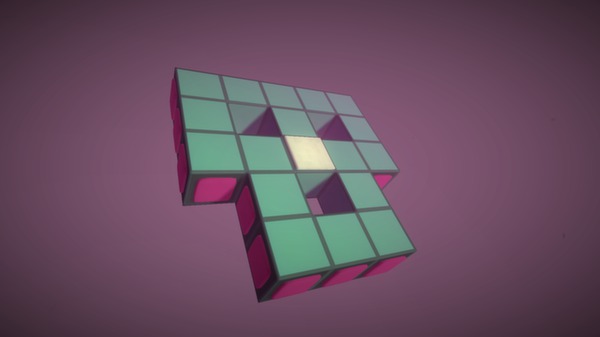 Pale colour planes and abstract geometry -- Steam store
Sources
This piece was written by reading the user reviews and aggregates on the Steam store page as of 2026-06-22. No review text is quoted directly; typical claims are reconstructed.
- Steam: English Country Tune (Very Positive, 92% of 183 purchaser reviews; all 447 reviews: 361 positive, 86 negative)
- Reviewed representative positive and negative claims by helpfulness, the recent trend, and the store genre/tags (Casual, Difficult, Abstract, Sokoban)
- Press: PC Gamer (85), Edge (7/10), TouchArcade ('boldly inflexible'), among others
Closing
Against the 92% of purchasers, my design-critic score is 8.5. The purity of the craft -- paring the verb down, refusing to verbalise the rules, making the player draw their own learning curve -- is remarkably high for a 2011 game. I dock it where the late difficulty tilts from the pleasure of observation toward the labour of combinatorial explosion. Steam's high rating and my score do not diverge much.
The pool splits not over quality but over expectation. It cuts deep for people who want to solve it unaided and stays cold to those who want to be guided. Anyone who saw Stephen's Sausage Roll through to the end will not regret meeting its source. Reviews and HowLongToBeat put completion around ten hours, though it swings widely with where you stall. A wilfully unfriendly, beautiful puzzle wearing a 'Casual' skin -- and the split itself tells you precisely who it is, and isn't, for.
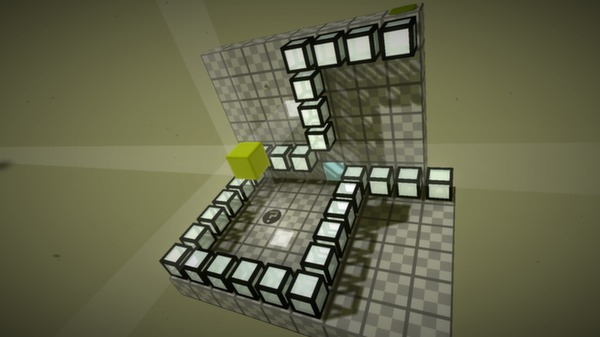 Rolling the cube through abstract space -- Steam store
Where are you with this game?
Press one and the game goes on your shelf. You can see it on your account page.
Reactions (no login)
Anonymous • one of each per visitor per day
Read next
Related reviews
Stephen's Sausage Roll
Faites griller une saucisse uniformément sur ses six faces. La difficulté en devient presque une plaisanterie.
SpaceChem
Un puzzle 2D de conception d'usine où l'on programme deux bras mécaniques (« waldos ») pour assembler des molécules de produits à partir de matières premières. Non pas « trouver » une solution, mais la « construire » — le point de départ des puzzles design-based de Zachtronics.
Tetrobot and Co.
Un puzzle de réflexion en grille où l'on dirige Psychobot, un minuscule robot réparateur, pour aspirer puis recracher des blocs et réparer l'intérieur d'un gigantesque robot en panne. Une œuvre de Swing Swing Submarine qui construit une cinquantaine de niveaux à partir des seules propriétés de trois matériaux — bois, sable, pierre — et de la règle selon laquelle seuls des matériaux identiques peuvent se coller entre eux.


