REVIEW · 2015-06-30
Infinifactory
SpaceChem en 3D — là où les avis Steam se divisent sur le dernier mur
Introduction
You play a human abducted by aliens, designing factories in first person from blocks and conveyors to assemble whatever your captors order. 'SpaceChem in 3D' is the developer's own line, and the first thing the review pool confirms. Made by Zachtronics, released 2015.
I write this from the Steam review pool. The label is 'Overwhelmingly Positive': 95% of 1,781 English reviews, and 2,348 of 2,472 across all languages (snapshot 2026-07-01). PC Gamer gave it 93. By the numbers, a unanimous classic — yet inside the pile there is a clear gradient.
That gradient depends less on quality than on which Zachtronics game you compare it to, and how far you mean to play. Praise for the opening and curses for the endgame live inside the same 95%.
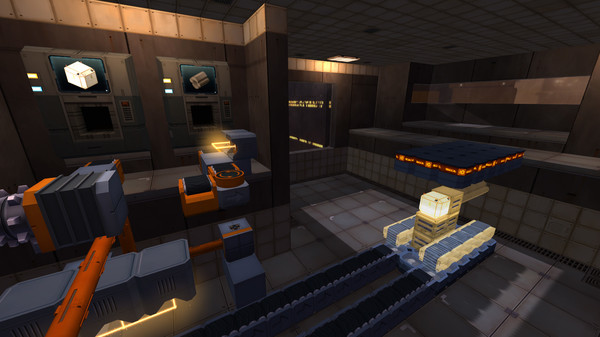 Assembling an ordered product in an alien factory — Steam store
First Impressions
Line up the helpful positives and the vocabulary rhymes: satisfying, earned, elegant, and 'it makes you feel like a talented designer.' Most cite watching a finished factory hum on its own, and cutting a 40-block solution down to four.
The negative side keeps returning to tedious, frustrating, a difficulty spike, and 'you can't set your own pace.' Notably, several reviewers who have played every Zachtronics game call this the hardest of the lot. The complaint is rarely 'boring' but 'it turns into something else late.'
What interests me is how often praise and complaint point at the same thing. One reviewer's 'meaty' endgame is another's 'unfair'; one's 'clean toolset' is another's 'too few blocks.' My job isn't to stage that fight but to translate where the verdicts fork into the language of design.
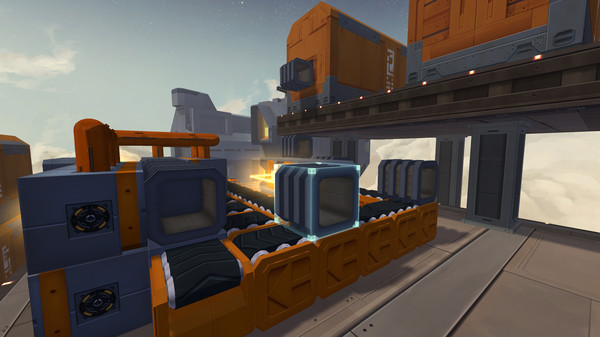 A finished factory humming on its own — the pleasure reviewers keep naming — Steam store
Putting the Mechanics into Words
What the positives praise most is how small the toolset is. Two verbs, really — conveyors that carry and sensors that push on a condition; some note this pair alone is Turing-complete. In Puzzlebyrinth's terms, the verbs are subtracted hard, and the grammar of arranging them becomes the puzzle.
But 3D makes the grammar denser than SpaceChem's. A third axis appears, and when an assembled product straddles rollers pointing different ways, a priority question arises. The 'undefined behaviour' and 'weird edge cases' the negatives cite are the cells of that grammar the game never prints.
And solutions never collapse to one. Clear a level and you land in histograms for cycles, blocks, and footprint. The happy groan of 'my friend's solution crushed mine' is a player choosing to peer into the combinatorial explosion — SpaceChem's histograms, back in 3D. See SpaceChem.
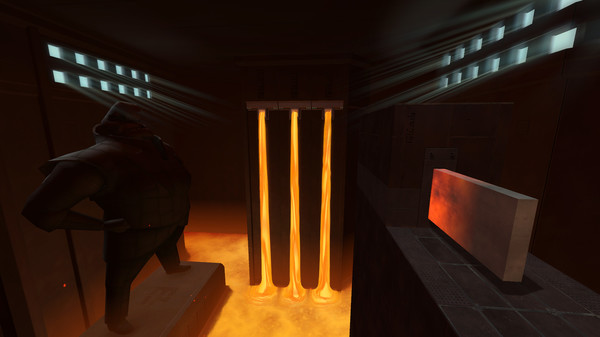 A production line built from conveyors and sensors — Steam store
Place in the Lineage
Nearly every review measures this against other Zachtronics games. For the positives, 'SpaceChem in 3D' is the highest praise; PC Gamer called it 'the most generous game Zachtronics has made,' opening SpaceChem's problem-solving to anyone who can place a block. I file it beside SpaceChem and Opus Magnum.
The negatives use the same ruler in reverse: play Opus Magnum or EXAPUNKS first and the block set feels thin; 'just play Factorio.' The argument isn't whether Zachtronics is good but which Zachtronics — itself a sign of how deep the lineage runs.
Placed in that line, its position is clear. Where SHENZHEN I/O went all-in on a language, this one went physical: a factory you build in first person. Same subtracted toolset, same histograms; what changed is which sense you optimise by — which is also why disappointment, when it comes, stays inside the family.
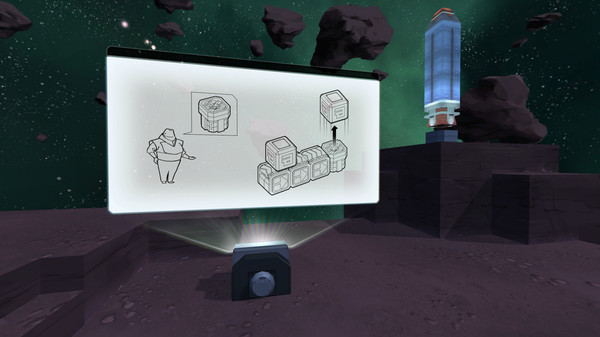 SpaceChem rebuilt in three-dimensional space — Steam store
The Texture of Difficulty
This is where opinion splits hardest, and it's about the kind of difficulty. Early and mid levels read as 'fair' and 'wide open' — the source of PC Gamer's 'most generous Zachtronics.' The trouble is the endgame: the final-chapter spike the negatives name in chorus.
Many point at one design: you can't fully set your own pace. Inputs arrive at a rate you don't wholly control, so you tune solutions to the machine's tempo. 'The endgame becomes busywork staggering the feed,' one writes. A second kind of time — waiting — is grafted onto calm logic.
To me it's a change of kind, not amount: the same spatial verbs, now demanding you sync to the machine's clock. The curve steps, late. And the first-person 3D makes some players ill — an observation-resolution problem; the reviews wishing for a top-down, Shapez-style view are pointing straight at it.
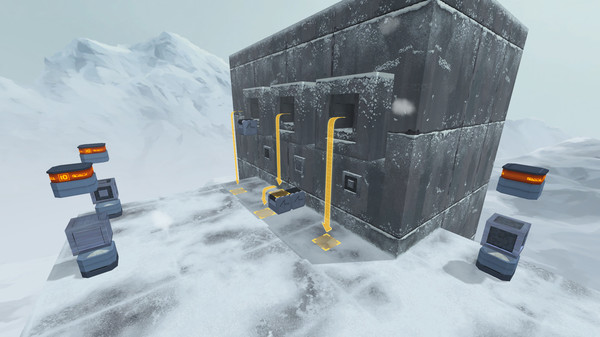 Late game: tuning a solution to the feed's tempo — Steam store
Sources
Written by reading the Steam user reviews on the store page as of 2026-07-01. No review text is quoted directly; typical claims are reconstructed.
- Steam: Infinifactory (Overwhelmingly Positive, 95% of 1,781 English reviews; 2,472 across all languages)
- Read via WebFetch: the top ~10 helpful positive, ~10 helpful negative, and several recent reviews
- Press: PC Gamer (93/100)
Closing
Steam reads 95% positive, PC Gamer 93; my design-critique score is 8.6. The two core verbs are clear and the histogram scaffolding is superb. It falls a step short of Opus Magnum's 9.0 because syncing to the feed's tempo late-game muddies an otherwise pure design.
The pool's verdict is plain: a wide door, a high wall. Reviews put the main campaign near 20 hours, with optimisation uncapped. For anyone with the patience to peer into the histograms, it's a strong recommendation; for those who get motion-sick without a top-down view, or who bristle at waiting on the feed, it's out of reach. Rarely is a game this clear about who it is for.
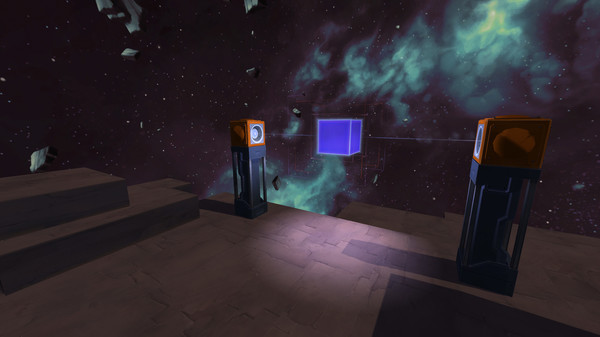 A later stage set against open space — Steam store
Where are you with this game?
Press one and the game goes on your shelf. You can see it on your account page.
Reactions (no login)
Anonymous • one of each per visitor per day
Read next
Related reviews
TIS-100
Un puzzle de programmation en assembleur : on ecrit du code sur une grille de minuscules noeuds paralleles pour reparer un ordinateur en panne. Chaque noeud ne dispose que de deux registres et d'une douzaine d'instructions, et l'echange de donnees entre noeuds peut provoquer un interblocage — sous ces contraintes, on rivalise sur les cycles, les instructions et le nombre de noeuds. Signe Zachtronics, createurs de SpaceChem et Opus Magnum.
SHENZHEN I/O
Un puzzle de programmation où vous incarnez un ingénieur d'une entreprise fictive de Shenzhen, écrivant un assembleur concis pour des microcontrôleurs étriqués et câblant des circuits sur une carte pour fabriquer des produits. Zachtronics ne propose aucun tutoriel : son manuel de plus de 30 pages est la première énigme.
Opus Magnum
Un puzzle en 2D où, dans l'atelier d'un alchimiste, on combine des bras rotatifs et télescopiques avec des rails pour transporter et lier des atomes, produisant automatiquement potions et métaux. Le plateau et le nombre de pièces sont illimités ; la vraie compétition commence après la résolution, autour de la question « comment construire avec le plus d'élégance, de rapidité et de compacité ? » — l'œuvre phare de Zachtronics.


