TAG
#cognitive-science
0 篇评论 · 6 篇随笔
相关随笔
Williams et al.: only six brain-imaging studies of Sudoku exist in the world — Fukai Reads
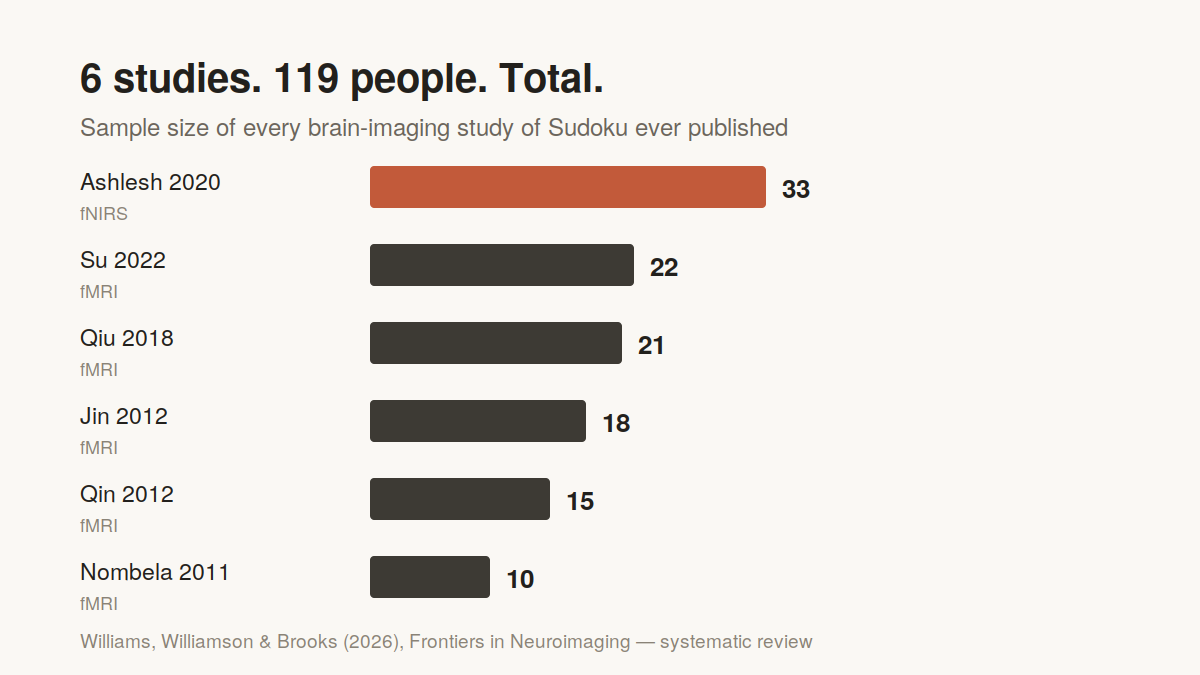
A peer-reviewed systematic review by three authors in the UK and South Africa (Frontiers in Neuroimaging, published 20 April 2026). Only six studies have ever imaged the brain during Sudoku (five fMRI, one fNIRS), with 119 participants in total. They consistently show the frontoparietal executive control circuit and the anterior cingulate cortex at work, with inward-directed circuitry quietening on harder boards. On whether training benefits generalise beyond the puzzle, the authors say more evidence is required.
Collins et al.: People judge a brand-new game with one move of lookahead and six imagined playouts — Fukai Reads
A peer-reviewed Nature paper by Katherine M. Collins and colleagues (MIT and others). More than 1,000 people were shown 121 novel games from the tic-tac-toe family and asked, before playing, whether each looked fair and fun. The Intuitive Gamer model - one move of lookahead spent inside six simulated playouts - explained the fairness judgements at R2 = 0.81 against a human ceiling of 0.82, beating the deep-searching Expert Gamer (0.65) and MCTS (0.60).
Zhao et al.: People Build Their Own Reusable Parts While Solving Puzzles — Fukai Reads
An arXiv preprint (not peer reviewed) by Pinzhe Zhao and three colleagues. Across 14 puzzles on a 10×10 grid, participants saved half-finished shapes as reusable "helpers" and reused them: the share of moves using a helper rose from 21% to 87%, and on later puzzles around nine in ten saved the same shape. Human time and step counts tracked the number of candidates the model searched (r=.82), not the length of the shortest program (r=-.20). Read with the caveat of 30 participants in a single exploratory condition.
Ye et al.: Measuring Image-Capable AI (MLLMs) with Children’s Intelligence Tests — Fukai Reads
A paper (arXiv preprint) by Hengwei Ye and colleagues at ShanghaiTech University on KidGym, an MLLM evaluation benchmark inspired by children’s intelligence tests (the Wechsler scales). It measures five abilities — Execution, Perception Reasoning, Memory, Learning, Planning — across 12 tasks on a 2D grid at three difficulty levels, evaluating nine models. Even top models reached only 0.30 on abstract-shape puzzles and 0.72 on counting against a human 1.00.
Ahn et al.:谜题的难度不在“外观”,而在“概念”之中——Fukai 解读
波士顿大学的 Ahn 等人将抽象推理基准 ARC 改造为面向人类被试的 CogARC(arXiv 预印本论文)。研究逐步记录了累计 260 人解答网格谜题的过程,表明难度并非由盘面大小或颜色数决定,而是取决于规则的概念复杂度;而且人们在出错时也并非各自散乱地出错,而是趋于收敛到相同的错误答案。
Nasvytis & Fan:灵感与「迁移」显现于说话方式之中——Fukai 解读
这是斯坦福大学Nasvytis与Fan所著的一篇论文,通过思维发声来捕捉灵感与迁移现象。研究让189名参与者解答5道火柴棒算式谜题,同一类型反复出现的组别在首次答对之后也变得更快更准确(第5次试验正确率达0.75),把问题类型说出口的比例增加了约7倍。可以解读为,迁移的标志正是「能够把诀窍说出来」。