TAG
#pcg
0 篇评论 · 16 篇随笔
相关随笔
Baek et al.: Ordering a Level That Is 75% Zelda and 25% Mario, in Plain Words — Fukai Reads
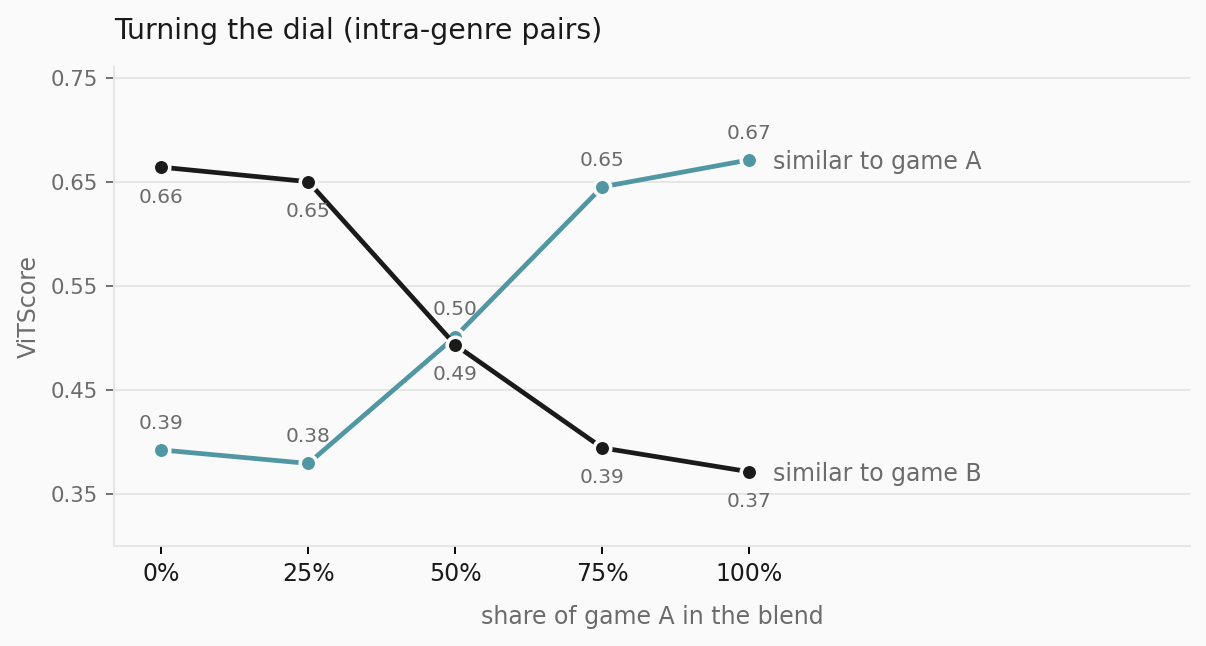
A paper by In-Chang Baek and four co-authors at GIST and Dongguk University (arXiv:2603.26782, an un-peer-reviewed preprint). They put 5,576 levels from Zelda, Dungeon, Lode Runner and Super Mario Bros into a single latent space so that levels can be blended across games using text and a mixing ratio. Sharing one model instead of four costs about 4.4% in overall similarity, and turning the ratio dial swaps similarity between the two source games as intended. Blending through a single written instruction, however, remains weak.
Siper et al.: Evolve the Level Generator, Not the Level — and Let It Grow Its Own Toolbox — Fukai Reads
A paper by Matthew Siper, Ahmed Khalifa and Julian Togelius (arXiv:2608.17947, accepted at IEEE Conference on Games 2026). Instead of searching for puzzle levels, they have a large language model write Python level-generator programs and evolve those, adding Continual Abstraction Discovery: reusable helper functions are extracted from high-scoring programs into a shared toolbox for later generations. Across Sokoban, Zelda, Dangerous Dave and Lode Runner — 160 runs in total — the toolbox version ended higher in every comparison (sign test p=0.008).
Xu与Verbrugge:把"重力方向"与"时间"变成关卡生成的坐标轴 — Fukai解读
麦吉尔大学的Kaijie Xu与Clark Verbrugge发表于FDG 2026、通过同行评审的论文。关卡自动生成一直以来都是先做好地形,再对重力反转、移动脚手架之类的机关做事后检验。这篇论文把机关本身升格为坐标轴,提出在(x, y)基础上加入"层"与"时刻"的大型图上寻路的HDPCG。切换间隔的误差降到了0.000~0.002,迂回路径的存留率是无引导基线的9~10倍。
Pfau & Vrettis:让玩家做出专属自己的宝可梦卡牌会怎样——Fukai 解读
由 Johannes Pfau 与 Panagiotis Vrettis(乌得勒支大学)撰写的 arXiv 预印本(尚未经过同行评审)。玩家写下名字和设定后,系统通过检索、文本模型与图像模型,在约20秒内生成一张宝可梦风格的卡牌;研究让49名学生共制作了196张卡牌。外观满意度在5分制中为4.25分,技能与数值的贴合度为4.04分。93.5%的人回答「这是我自己的想法」。不过,生成的卡牌至今尚未投入过任何对战,平衡性尚未经过验证。
Bazzaz and Cooper: Comparing Generative AI to PCG Across 500,000 Steam Reviews — Fukai Reads
A paper by Bazzaz and Cooper at Northeastern analysing 508,192 Steam reviews. Comparing 5,970 titles that disclose generative-AI use against 5,186 titles that use PCG, the recommend rate is 86.3% for PCG versus 68.4% for generative AI — a 17.9-point gap — and generative-AI reviews split almost evenly at 53.0% positive to 47.0% negative. A thematic analysis of 600 reviews raises five themes: signals of low developer investment, ideological rejection, conditional acceptance, mismatch between disclosure and evidence, and criticism of not using AI where it should be. arXiv:2608.11539, ACM DOI 10.1145/3831347 assigned.
Chen: Reconstruct the Persistent World First, Then Build Something Playable — Fukai Reads
A narrative-to-game paper by Yi-Chun Chen. Before generating scenes or gameplay individually, it makes explicit reconstruction of a persistent world — entities, locations, relationships, evolving state — the central objective, maintained as one computational object shared across the pipeline. The prototype builds the world with GPT-5-mini plus constrained world completion and realises it as playable tile-based PyGame environments. An arXiv preprint offering qualitative feasibility across three cases, with no quantitative evaluation.
Huang et al.: Letting an AI Play the Generated Game, Then Fix It — Fukai Reads
A game-generation paper by Yixu Huang and colleagues (Fudan University, Xiaohongshu and others). Play2Code puts a screen-driving GUI agent into the generation loop as a playtester, evaluated on PlaytestArena, a new environment of 200 tasks and 1,548 rubric criteria. Averaged over three backbones, rubric pass-rate goes from 29.7% for single-pass generation and 52.2% for a code-inspection-only pipeline to 66.8%.
Wu et al.: Rebuilding a Case Report Into a Chain of Decisions — Fukai Reads
A medical-education gamification paper by Qian Wu and colleagues (CUHK and others). MedGame is a dual-engine framework that converts static case reports into a three-level Act / Scene / Decision Node script and then into a dependency graph of multimodal generation tasks. Fine-tuning on a 5,000-case benchmark lifts structural validity from 79.4% to 99.1%, while medical accuracy plateaus around 7 out of 10.
Ponnock & Ho: The Order of Mario 1-1 Has a Measurable Teaching Effect — Fukai Reads
A reinforcement learning and level design paper by Jesse Ponnock and Lucas Ho (arXiv preprint, not peer-reviewed). Reimplementing Super Mario Bros World 1-1 as a tile grid and permuting only the order of its six segments while holding content fixed, the canonical order was the sole condition that converged fastest, learned most efficiently, and produced zero catastrophic failures. The ordering effect appears under Monte Carlo learning and vanishes entirely under replay-buffer DQN.
Li et al.: Rereading Video World Models as Game Engines — the Unsolved Problem Called State — Fukai Reads
A survey of interactive world models by Zhen Li and colleagues. It reorganizes research on generating game worlds with video models along four dimensions drawn from the engine's action-state-observation loop, and argues that the remaining hard problems all revolve around explicit game state. It also contributes a 90+ hour Black Myth: Wukong dataset.
Li et al.: Making Geometry Problem Solving Verifiable with a Solver as Referee — Fukai Reads
An arXiv preprint by Can Li et al. on geometry problem solving (GPS). Their SD-GPS translates diagram-and-text problems into a form a symbolic solver can execute, and at impasses proposes helper lemmas verified by the solver itself. The abstract reports it consistently outperforms existing methods on Geometry3K and PGPS9K. Fukai reads it for its use in solvability-guaranteed puzzle generation.
Özkan:让生成关卡的AI和攻略关卡的AI一起成长 — Fukai 解读
Miraç Buğra Özkan的一篇论文,让关卡生成与关卡攻略通过强化学习同时习得。在Unity中让蜂鸟(攻略方)与浮岛(生成方)一边观察彼此的成绩一边学习,在100种未知布局上达到约90.2%的攻略成功率。
Bazzaz 等人:「只是认为是 AI 制作」就会改变体验——Fukai 精读
Bazzaz 与 Cooper 的 CHI '26 论文,探讨生成内容的知觉偏见。让 142 人在 Super Mario Bros. 和 Sokoban 中混合游玩人类制作与 AI 生成的关卡,发现玩家几乎无法判断作者,却对自己认为是 AI 制作的关卡给出更低的乐趣、更难、更令人恼火的评价。
Jara Gonzalez & Guzdial: Generating Enemy Shapes as Gates You Need a Mechanic to Beat — Fukai Reads
A paper by Jara Gonzalez and Guzdial on generating enemy morphologies (collision shapes). They frame 'enemies defeatable only with a specific mechanic' as a 4x4 grid generation problem, compare reinforcement learning, A* search, and neural generation, and find a simple A* reachability rule yields the best gating and most diverse shapes at the lowest cost.
Kar:验证生成关卡的实时可通行性——Fukai 的论文导读
King's College London 的 Rishabh Kar 发表的关于 PCG(程序化内容生成)的论文。提出 Momentum 系统——在不暂停游戏的前提下,于同一游戏循环中实时验证生成关卡的可通行性。两个自主智能体在玩家前方行进,分别通过空中几何检测和地面 NavMesh 检测提前勘察路径。评估结果以从代码推导出的结构性估算呈现。
Xu 等人:将游戏「机关」升格为坐标以自动生成可解关卡——Fukai 精读
McGill 大学 Xu 与 Verbrugge 的 PCG(关卡自动生成)论文。针对传统以地形为先的方法,提出将重力反转、移动地板等「机关」升格为坐标之一的维度扩展图上进行路径搜索、在生成过程中保证可解性的 HDPCG。并在 Unity 上实际再现了可游玩的关卡。