TAG
#player-modeling
0 篇评论 · 11 篇随笔
相关随笔
Guo et al.: humans drifted off the greedy move within about ten games; self-evolving AI did not — Fukai Reads
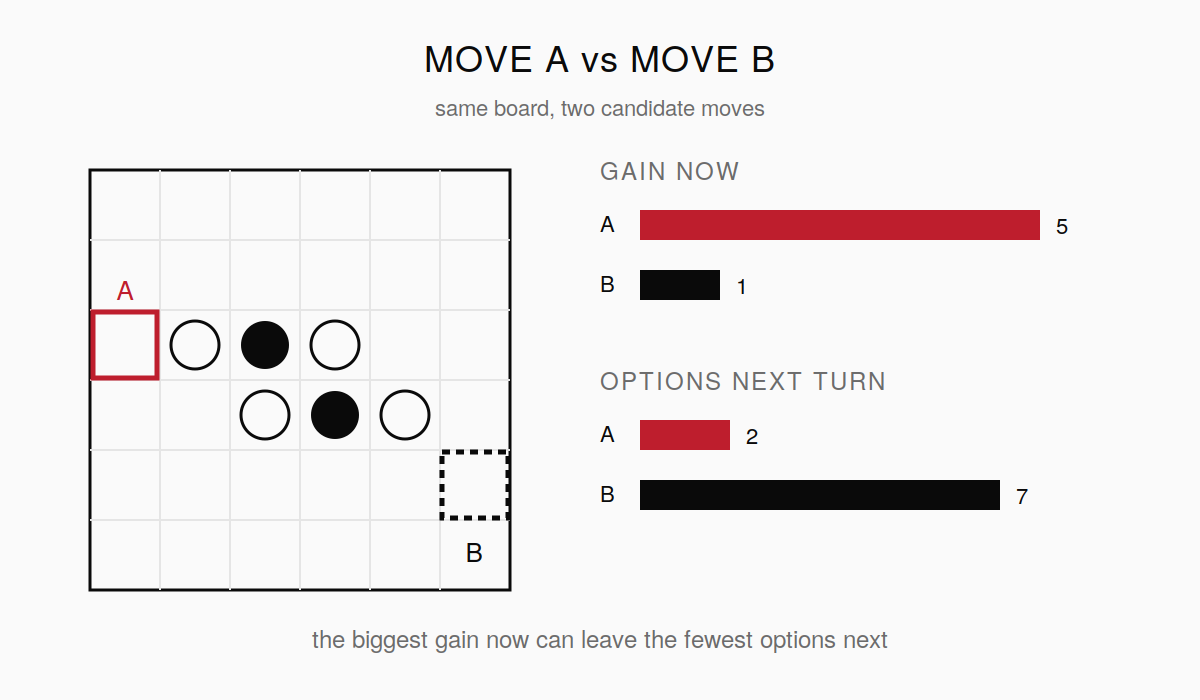
A preprint by Yingying Guo and four co-authors (arXiv:2608.07490, not peer-reviewed). They propose a way to measure how repeated play changes the way humans and language agents choose moves. Thirty-two students played 709 games across three board games, and four self-evolving language agents were run through the same metric space. Humans mostly shifted from the locally greedy move toward more global play: on the game-specific behavioral metrics, 11 of 12, 10 of 11 and 8 of 9 participants improved. The agents' gains were short-lived. The authors write that the central limitation is not the absence of reflection but the failure to convert reflection into reusable changes in behavior.
Melo Legarda et al.: Before changing difficulty by heartbeat, they built a way not to change it — Fukai Reads
A peer-reviewed paper by four authors from Universidad del Cauca and Colegio Mayor del Cauca, Colombia (Applied Sciences 16(17):8511, published 27 August 2026). They built a mechanism that adjusts game difficulty from a chest-strap heart sensor and logged eight sessions totalling 6 hours 48 minutes. Mean end-to-end latency was 2.06 s. The striking number: against 191 committed state transitions there were 83 flips the automaton withheld — nearly a third of the change-or-hold decisions land on “do not change”. No subjective data was collected, and the authors never claim the game became more enjoyable.
Tudor et al.: The scoreboard was one query away, and the agent never opened it — Fukai Reads
An arXiv preprint (submitted 2 September 2026) by seven authors from Oxford and elsewhere. They wired 76 tool endpoints into Sid Meier's Civilization VI and had language-model agents play whole games of 300+ turns. Agents queried victory progress only once every 30-75 turns (the supplied playbook recommended every 20), and in 7 of 20 losses that were foreseeable they never checked it in the final 20 turns. Commitments the agents wrote down for themselves were carried out within ten turns only 48.2%-65.8% of the time.
Elshamy et al.: Read the player's skill, then redraw the level itself — Fukai Reads
A Scientific Reports paper from Elshamy and colleagues at E-JUST on inferring player skill and rewriting the terrain of the level itself. Where conventional dynamic difficulty adjustment tunes enemy health and item drops, this pipeline rearranges floors, gaps and enemies in place. Skill classification reached 97.82% accuracy; 74.1% of rewritten levels remained completable.
Collins et al.: People judge a brand-new game with one move of lookahead and six imagined playouts — Fukai Reads
A peer-reviewed Nature paper by Katherine M. Collins and colleagues (MIT and others). More than 1,000 people were shown 121 novel games from the tic-tac-toe family and asked, before playing, whether each looked fair and fun. The Intuitive Gamer model - one move of lookahead spent inside six simulated playouts - explained the fairness judgements at R2 = 0.81 against a human ceiling of 0.82, beating the deep-searching Expert Gamer (0.65) and MCTS (0.60).
Tarun Kumar S: What Happens When You Tell a Human-Move Predictor the Last 20 Moves and the Clock — Fukai Reads
A paper by Tarun Kumar S of Peargent Labs on Otter, a chess AI that predicts human moves. Where earlier models treated each position independently, Otter conditions on the last 20 moves and on remaining clock time, reaching 55.23% top-1 accuracy with 15.3M parameters — 1.98 points above Maia 2. Of the +7.62 point gain over a board-only baseline, history contributes +5.24 and the clock +2.38. An arXiv preprint posted 5 August 2026, not yet peer reviewed.
Gould & Ward et al.:用「人类所需时间」衡量谜题难度——Fukai 解读
这是一篇由 Gould 与 Ward 等人撰写的 AI 评估论文。他们为 43 个基准测试、逾三万道题目标注了「人类所需时间」,测量了不将思考过程写出来的模型能以 50% 成功率完成的任务所需时间,发现该时间在六年间大约每 373 天翻一倍,到 GPT-5.5 已达约 3 分钟。其中涉及数独与填字游戏的难度计量方法,可以直接搬到谜题设计上使用。
Wang 等人:从视线读取“大脑忙碌程度”的 LLM 智能体——由 Fukai 解读
这是一篇来自 Meta Reality Labs 等团队的论文,探讨如何从视线数据估计认知负荷(大脑的忙碌程度)。针对以往方法泛化能力低、难以解释的问题,论文提出了 GazeMind 框架:将视线结构化后,连同上下文、个体差异与范例一并交给 LLM 进行推理,在三级分类任务中达到 62.73% 的准确率(比现有方法高出20个百分点以上)。
Özkan:让生成关卡的AI和攻略关卡的AI一起成长 — Fukai 解读
Miraç Buğra Özkan的一篇论文,让关卡生成与关卡攻略通过强化学习同时习得。在Unity中让蜂鸟(攻略方)与浮岛(生成方)一边观察彼此的成绩一边学习,在100种未知布局上达到约90.2%的攻略成功率。
Feng et al.:LLM 智能体能在交易游戏中智慧地讨价还价吗——Fukai 阅读笔记
清华大学团队的论文,关于在合作兼竞争的交易游戏中评估 LLM 智能体的基准 SidConArena。以桌游 Sidereal Confluence 为题材,在谈判、生产、封印竞价三个阶段进行评估,报告前沿模型表现较强,但仍存在资源价值误判、被动谈判、长期投资规划薄弱等问题。
McConnell & Zhao:用遗传算法实时生成「恰到好处」难度谜题 — Fukai 的读书笔记
McConnell 与 Zhao 关于使用遗传算法进行自适应谜题生成的论文。将类似 Cosmic Express 的路径谜题,根据记录玩家解题方式的玩家模型,以每题约7秒的速度实时生成,并在18人实验中证明「仅依赖时间指标」的版本在体感难度与进度感方面逊色于其他版本。