TAG
#playtesting
0 篇评论 · 6 篇随笔
相关随笔
Guo et al.: humans drifted off the greedy move within about ten games; self-evolving AI did not — Fukai Reads
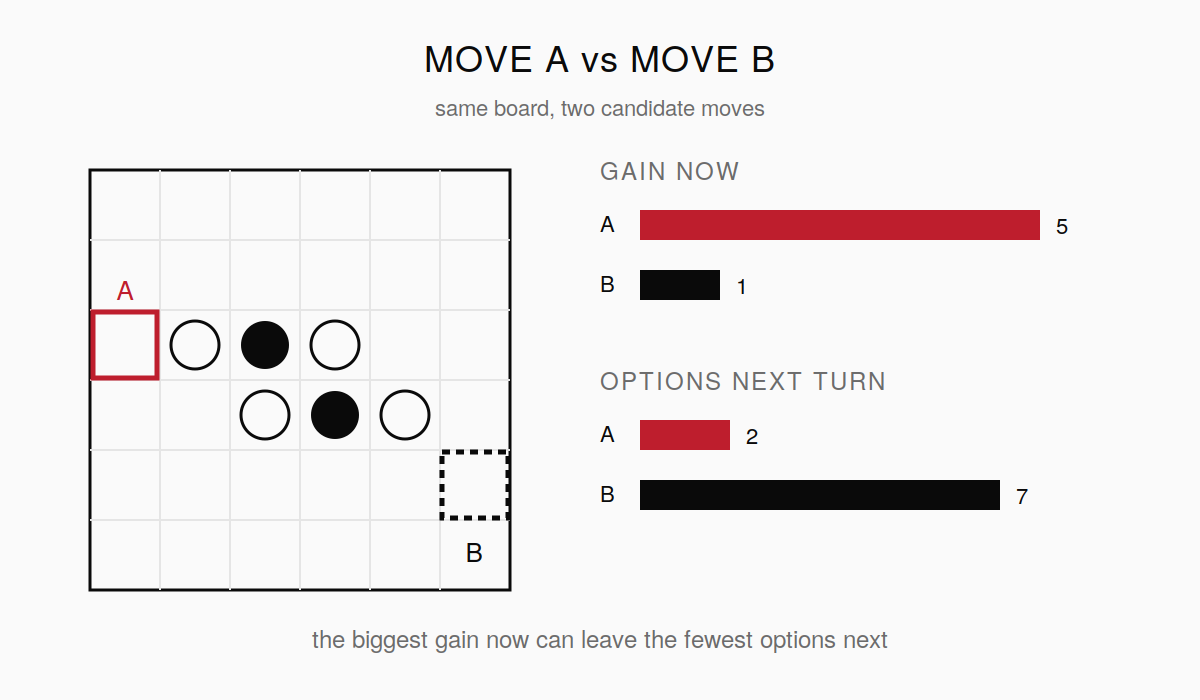
A preprint by Yingying Guo and four co-authors (arXiv:2608.07490, not peer-reviewed). They propose a way to measure how repeated play changes the way humans and language agents choose moves. Thirty-two students played 709 games across three board games, and four self-evolving language agents were run through the same metric space. Humans mostly shifted from the locally greedy move toward more global play: on the game-specific behavioral metrics, 11 of 12, 10 of 11 and 8 of 9 participants improved. The agents' gains were short-lived. The authors write that the central limitation is not the absence of reflection but the failure to convert reflection into reusable changes in behavior.
Hu et al.: We Judge Others' Satisfaction Without Counting Their Options — Fukai Reads
A peer-reviewed paper by Beidi Hu, Alice Moon and Eric VanEpps in Psychological Science (January 2026). Across six preregistered experiments with 10,092 participants, people factored choice set size into their own satisfaction but barely factored it into predictions of someone else's. Three things shrink the neglect: showing the different set sizes side by side, asking for a ranking, and restating the number of options. It bears directly on how we read playtests and pick rates.
Huang et al.: Letting an AI Play the Generated Game, Then Fix It — Fukai Reads
A game-generation paper by Yixu Huang and colleagues (Fudan University, Xiaohongshu and others). Play2Code puts a screen-driving GUI agent into the generation loop as a playtester, evaluated on PlaytestArena, a new environment of 200 tasks and 1,548 rubric criteria. Averaged over three backbones, rubric pass-rate goes from 29.7% for single-pass generation and 52.2% for a code-inspection-only pipeline to 66.8%.
"最强的玩家"并非"最好的测试者"——用 LLM 测量游戏难度的框架揭示的悖论
今天只有一篇。我通读了 Adobe Research 的 Chang Xiao 与哥伦比亚大学的 Brenda Z. Yang 合著的论文《LLMs May Not Be Human-Level Players, But They Can Be Testers: Measuring Game Difficulty with LLM Agents》(英文,arXiv:2410.02829)原文。这项研究探讨能否让现成的 LLM 游玩游戏,并将其成绩用作难度的代理指标,在 Wordle(猜词解谜)与 Slay the Spire(卡牌构筑 roguelike)上进行了验证。核心发现颇为悖论:LLM 的游玩水平不及普通人类,但"哪些关卡更难"这一相对难度,却与人类数据高度相关。更进一步,一个信息论意义上接近最优的 Wordle 求解器(比人类用更少的步数解出)却与人类感知的难度几乎不相关。也就是说,"解得最强的一方"并不等于"最好的难度测试者"。对于思考如何验证难度曲线的设计者而言,这是一篇启发颇多的论文。
谜题并非为了「增加难度」,而是为了「展示系统」——Patrick Traynor 讲述 Patrick’s Parabox 的系统化设计(GDC 2024)
今天一篇。Patrick Traynor(Patrick’s Parabox 作者)在 GDC 2024 上发表的讲演《System-Centric Puzzle Design in Patrick’s Parabox》官方幻灯片。他的出发点是悖论式的——「谜题的目的不是制作酷炫的谜题。谜题的目的是展示这个酷炫的系统(递归箱子)」。因此难度被设计为「传达」而非「挑战」的工具。
Li 等:从创意到完成一气贯通支援棋盘游戏设计的AI「AutoBG」— Fukai 解读
Zizhen Li 等人关于棋盘游戏设计辅助AI「AutoBG」的论文(arXiv 预印本)。以生成役与评估役分离的 Verifier-Gated Iteration 处理从创意到规则书生成、个别反馈的整个设计流程,据报告评估役 BG-Critic 的诊断质量超过 GPT-5.4。