RETRO-REVIEW · 2026-08-16
A Dark Room (2013) — The Single Fire Lit in a Room Made Only of Words
How a quiet browser experiment climbed to the top of the paid App Store charts
Introduction — The Fire Lit in a Room Made Only of Words
On June 10, 2013, a modest link appeared on a browser-game forum. Opening it showed no image, no sound — just a single line of text, "You are in a dark room. There's a fire in front of you," and a single button: Light Fire. That was the entirety of A Dark Room. Its creator, Michael Townsend, released it as a personal experiment written in nothing but HTML and JavaScript.
I have spent many essays digging up retro titles whose form was dictated by hardware limits. This game's constraint wasn't technical, though — it was a line the author drew himself. What happens when you decide to tell a story using only words and choices? I read this as a bet placed once again, this time on a 2013 browser, on the same trust in the reader's imagination that 1980s text adventures once relied on.
That fire would go on to draw in a "strange man" sent out to gather wood, unlock traps, raise a village, and finally assemble an iron ship that launches into the night sky. And the fire itself would travel further still — out of the browser, through the hands of a stranger, all the way to the top of the paid App Store. This piece follows that path.
 A single fire lit in the darkness (illustration, AI-generated)
The Context — A 2013 Summer of Text-Only Browser Games
In April 2013, a 19-year-old French student known as "aniwey" released Candy Box!, an ASCII-art, text-only looting game that drew hundreds of thousands of players. That August, Cookie Clicker arrived, calling itself a "non-game" while becoming a worldwide craze. A Dark Room, released June 10, sits squarely between those two enormous waves — a short season in which text-and-number games with no graphics repeatedly captured the browser-going public's attention.
Townsend is said to have started writing this game with the endlessly-accumulating resource loop of Candy Box! in mind. But he didn't let it end at the pleasure of stockpiling. At a certain point in the story, the protagonist the player has been protecting turns out to be a stranded visitor from another world, and the setting flips from a ruined Earth to a spacecraft. Combining the pleasure of accumulation with a hidden narrative reveal is what set this game apart from its contemporaries in the genre.
In July 2013, Townsend released the game's source code under the MPL 2.0 license. "I want people to learn from them, or use them to build their own things," he said. Placing an anonymous individual's code somewhere anyone could freely read it is exactly the posture that would later draw in a stranger.
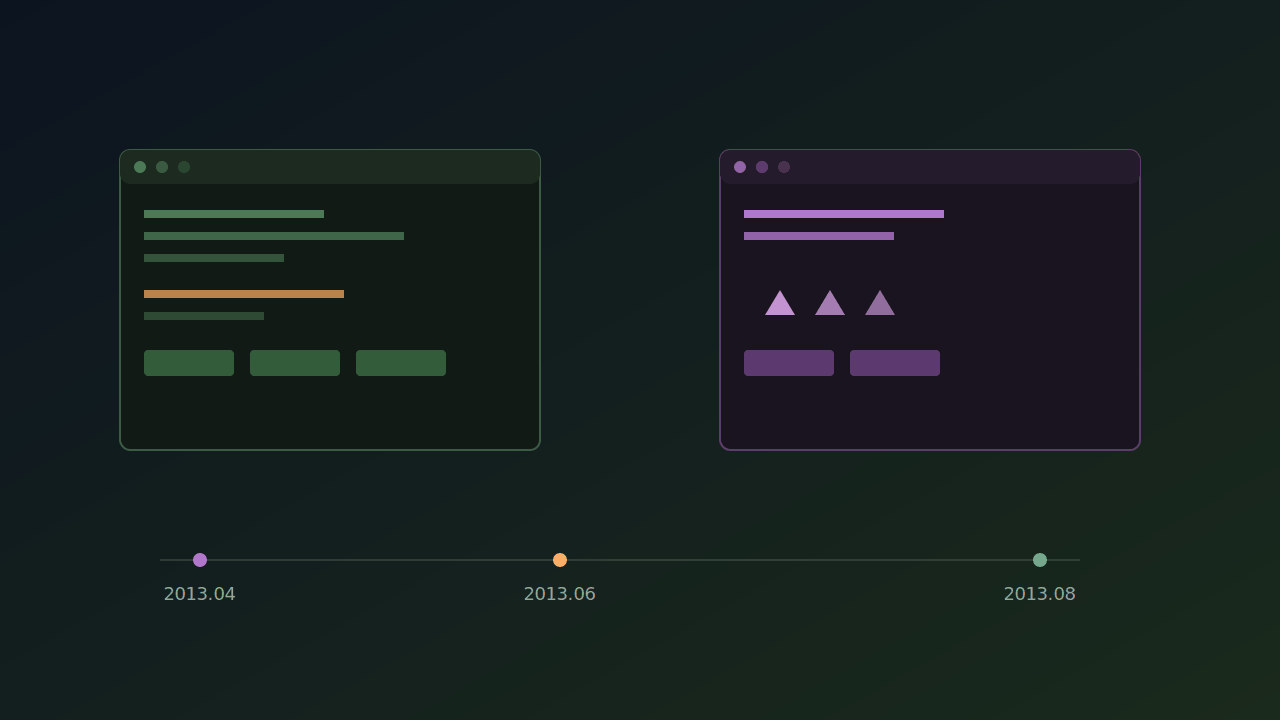 Text-only games that arrived one after another in 2013 (illustration, AI-generated)
Mechanics — Verbs Unlocked One Line at a Time
From start to finish, the screen consists of nothing but link-like buttons and a scrolling log. At first, the only thing you can do is light the fire. Keep it burning, and a "strange man" eventually appears to help gather wood; the ability to build traps unlocks next, then furs, a village, more villagers, and eventually scouts sent out into the wider world — a design where new abilities appear one at a time, strictly in sequence.
Amir Rajan, who ported the game to iOS, described the design this way: "Only using words is a wonderful constraint. I wish more creators would place emphasis on content." He also described how the game withholds information: it "lets the player form a world in the mind's eye, and right when the player thinks they've got it all figured out, the game throws them a curveball." With no images on screen, players have no choice but to picture what lies outside the dark room using imagination alone — and that very absence is what drives the immersion.
In late 2013, Rajan took over the browser version's code from Townsend and rebuilt it entirely for touchscreens. The two never met in person; as Rajan later put it, "A virtual handshake, 70 emails, one video conference and four months later, A Dark Room shipped." He also implemented VoiceOver support for blind players — a feature Townsend later said he regretted not building into the web version. Rajan described the porting process itself as "like translating poetry from one language to another."
 Doors and tools opening one at a time out of the darkness (illustration, AI-generated)
Lineage to the Present — From the Top of the Paid Charts to Narrative Incrementals
The iOS version launched as a paid app in late 2013 to a quiet initial response — sales in its first few months were modest. But 2014 changed everything. For the week of April 21–27 that year, the game reached #1 on Apple's official weekly Paid iPhone Games chart. According to developer Amir Rajan, with no feature or promotion from Apple, it also became the #1 free premium app in the US for 18 consecutive days during a free period, at one point climbing to #3 overall, ahead of Candy Crush and Clash of Clans.
Over its first two years, the game's total gross revenue reached $697,270, with $191,810 going to the development team after expenses. In its first 12 months alone it recorded 773,933 paid downloads and 1.05 million free downloads — 1.02 million of those concentrated in a single limited-time free week in August 2014. The game is often cited as an example of a title that launched free on the web, was refined purely by word of mouth, and reached the top of the mobile market with no prior capital or advertising behind it.
Its genre lineage is equally clear. Wikipedia's article on incremental games draws a line between the ironic, endlessly-accumulating branch of the genre (Progress Quest in 2002, Cow Clicker, Cookie Clicker in 2013) and Candy Box! together with this game, which it credits with establishing narrative-driven incremental games as a distinct subgenre. That branch fed forward into the post-2015 rise of Steam-era incremental games with prestige systems, such as Clicker Heroes. IGN's Justin Davis has likewise grouped Candy Box!, A Dark Room, and Cookie Clicker together as the "foundational trio" that defined the genre.
 A single flame branching outward into today's screens (illustration, AI-generated)
Sources
Sources referenced in this article:
・PocketGamer.biz, "Shedding light: The making of A Dark Room"
・Game Developer, "A Dark Room's unique journey from the web to iOS"
・Game Developer, "A two year look at the sales of chart-topping iOS title, A Dark Room"
・TouchArcade, "Apple's Official Weekly Top Games Chart: 4/21 – 4/27," 2014
Closing — Before the Dying Fire
The game went on to ship on Android in 2016, on Nintendo Switch on April 12, 2019, and in a Japanese-language release on May 7, 2020, and remains playable today. But what I wanted to trace in this piece isn't the size of its revenue. It's the fact that an anonymous individual's hobby code, passed through the hands of a total stranger, reached the top of the paid App Store without a single image or sound.
What began as a single line of text — tending a fire in a dark room — grew into a game where you build a village, send out scouts, and finally assemble a ship that vanishes into the night sky. Almost nothing is ever drawn on screen. And yet many people saw a whole world there. How much can be entrusted to imagination alone? The quiet bet this game placed in 2013 is still burning, somewhere outside the screen.
 An empty room, with only stars left beyond the window (illustration, AI-generated)
Reactions (no login)
Anonymous • one of each per visitor per day
関連シリーズ
Retro Revisited第32回 / 全45回