RETRO-REVIEW · 2026-07-27
Boulder Dash (1984) — Two Men Who Turned a Falling Rock Into a Rule
How gravity itself became the enemy: a Canadian duo and six months of code
Introduction
This is a work released in March 1984 for Atari 8-bit computers. It was created by Canadian developers Peter Liepa and Chris Gray, and published by the small label First Star Software. The player controls Rockford, tunneling through cave dirt to collect a required number of diamonds and reach the exit before time runs out. The title is said to be a pun on the English word "balderdash," meaning nonsense.
Only one rule governs this board: gravity. Remove the dirt beneath a boulder and, a moment later, it falls; get crushed under one and Rockford dies instantly. On the other hand, drop a rock on a fluttering butterfly and its corpse turns into diamonds. Get the order wrong and you're stuck; read it correctly and treasure multiplies. The idea that physical law itself could serve as puzzle logic was, in 1984, a genuinely new discovery.
This article rereads the game not as nostalgia but as an ancestor of today's puzzle design, tracing how a single falling rock built a lineage — checked against primary sources.
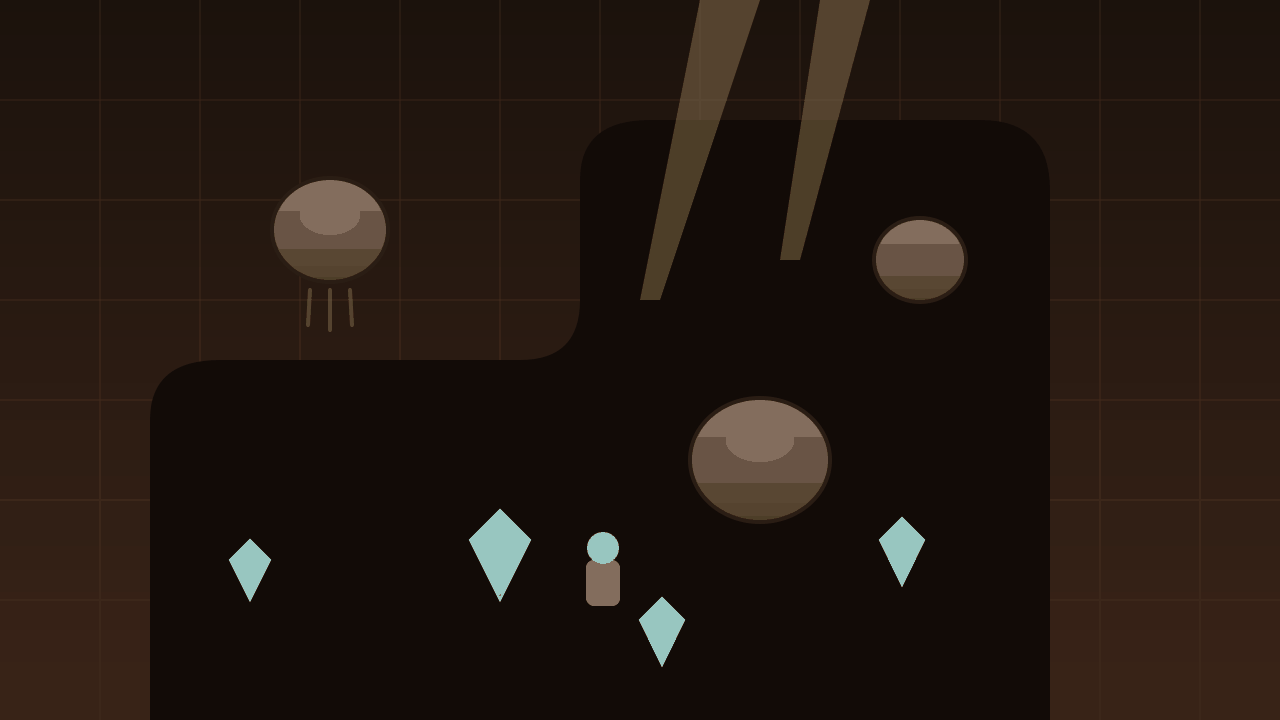 A boulder waiting to fall above a freshly dug tunnel (illustration, AI-generated)
The Era
At the end of 1983, the North American home console market had just suffered the crash known as the "Atari shock." But the "home computer" market — Atari 8-bit machines, the Commodore 64 — survived as a separate ecosystem from consoles. Boulder Dash was born precisely in that surviving soil: an era of keyboard-equipped home machines where users writing their own programs was nothing unusual.
Development traces back to 1982, when 14-year-old Chris Gray wrote a BASIC clone inspired by the arcade game The Pit (1982) and brought it to the local publisher Inhome Software. It was too rough to sell, but they saw potential in it. Peter Liepa then joined, first rewriting the entire game in Forth over roughly six months, then porting it to 6502 assembly language. Liepa, who lived in Toronto, and Gray, who lived in the suburbs, were separated by both distance and temperament — in a later interview, Liepa recalled the process as less a true collaboration than a handoff.
In an era before the internet, a single game spread across the world only through physical porting work and distribution networks. Within that same year, 1984, it was ported to the Commodore 64, Apple II, and, in Europe, the ZX Spectrum and Amstrad CPC; in Japan, publisher Comptiq brought it to the PC-8801 (October 1984) and the FM-7 and X1 (November 1984), with a ColecoVision port following that December. It was also included in Exidy's Max-A-Flex arcade cabinet, said to be the first home-computer game ever converted into an arcade cabinet. Code written in six months crossed both the Atlantic and the Pacific within the same calendar year.
 The porting culture of 1984, reaching multiple platforms worldwide within six months (illustration, AI-generated)
Mechanics
Placed alongside 1982's Sokoban — another board puzzle born in the same early-1980s window, and one this series has already covered — the difference in character becomes clear. Sokoban is a static pushing logic with no time pressure, giving the player room to pause and read the board. Boulder Dash, by contrast, runs in real time: the act of digging dirt itself triggers the physical event of a boulder falling. The player must move while predicting "what happens next if I dig here now." Static logic versus physics embedded in time — the same era's shared idea of "grid plus simple rule" produced two entirely different kinds of solving pleasure.
The concrete elements grow directly out of the rules. Amoebas keep multiplying into surrounding empty space; once they fill an enclosed space they turn to rock, and if they keep multiplying in a space exposed to open air, they turn to diamonds. Fireflies and butterflies move in fixed patterns along walls, and, as noted, crushing a butterfly under a rock drops diamonds. Even the simple win condition — collect enough diamonds within the time limit and the exit opens — sits on top of this foundation of complex physical interactions.
In other words, this board's puzzle quality comes not from solving a pre-arranged riddle but from reading the environment's own physical laws in advance and exploiting chain reactions. Pulling this off within the processing power of 1984's 8-bit machines is exactly why it struck players of the time as fresh.
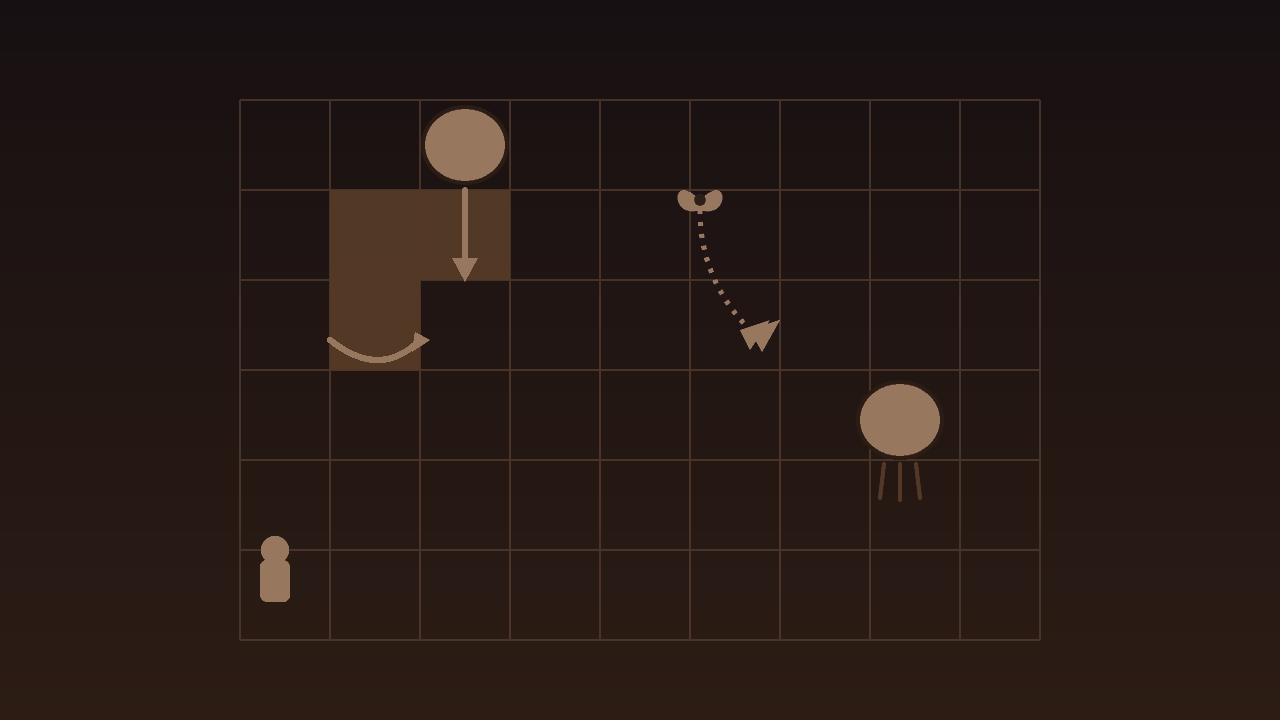 Impression of the board structure showing dig, fall, crush chains (illustration, AI-generated)
Lineage to the Present
This rule of "the falling rock" produced direct clones. In 1987, Germany's Kingsoft released Emerald Mine for the Amiga and Atari ST, built as a Boulder Dash clone, and it became the company's best-selling title. Its designer, Volker Wertich, would go on to create The Settlers in 1993.
In 1991 came Supaplex, made by Swiss students Michael Stopp and Philip Jespersen. It inherited Boulder Dash's gravity physics while newly incorporating Sokoban-style pushable yellow disks, and it was also the first Boulder Dash-like game whose objects were not strictly bound to the grid, allowing smooth in-between movement. All 111 levels are designed to demand puzzle-like reading over reflexes. Here, two separate lineages — 1982's Sokoban and 1984's Boulder Dash — converged inside a single game.
Then in 1995, German developer Holger Schemel's Rocks'n'Diamonds unified four rule sets — Boulder Dash, Emerald Mine, Supaplex, and Sokoban — into a single open-source engine. It has been maintained in a public Git repository since 2014, and its associated pages host more than 50,000 user-made levels. The rule of a single falling rock from 1984 thus survives, more than forty years on, as a living archive still being added to by volunteers.
 Impression of rules converging from 1984 to 1995 (illustration, AI-generated)
Sources
Sources consulted for this article:
・Wikipedia (Japanese): Boulder Dash
・Wikipedia: Boulder Dash (video game)
・Boulder Dash official site: History
・Boulder Dash official site: Interview with Peter Liepa
・ANTIC The Atari 8-bit Podcast: Interview 66 - Peter Liepa, Boulder Dash
Closing
It's unclear how self-aware this board was, at the time, about turning a simple physical phenomenon — a falling rock — into a rule. But the design philosophy of generating an enormous space of board possibilities from a small number of physical laws was carried forward for forty years, into Emerald Mine, into Supaplex, and finally into the single open vessel of Rocks'n'Diamonds. The static logic that 1982's Sokoban demonstrated, and the dynamic physics that this 1984 work demonstrated, were built up separately — which is exactly why today's puzzle games can freely combine both vocabularies.
The two developers who wrote this code in six months probably never imagined their rule would survive this long. But somewhere, on someone's board, a rock is still waiting to fall.
 Quiet light filtering in after the dig (illustration, AI-generated)
Reactions (no login)
Anonymous • one of each per visitor per day
Learn — Curriculum
LearnTeil 2 Lineage — Where Puzzles Came FromKapitel 5 Origins of the Digital Puzzle5 / 13
関連シリーズ
Retro Revisited第24回 / 全43回
