HISTORY · 2026-10-04
Tower of Hanoi (1883) — The 64-Disk Legend a Mathematician Sold Under a Pseudonym
From Lucas's pseudonym and Brahma's tower to the 2^n − 1 formula and the four-peg proof
Introduction — Three pegs and disks of different sizes
This is a wooden disk puzzle sold in France in 1883. The disks all differ in size and start stacked on one peg, largest at the bottom. The goal is to move the whole stack to another peg.
There are only two rules. Move one disk at a time, and never place a larger disk on a smaller one. Three disks take seven moves. Five disks take thirty-one. The count balloons fast.
The French mathematician Édouard Lucas devised it, but he did not sell it under his own name. The credited author was an invented "Professor N. Claus (de Siam)".
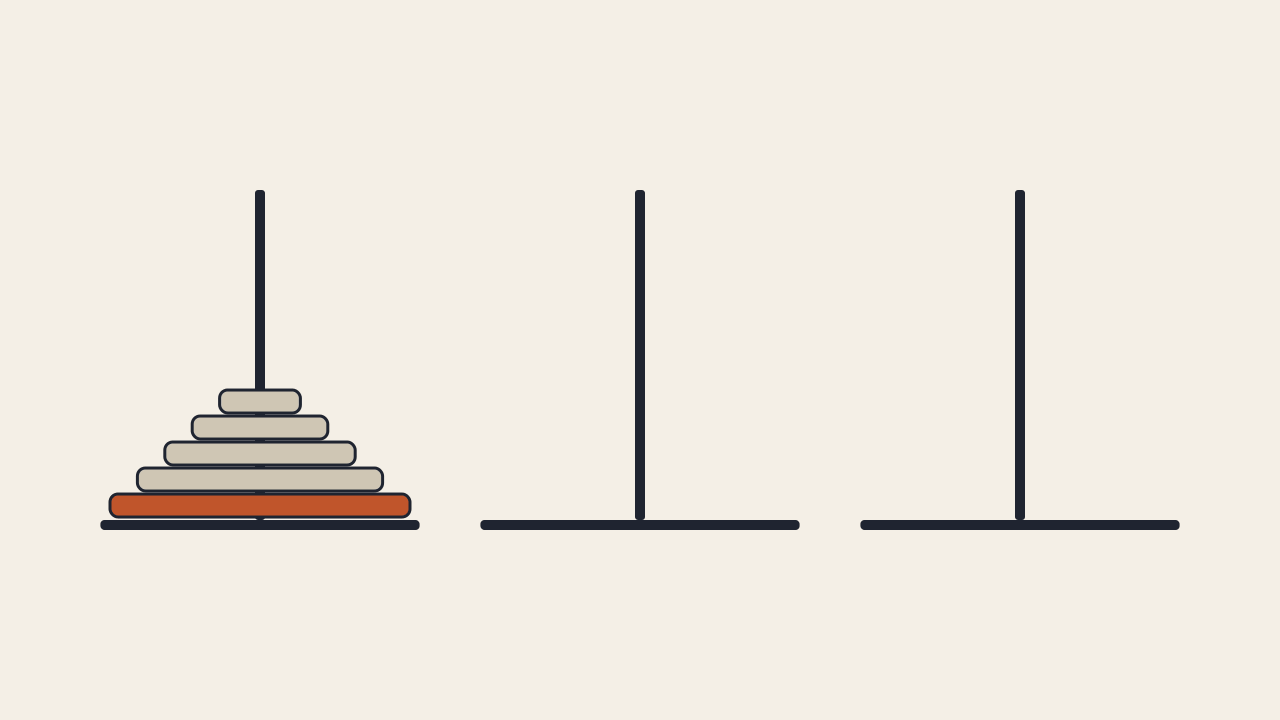 Five disks stacked largest to smallest (illustration, AI-generated)
Context — A fake professor and the legend of Brahma's tower
The pseudonym "N. Claus (de Siam)" is said to be an anagram of "Lucas d'Amiens". The Japanese Wikipedia describes it as an anagram of Lucas's school and his own name.
The puzzle came with a legend in its leaflet. In a temple at Benares, priests move 64 golden disks day and night under the same rules. When they finish, the world ends.
The box said "Tower of Hanoi"; the leaflet said "Tower of Brahma". Hanoi is a city in northern Vietnam. Evocative Eastern names dressed a mathematical game in a story.
Lucas's account later appeared in his posthumous Récréations mathématiques, and a booklet followed in 1889. A mathematician hiding his name to sell a toy fits the nineteenth-century craze for recreational mathematics.
 A night scene evoking the legendary tower (illustration, AI-generated)
Mechanics — Splitting the problem makes the count a formula
The key is to shrink the problem. To move n disks, first park the top n−1 on the spare peg. Then place the largest on the target. Finally move the n−1 back on top of it.
Repeating this gives a minimum of 2^n − 1 moves: 7 for three disks, 31 for five. The formula is a basic fact listed on English Wikipedia. Each extra disk roughly doubles the work.
For 64 disks, that is 2^64 − 1 = 18,446,744,073,709,551,615 moves. At one move per second it takes about 585 billion years. The legendary end of the world lies far beyond the universe's present age.
That arithmetic turns the toy from a hand game into a lesson in counting. Once you see the rule, you know everything without trying every move.
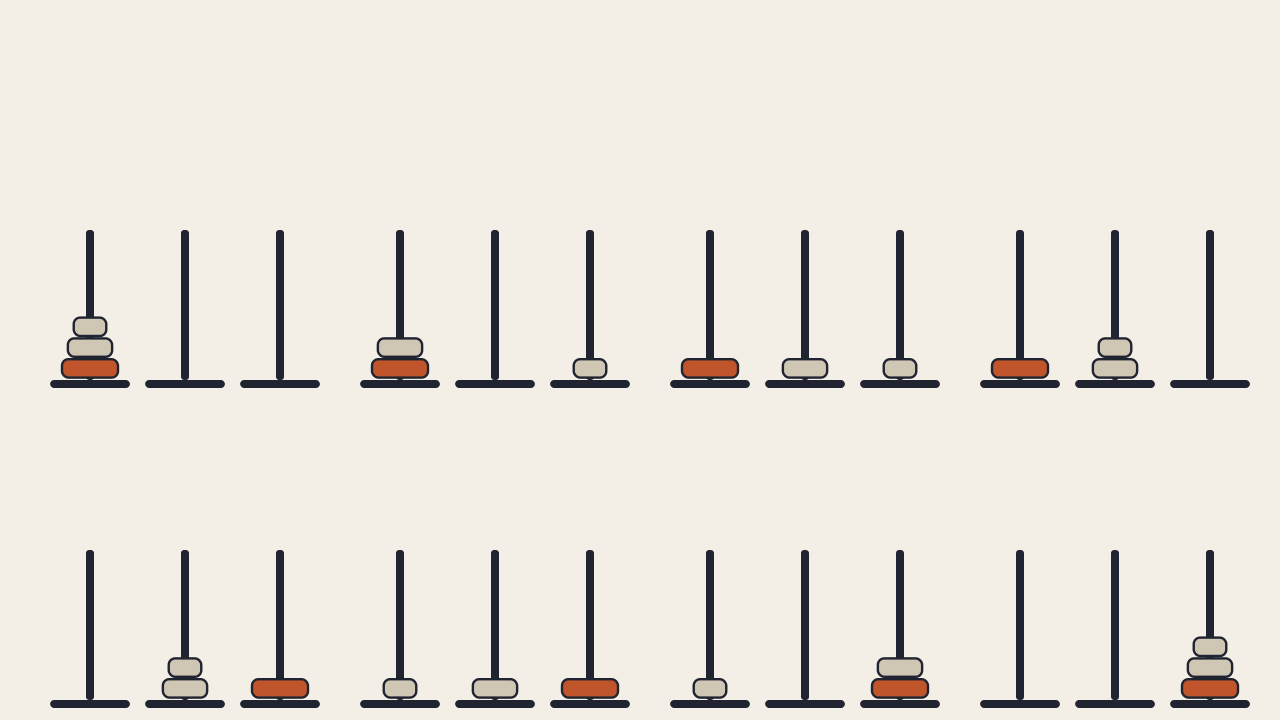 Eight positions solving three disks in seven moves (diagram, AI-generated)
Legacy — Four pegs became a century-long homework problem
The four-peg version has been studied extensively. According to English Wikipedia, the known procedure for four or more pegs is the Frame–Stewart algorithm from 1941. Proof that it is optimal stayed open for a long time.
In June 2014, Thierry Bousch released a preprint showing that this move count is indeed minimal for four pegs. As he writes, the conjecture had been verified by computer up to N = 30 but never proved.
The puzzle crossed into psychology too. The Tower of London test, created by psychologist Tim Shallice in 1982, is related to the Tower of Hanoi and is used to assess planning ability.
Elsewhere on this site, the Tower of Hanoi also appears. For a close cousin in reading procedures, see [Baguenaudier (1872)](/en/articles/baguenaudier-1872). For AI reasoning, see [the Pereira et al. paper note](/en/articles/paper-pereira-hanoi-world-model).
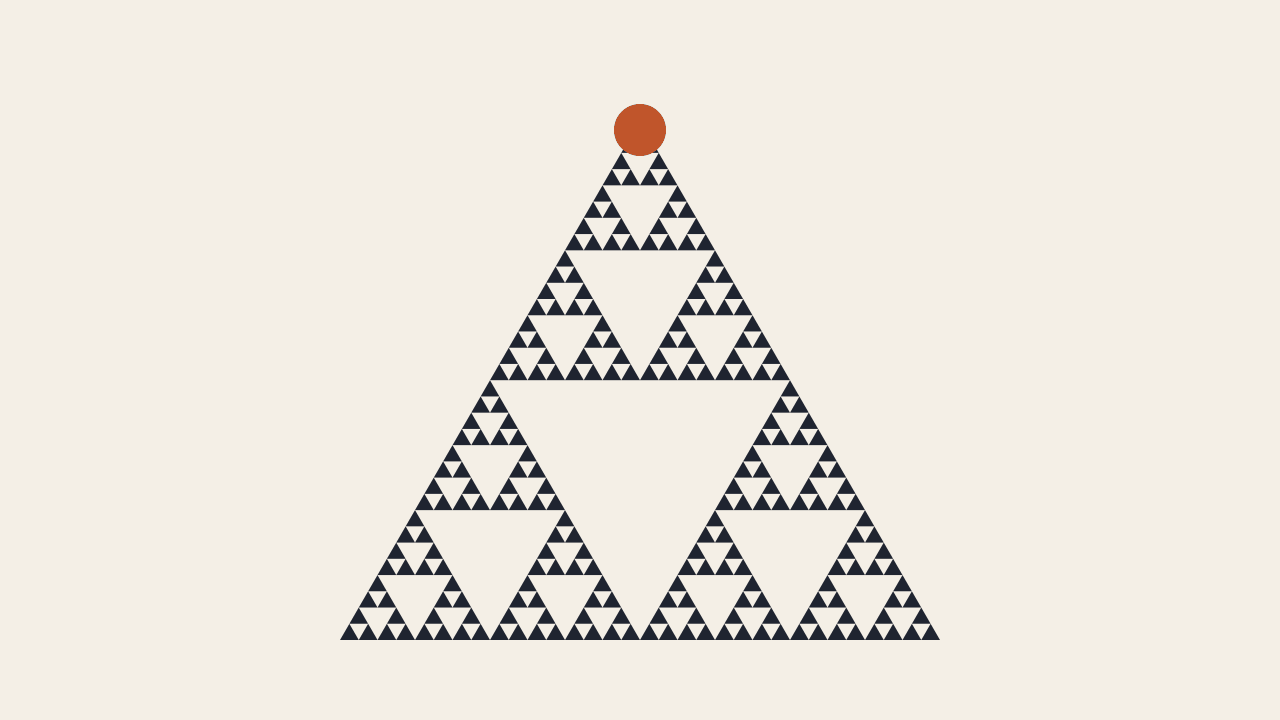 Small problems building a larger one (illustration, AI-generated)
References
Sources consulted for this article:
・Wikipedia (EN): Tower of Hanoi
・Thierry Bousch: The Fourth Tower of Hanoi (preprint dated June 15, 2014)
・Wikipedia (EN): Tower of London test
Note: the pseudonym, the 64-disk legend and the 1889 booklet rest on the Wikipedia articles above; I have not checked the original leaflet.
Closing — The year a mathematician sold a puzzle with a story
What the 1883 Tower of Hanoi showed is that a game with two rules can hide deep structure. Every disk we move traces the shape of recursion.
The legend is invented. But it made the number 64 memorable. Selling mathematics together with a story is a move that has not aged in 140 years.
Do you have three pegs at hand? Three coins and three lines on paper will do. Try three disks first, and check the seven moves.
 Three pegs and a single disk left in a quiet scene (illustration, AI-generated)
Reactions (no login)
Anonymous • one of each per visitor per day
関連シリーズ
Puzzle Incident History第51回 / 全51回
Read next

Related reviews
Maquette
Ein rekursives Ego-Rätsel in einer in sich verschachtelten Welt: Das Modell in ihrer Mitte ist genau die Welt, in der du stehst, sodass das Verkleinern oder Vergrößern von Objekten über alle Maßstäbe hinweg nachhallt – eingebettet in eine Liebesgeschichte.
Recursed
Ein 2D-Rätsel, das Rekursion in ein kleines Pixel-Art-Zimmer übersetzt. Der Großvater von Patrick's Parabox.

