ESSAY · 2026-09-02
Lighting as a Verb — The Grammar of Puzzles Where Light Rewrites Existence
From Closure's vanishing floors to Lightmatter's lethal dark
Introduction
There's no input simpler than a light switch. On or off — one button. Yet in puzzle games, that single binary has been asked to carry wildly different jobs from title to title. In one game it decides whether the floor exists at all. In another it decides where you're allowed to jump. In a third it decides whether you live or die. Few verbs get such different assignments from the same switch.
This essay continues the Single-Verb Design series, comparing how the single verb of lighting something gets reassigned across four games. Where flipping gravity rewrites a board's physics, light and dark run on something more primal: darkness has meant danger since long before puzzle games existed, and designers can either lean on that assumption or invert it outright.
I look at four games where lighting is the same verb but never means the same thing: 2012's Closure, where light decides which floor is even real; 2013's Contrast, where a light's position decides where you can jump; 2020's Lightmatter, which inverts which of light and dark is safe; and the same year's Creaks, where light rewrites what an enemy even is.
Closure — Only What's Lit Exists
2012's Closure commits fully to one rule: only lit floors and walls are solid enough to touch. Everything outside the light simply isn't there. Step off the edge of the light, and the floor beneath you disappears along with it.
All the player has is a portable orb of light and hinge-mounted spotlights that can be aimed. Set the orb down and its surroundings become solid; swing a spotlight, and the floor ahead solidifies while the floor you were standing on may vanish. Turning on a light isn't a convenience here — it's an act of creating the board itself.
What makes this work is that more light doesn't simply mean more safety. Wherever you place a light source, somewhere else falls dark. The player is constantly trading which spot gets to exist against which one gets erased — existence itself is a scarce resource being fought over.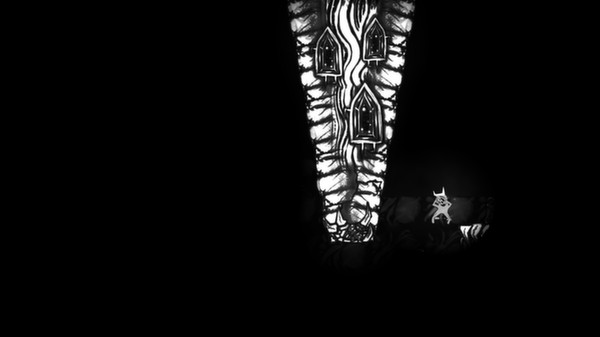 Closure (Steam official screenshot)
Contrast — Where a Light Sits Decides Where You Can Jump
In 2013's Contrast, light doesn't decide whether a floor exists — it decides where the protagonist Dawn can jump to. Dawn can slip between the solid 3D world and the flat shadow world cast on walls, but only where a light source is actually casting a shadow.
Players push spotlights and film projectors around, aiming them to throw a new shadow onto the wall they need to reach. Since a shadow's shape, length, and target wall all depend on where the light sits, the puzzle isn't "where do I stand to reach the shadow" — it's "where do I put the light so the shadow reaches."
That one extra step of indirection is what makes it work. The player often can't touch the light source directly and has to nudge a streetlamp or stage light instead. Walking and placing light become two separate verbs, so even a simple shadow-jump demands a plan laid one move ahead of the jump itself.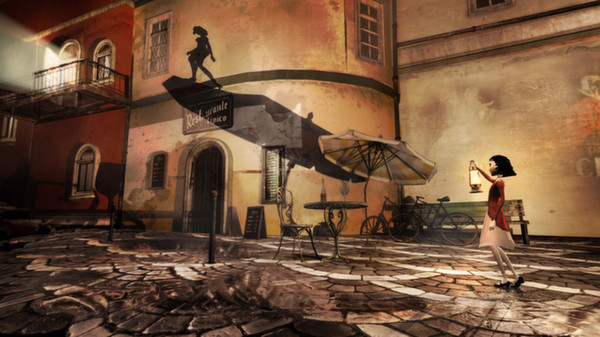 Contrast (Steam official screenshot)
Lightmatter and Creaks — Assigning Opposite Values to the Same Binary
2020's Lightmatter flips what light and dark mean. It's a floor-is-lava puzzle recast with darkness as the lava: step into shadow and you fall to your death, while lit ground is safe. Players carry light sources, redirect beams off mirrors, and haul light-emitting boxes to build a safe path across the dark.
Creaks, released the same year, doesn't touch life or death at all. Instead, light rewrites an enemy's identity. The game's monsters turn into ordinary furniture the instant light hits them. Players flip switches and lamps to defang enemies and clear a path deeper into the house.
Both games start from the same assumption — darkness is dangerous — yet land on different outcomes once light is switched on. In Lightmatter, light is literally the condition for staying alive. In Creaks, light is a tool that changes what a threat means. Placed side by side, they show how far apart two answers can land from the same binary switch.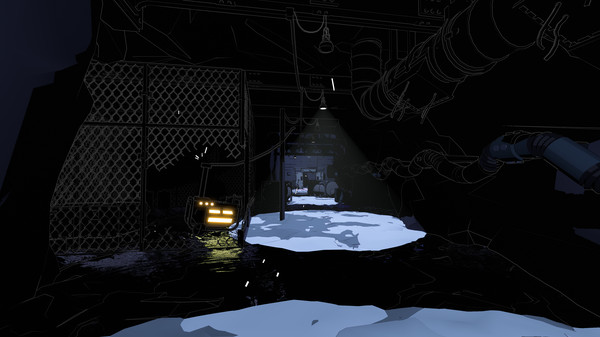 Lightmatter (Steam official screenshot)
Why One Axis — On or Off — Produces Four Different Grammars
The line between light and dark is something players already understand before they've touched a single control. Darkness means you can't see, and what you can't see is dangerous — that intuition is imported straight from lived experience. Designers never have to teach it. That's exactly why simply swapping what happens when a light comes on can completely change how a game feels.
Like the depth Subtraction as Design found without adding new verbs, the light-dark axis deepens by reassigning meaning rather than adding buttons. Closure ties it to existence, Contrast to destination, Lightmatter to survival, Creaks to an enemy's identity. The input never changes — on or off — only what it outputs branches four ways.
That structure travels well beyond these four games. When designing something new, it's often more productive to ask which binary assumption players already hold, rather than inventing a brand-new verb, then wire a fresh meaning onto it — originality without adding to what players have to learn.
Closing
Closure, Contrast, Lightmatter, and Creaks all show that a single button — turning on a light — can carry the weight of existence, destination, survival, or identity. The verb itself never multiplies. What multiplies is the meaning it gets assigned to rewrite on the board. Seen through the Single-Verb Design lens, this is one more entry in a lineage that keeps finding depth without adding new verbs.
If I built a puzzle around this verb next, I wouldn't lock it to one meaning. I'd want light to decide whether the floor exists early on, then have that same light rewrite an enemy's identity later. I'll leave the question open for you too: if the light switch in the room you're in right now could be wired to one meaning other than on-and-off, what would you choose?
Reactions (no login)
Anonymous • one of each per visitor per day
関連シリーズ
次に読む
関連レビュー
RiME
嵐のあと、少年が見知らぬ島で目を覚ます。走り、登り、泳ぎ、声で石の仕掛けに呼びかけながら、赤い狐に導かれて塔の頂を目指す。戦闘も HUD も台詞もない、五章構成のパズル・アドベンチャー。Tequila Works が 2017 年に発表した。
Hue
ボタン一つで世界の背景色を8色に切り替え、背景と同じ色の物体だけを消して進む2Dパズルプラットフォーマー。壁も箱もレーザーも「色」で操作し、灰色の世界に色を取り戻しながら行方不明の母を探す、Fiddlesticks Games の一作。
ElecHead
頭が電池のロボットを操り、体で触れた床や壁に電気を流して道を作る2Dパズルプラットフォーマー。頭を投げて遠くのスイッチに通電し、切り離している間の十秒制限をかいくぐる。日本の個人開発者 NamaTakahashi が『触れて通電する』一つの動詞を限界まで展開した一作。


