RETRO-REVIEW · 2026-09-28
MOTAS (2001) — The One-Person Flash Site That Named the "Escape Room" Genre
Jan Albartus's 20-room puzzle adventure is credited by name in Crimson Room's own credits
Introduction — Why Is MOTAS (2001) Called the Ancestor of the Escape Room Genre?
MOTAS (Mystery of Time and Space) is a Flash puzzle adventure released in November 2001 by solo developer Jan Albartus, working under the handle LOGAN. You wake in a room, gather clues to escape it, and eventually acquire a device that lets you travel through time and space across 20 rooms in total. The English Wikipedia states that the term "escape the room" itself originated from this 2001 game.
When I covered Crimson Room (2004) earlier on this site, I noted that its credits mention MOTAS. This piece turns to MOTAS itself, the source of that lineage.
The game was born in 2001, when most browser games were still single-serving novelties. A 20-room scope, a time-travel device, volunteer translations into multiple languages — this one-person site was already trying out much of what later escape-room games would take for granted.
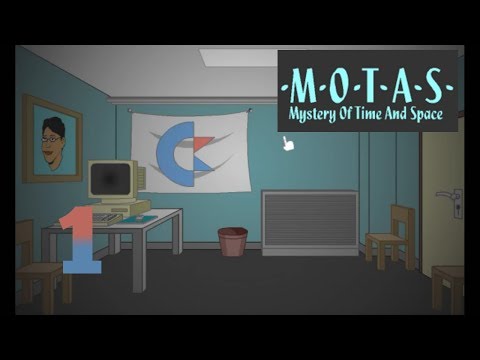 From "The Mystery of Time and Space (MOTAS) Part 1" (Stygian Phoenix, YouTube)
Context — How Could One Developer Build Something This Large in 2001?
In November 2001, MOTAS launched on a free hosting server with very little content. Flash at the time was one of the few environments where a single person could handle the art, sound, and programming alone, with no publisher gatekeeping — a single URL was enough to put a game in front of the world.
Progress-tracking was added in February 2002, and the game kept growing room by room from there. It finally reached its full 20 rooms by May 2008, and has not been updated since. A Flash site that kept expanding for nearly seven years was unusual even by the standards of its own time.
Its popularity brought its own headaches. Hosted on a free server, the site reportedly became unstable whenever traffic spiked. Even so, volunteers eventually translated it into 15 languages beyond English, and it kept being played worldwide.
Mechanics — How Did a Room Puzzle Turn Into a Puzzle About Time Itself?
The early rooms are the template every later escape-room game would repeat: find hidden items, combine them, decode codes given as numbers, colors, or directions. Difficulty climbs room by room, and review site Jay is Games described the early levels as "quite easy" while the later ones become "amazingly difficult."
Partway through, the player acquires the Manipulator of Time and Space, a device that turns the game from room-escaping into era-hopping. Fragmentary, cipher-like mission reports slowly suggest the protagonist might be a clone, or perhaps an alien. What began as a single-room puzzle had, by then, quietly knit itself into a story.
This level of craft reached major English-language outlets. UK's Channel 4 covered it as a title with "intricate problems," and both the New York Times and PCWorld.com gave it favorable coverage. Some criticized the puzzles' obscurity, but for a single Flash site to be covered by national press at all was unusual for its time.
 From "The Mystery of Time and Space Walkthrough (MOTAS)" (aWalkThroughLife, YouTube)
Legacy — Where Do This One Site's Name and Shape Live On Today?
MOTAS's biggest legacy is probably its name. The English Wikipedia's "Escape room video game" entry states plainly that the term "escape the room" originated from this 2001 game.
The lineage here isn't speculation; it's on the record. Toshimitsu Takagi, who made Crimson Room in 2004, named three prior Flash games — MOTAS, Droom, and Chasm — as influences in his own credits. Trace the two lineages I've already written about on this site, Crimson Room (2004) and the Real Escape Game (2007), back far enough, and they both lead here, to one person's site.
MOTAS itself hasn't been updated since 2008, but it hasn't disappeared either. It's still playable both on the developer's own site and on the Internet Archive. And the term it coined grew, over more than two decades, into a full commercial genre — a game like Escape Simulator (Pine Studio, 2021) on Steam is now reshaping what began as a free single browser room into an industry of its own.
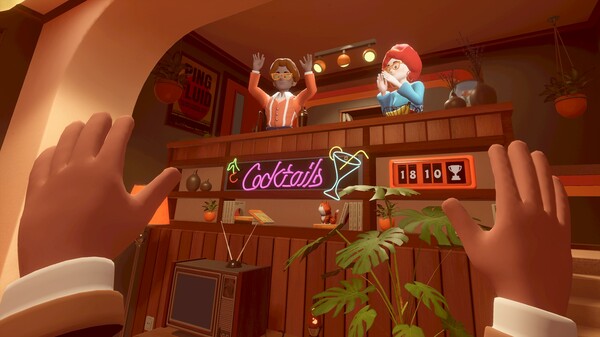 From a screenshot of Escape Simulator (Pine Studio, 2021)
Sources
Sources referenced in this article:
・Wikipedia: Escape room video game
・StrategyWiki: Mystery Of Time And Space
・Jay is Games: Mystery of Time and Space (MOTAS) — Walkthrough, Tips, Review
Closing — What It Means When Only the Name Survives
The name Jan Albartus is barely known even among people who play escape-room games regularly. He made just one of the three prior titles listed in another game's credits, and his name survives only as a single line within them.
But if the very term "escape the room" came into being after his game, that changes things. I don't know of many other cases where someone is remembered not as a genre's founder, but as the one who gave it its name. A name outliving the person who made it, and walking off on its own — that may be a fairly common story in the history of play.
Reactions (no login)
Anonymous • one of each per visitor per day
関連シリーズ
Retro Revisited第44回 / 全45回
Read next

Related reviews
The House of Da Vinci 2
A first-person puzzle adventure in which you serve as an apprentice to Leonardo da Vinci, opening handmade mechanical contraptions one at a time across Renaissance Italy. A device called the Oculus Perpetua lets you reach into the past and change the shape of the room in the present. Blue Brain Games' sequel to The House of Da Vinci.
Tiny Room Stories: Town Mystery
An escape-room puzzle game in which a private detective, summoned to the deserted town of Redcliff, inspects diorama-like rooms that can be rotated and viewed from any angle, opening keys and combination locks while searching for his father. Made at a very small scale by Kiary Games and ported from mobile.
The 7th Guest: 25th Anniversary Edition
Ein Puzzle-Adventure aus der Ich-Perspektive: Sechs eingeladene Gäste kommen in ein verlassenes Herrenhaus, in dem einundzwanzig raumgroße Vorrichtungen zwischen ihnen und dem Geheimnis des Hauses stehen. Dies ist MojoTouchs Neuauflage von 2019 des Meilensteins von Trilobyte aus dem Jahr 1993, der mit gefilmten Schauspielern und vorgerenderten Kulissen zeigte, was eine CD-ROM alles fassen konnte.


