REVIEW · 2025-04-10
The Talos Principle: Reawakened
Gestritten wird nicht über die Rätsel, sondern über das Gefäß
First Impressions
The thing that stopped me first in this review pool is simple. Overall the game reads 90% positive, yet the review with the most helpful votes on the page is a negative one. Not from someone who bounced early, either: thirty-four hours in, and still not recommending it. Official asset for The Talos Principle: Reawakened — Steam store key art
Sort by helpfulness and the top ten split four to six against. The votes lean the same way: 229 for the top negative, 217 for the top positive (snapshot 22 August 2026). The aggregate says 90% of 1,069 reviews are positive, labelled Very Positive. The majority and the most-read verdict are not saying the same thing.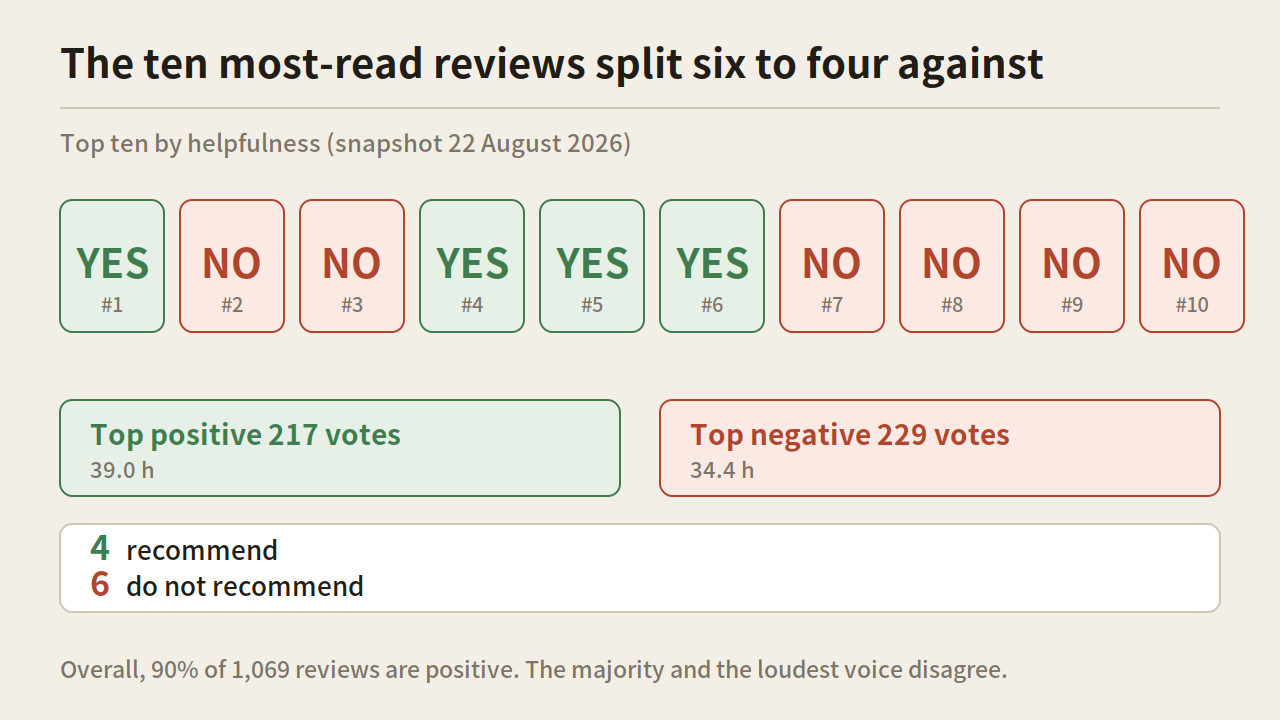 The top ten split four to six, and the votes lean the same way (diagram, drawn for this piece)
So I counted what the six negatives are actually angry about. Performance in six of them, unreadable on-screen text in four, rendering artefacts in four. Then price, the new chapter, the editor. Not one of them attacks the puzzle design. That is where this piece starts.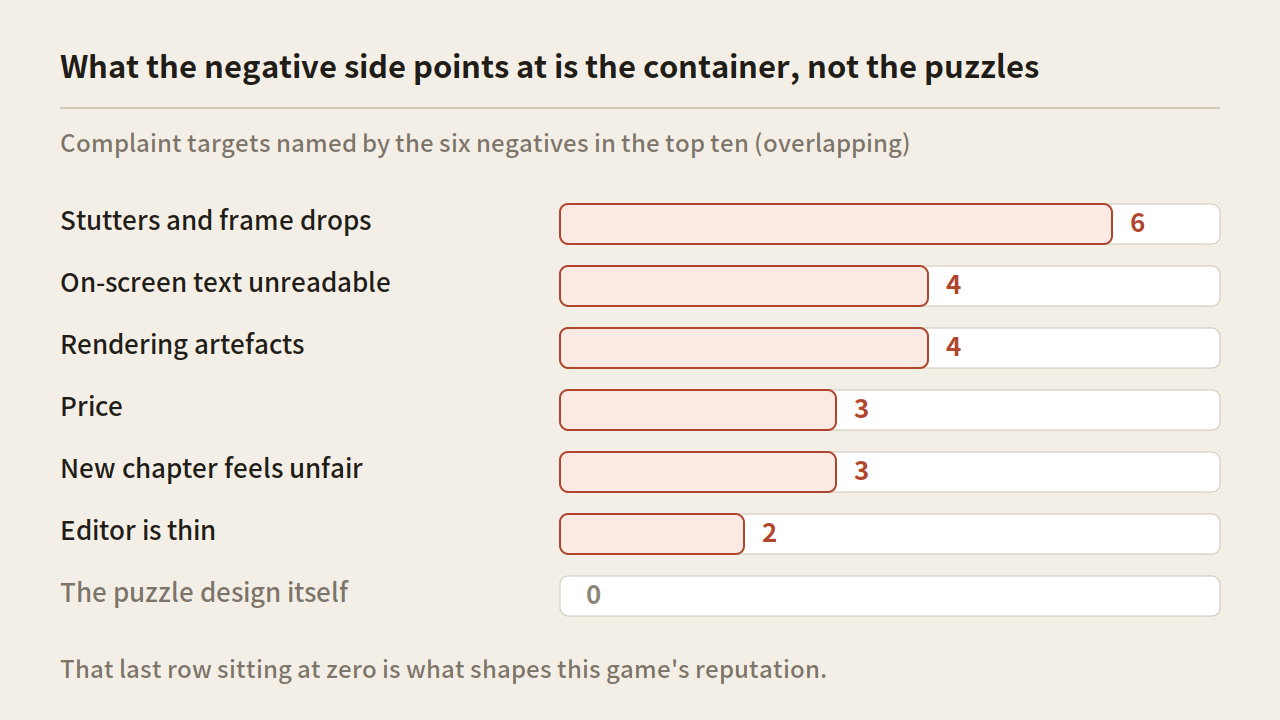 The complaints cluster on the container; the puzzle design draws none (diagram, drawn for this piece)
Putting the Mechanics into Words
First, what the game actually is. You walk through ruined gardens, fiddle with tools in front of locked doors, and route a beam to get through. Nothing to shoot; reading the mechanism is the progress. Croteam released it in 2014; this is the same studio rebuilding it in Unreal Engine 5. In-game view of The Talos Principle: Reawakened — Steam store screenshot
The tools carry over from the original, and there are four. A jammer that shuts a device off, a connector that carries the beam, a recorder that replays your own movement, a fan that lifts you. Later rooms do not hand you more tools; they ask more of how the four mesh. It is a clean example of few verbs, deep combinations.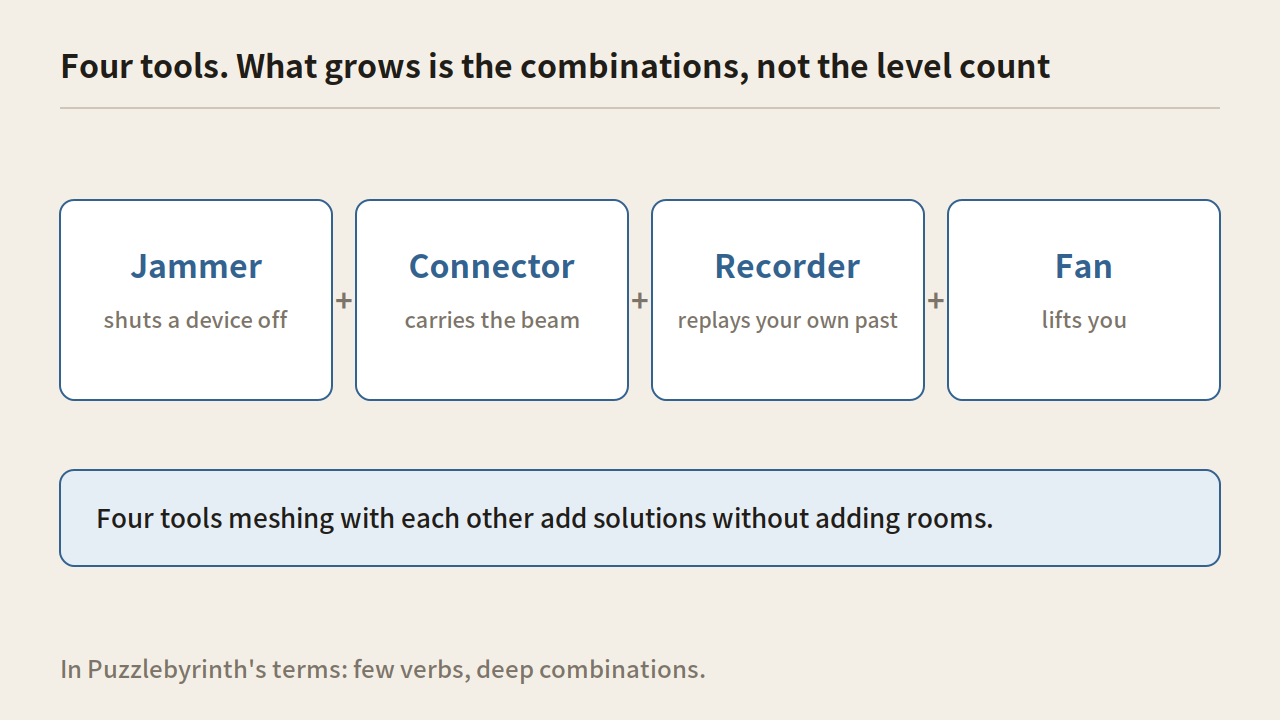 Four tools; what grows is how they mesh (diagram, drawn for this piece)
What this edition adds is rewind and pause. Recorder rooms used to mean restarting whenever your recorded self missed its cue. The positive side returns to this again and again — one review says it is worth the purchase on its own. Cutting the cost of a mistake from minutes to seconds buys you more attempts. It does not change the solution, but it keeps your hands moving while you are stuck. What they are really talking about is the price of trying again.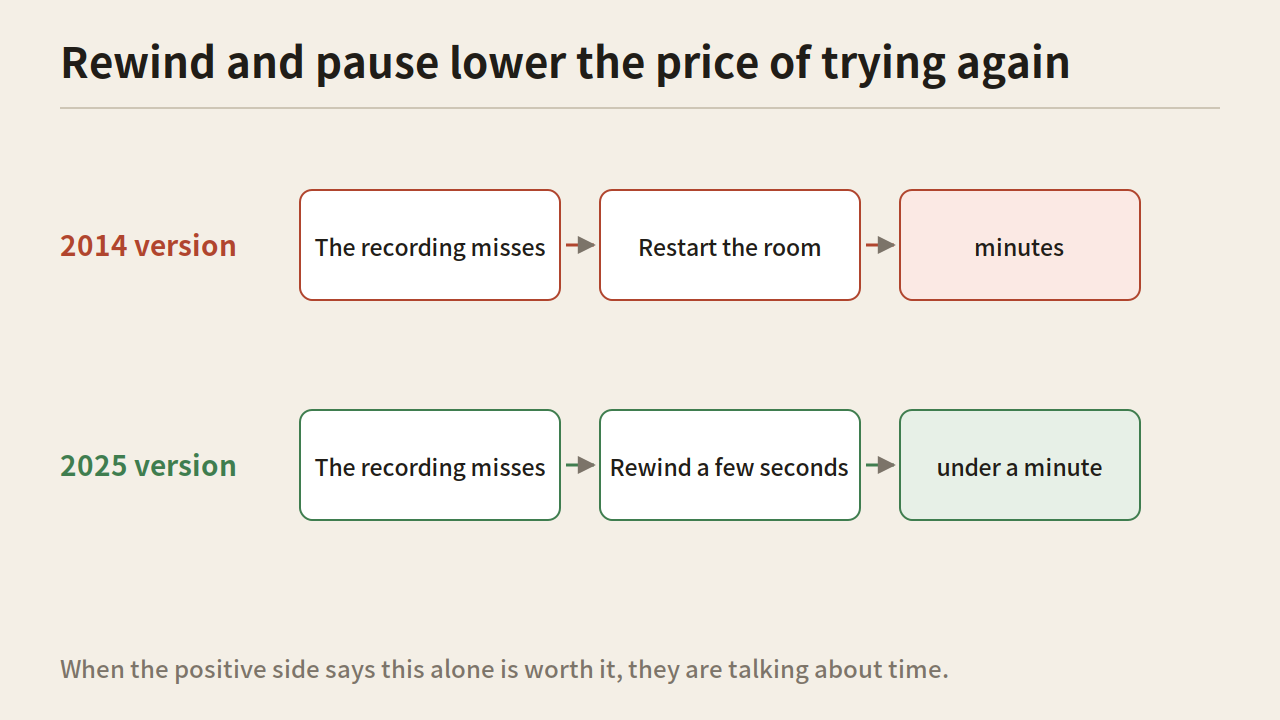 The cost of a retry drops from minutes to seconds (diagram, drawn for this piece)
The negative side does not attack that feature. It attacks the picture. More grass, more reflection, distant devices losing their edges. The mechanisms stand out less, several of them say. That is not a matter of taste. It is about whether the board can be read — a question of observational resolution.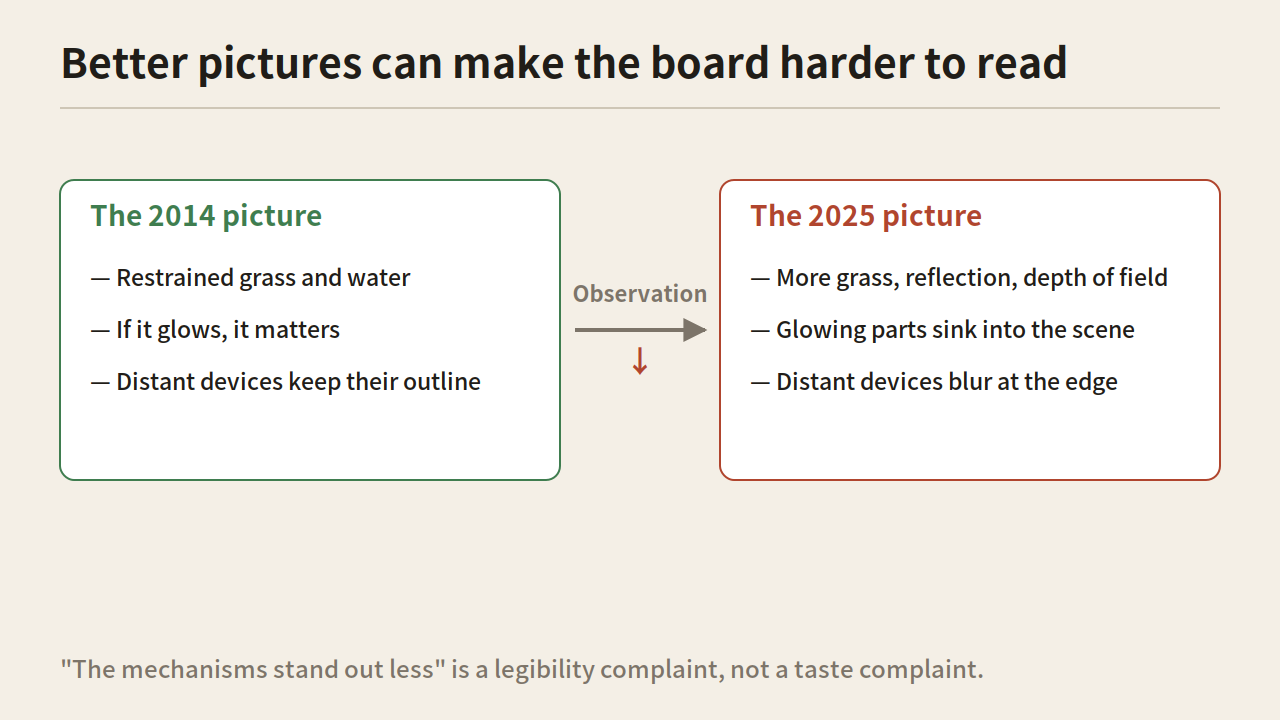 More visual information can bury the markers you need (diagram, drawn for this piece)
The Texture of Difficulty
The new chapter is called In the Beginning: three worlds of six puzzles, eighteen in all. On the forums one player reports four or five hours and another insists it took far longer. Eighteen rooms, and the part of the package the two sides argue about most.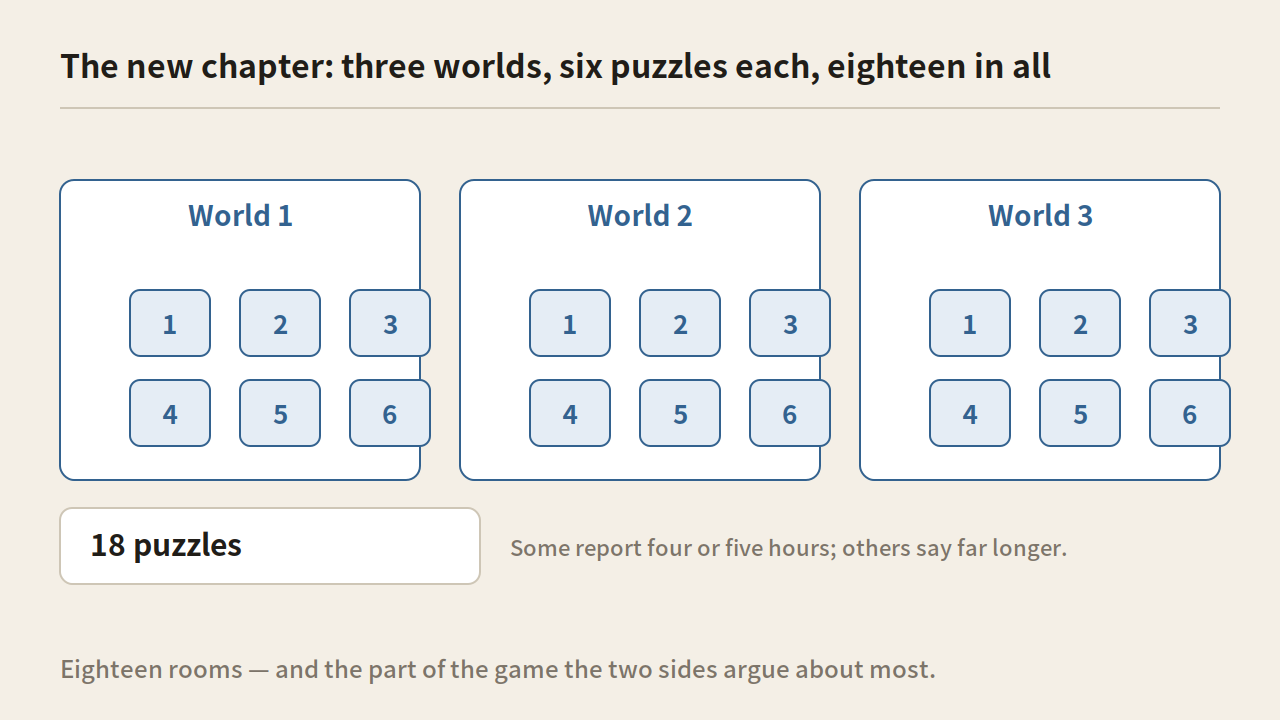 The new chapter is three worlds of six (diagram, drawn for this piece)
Read the pool closely and getting stuck comes in three kinds. You cannot see the combination. You cannot read how your recorded self should overlap. Or you simply cannot read the screen. The first two are inside the design; only the third is outside it. Count the third as difficulty and the game scores lower than it deserves.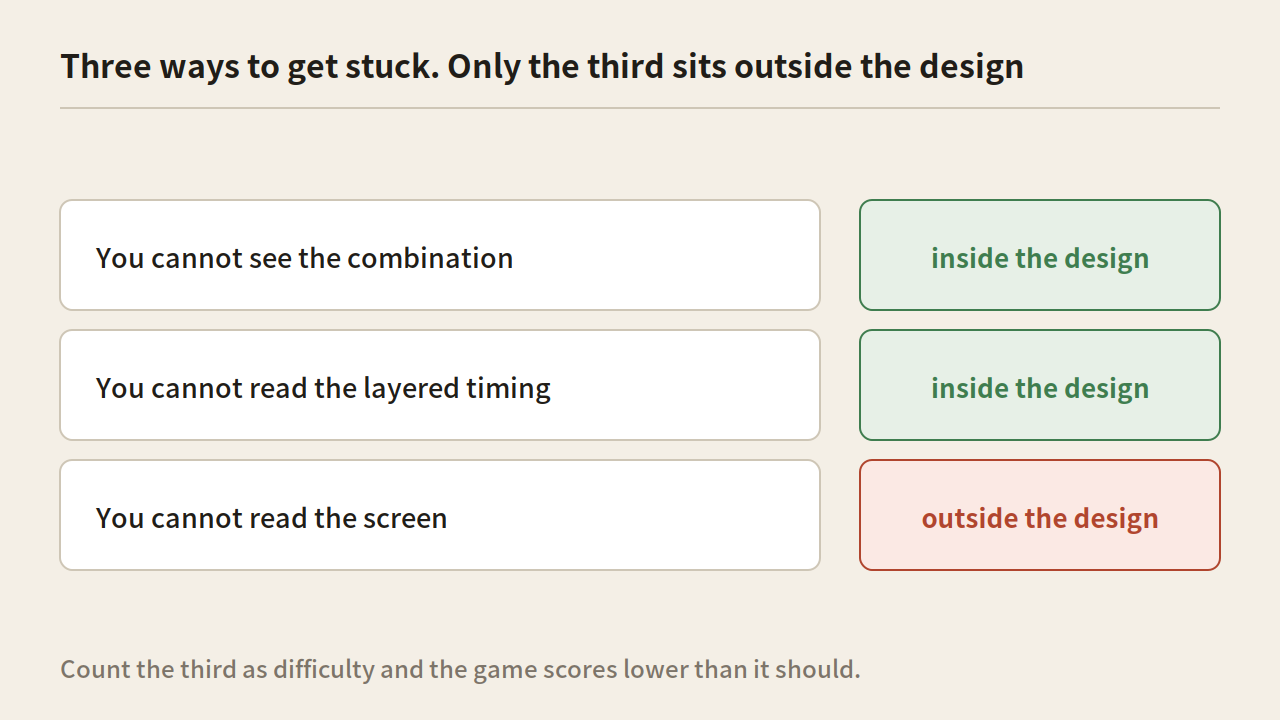 Only the third kind of stall sits outside the design (diagram, drawn for this piece)
Hours are worth a look too. Across the top ten, the positive median is 66.2 hours and the negative median 23.4. The positive side played more than twice as long. Still, 23.4 hours clears the roughly thirteen-hour main story. These are not people who gave up in the first evening.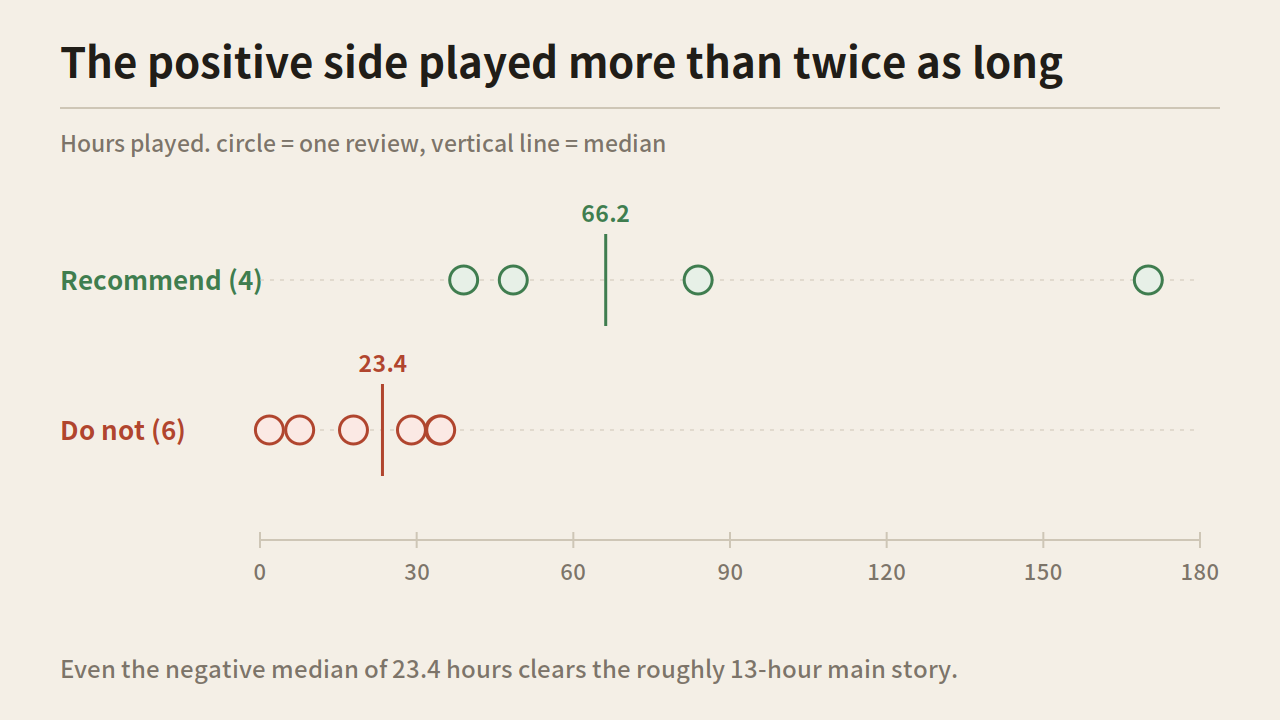 The positive side played longer, but the negatives cleared the main story too (diagram, drawn for this piece)
Place in the Lineage
Where this edition sits is unusual. The 2014 The Talos Principle is still on the same storefront. The old one reads 95% positive across 17,107 reviews at a $29.99 list price; this one 90% across 1,069 at $39.99. Reviewers keep pointing out that the original drops to around $4.50 on sale.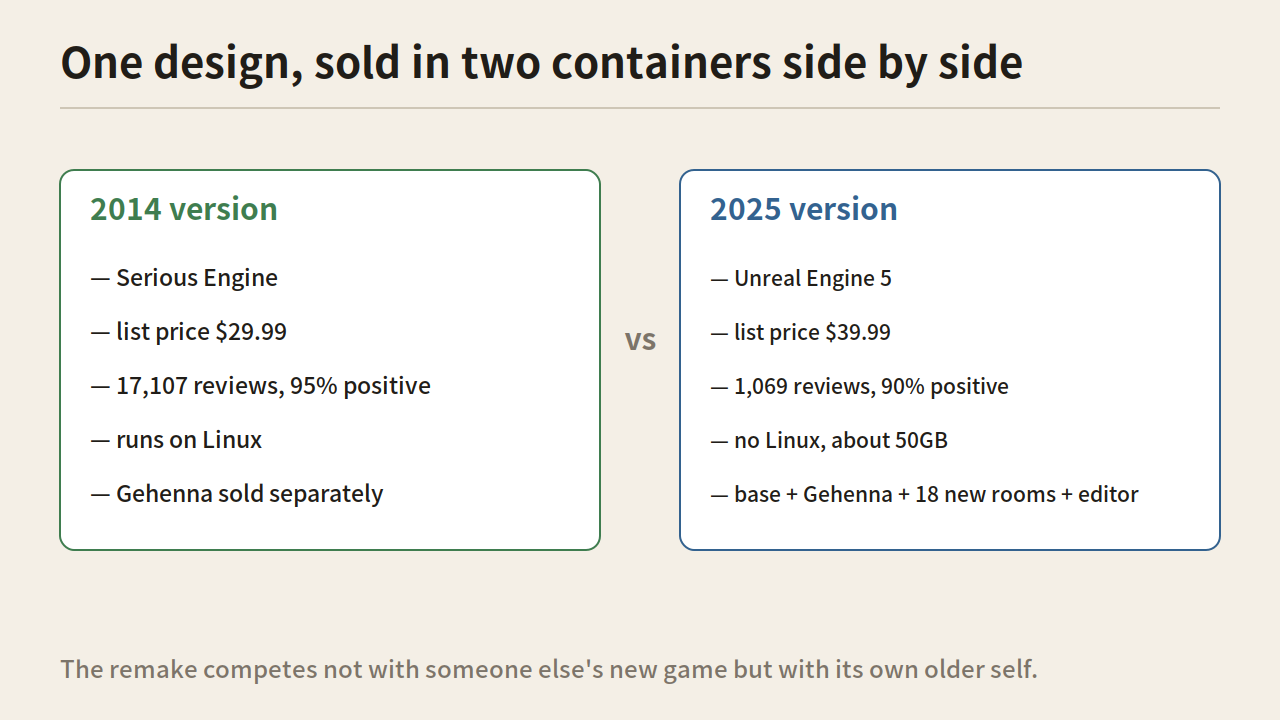 One design, sold in two containers at once (diagram, drawn for this piece)
The number moves depending on which vessel you measure with. OpenCritic has it at 88, with 97% of thirty critics recommending. Metacritic's critic column reads 89 from fourteen. Its user column reads 6.8 from ninety-three. Steam's 90% sits with the critics. Different sample sizes, different reasons to write — but it is worth remembering what that 6.8 was measuring.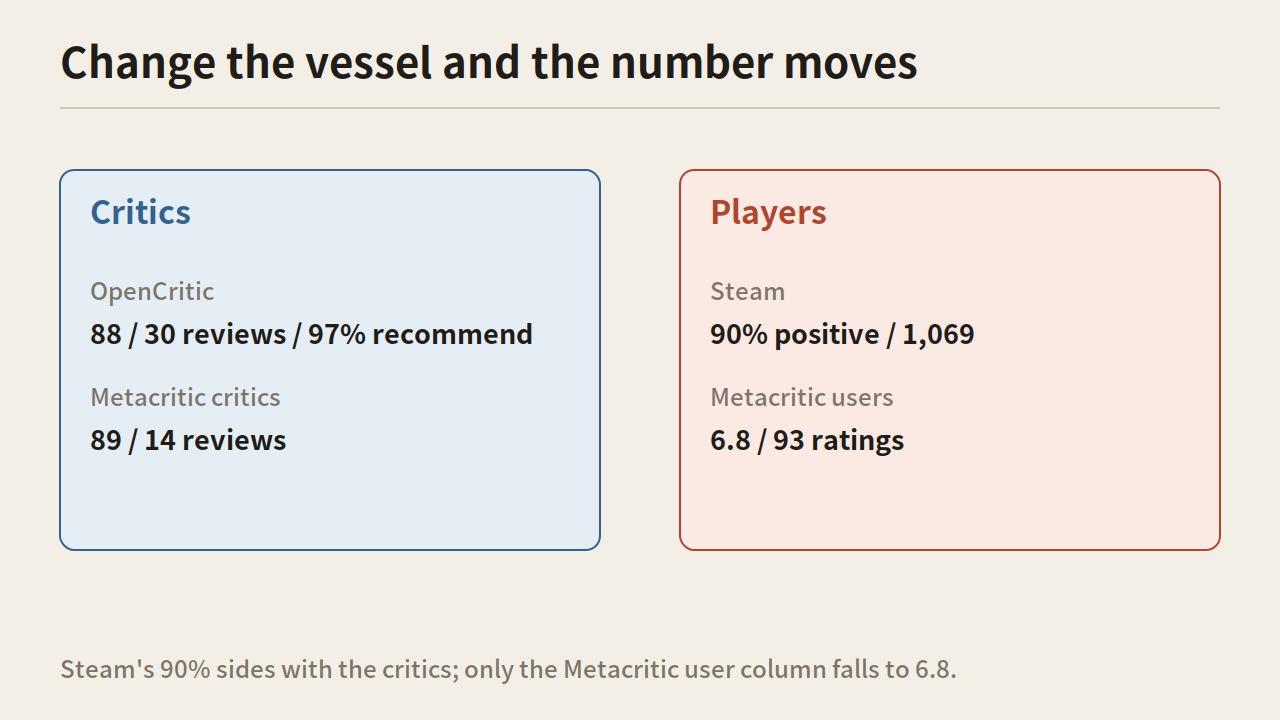 Change the vessel and the number moves (diagram, drawn for this piece)
In the series line this is not a step forward but a branch sideways. Base game, expansion, sequel, and now a rebuild. In May 2026 a third game was announced as the finale. This edition's job, most likely, was to set the first one back on the shelf before that arrives.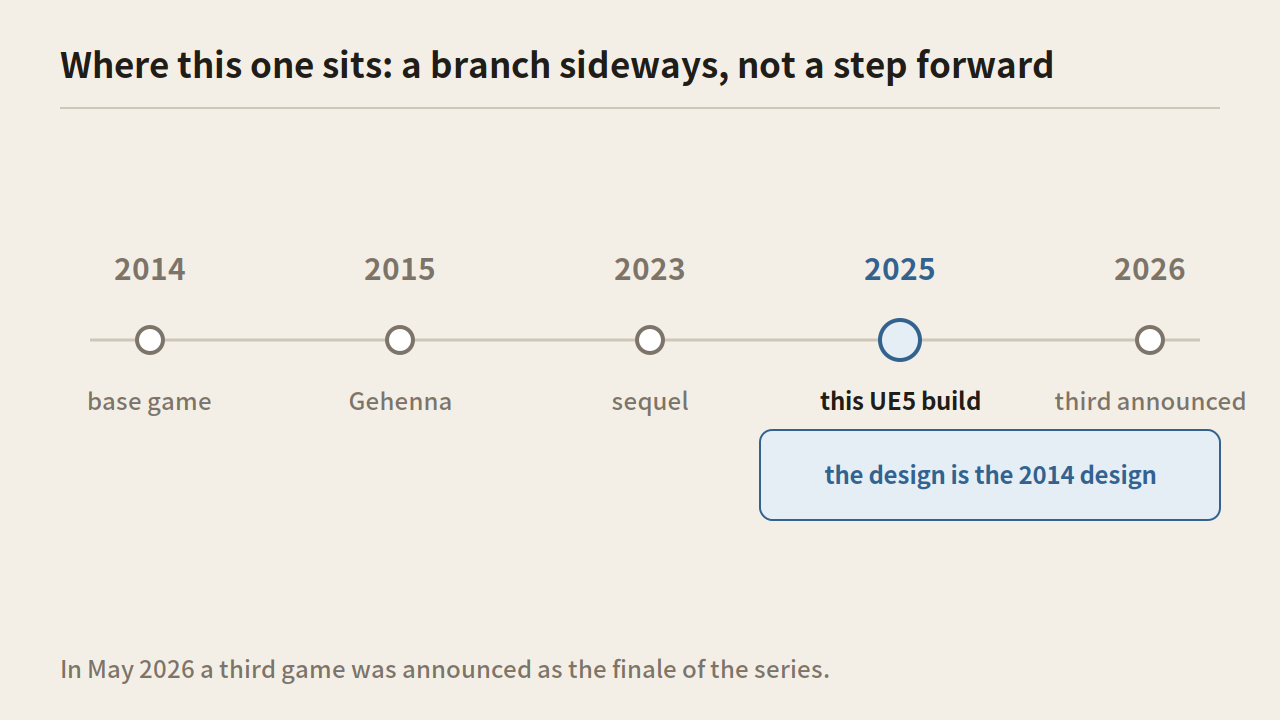 A branch sideways rather than a step forward (diagram, drawn for this piece)
Sources
This piece was written by reading the Steam user reviews and the official and aggregate pages as of 22 August 2026. No review text is quoted directly; recurring claims are reconstructed.
- Steam: The Talos Principle: Reawakened (90% of 1,069 reviews positive, Very Positive; 86% of 37 in the last thirty days)
- Read the top ten by helpfulness in full (four positive, six negative), plus the most-recent listing and a forum thread on the length of the new chapter
- For comparison, checked the 2014 store page (95% of 17,107 reviews, $29.99 list)
- Critic aggregates from OpenCritic (88, thirty reviews, 97% recommend) and Metacritic (PC 89 from fourteen critics; 6.8 from ninety-three users)
- On handheld performance I read Steam Deck HQ's review; completion times come from an aggregate site (about 13 hours main story, about 34 to complete)
- On images. The opening key art and the in-game shot are official Steam assets whose existence was confirmed on the store page, but the image CDN was unreachable from this environment, so their contents could not be checked by eye and the captions stay generic. The other thirteen are diagrams I drew for this piece, checked one by one in both languages.
Closing
Let me split the score. The design is the 2014 design, and I put it at 9.0. Then I subtract for the container: the stutter, the unreadable text, and a price that sits above the original on the same shelf. That leaves 8.4 — near Steam's 90%, arrived at differently.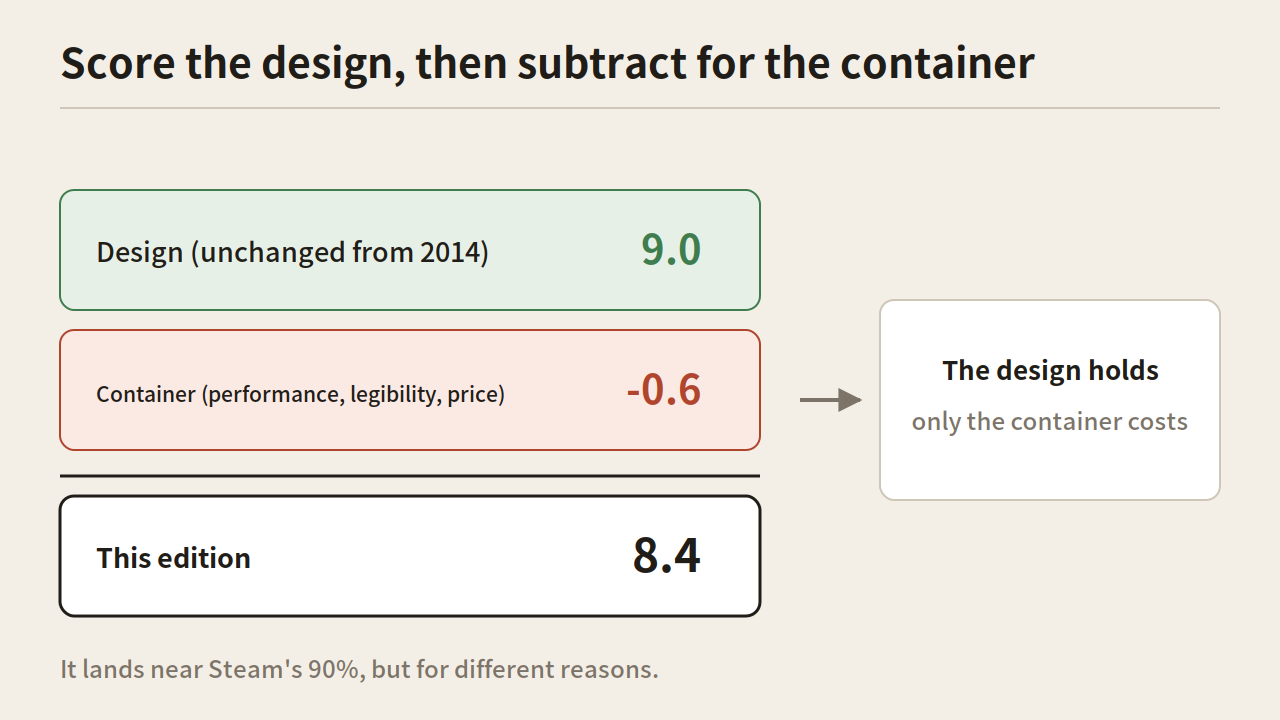 Score the design, subtract the container, land at 8.4 (diagram, drawn for this piece)
Which one to buy comes down to two questions: whether you played the original, and whether you have hardware to spare. New to it with a modest machine, the 2014 build is the safer buy. Returning with hardware to spare, the eighteen new rooms and the editor are what you are paying for. None of those answers doubts the puzzles. That is the most honest thing about this game's reputation.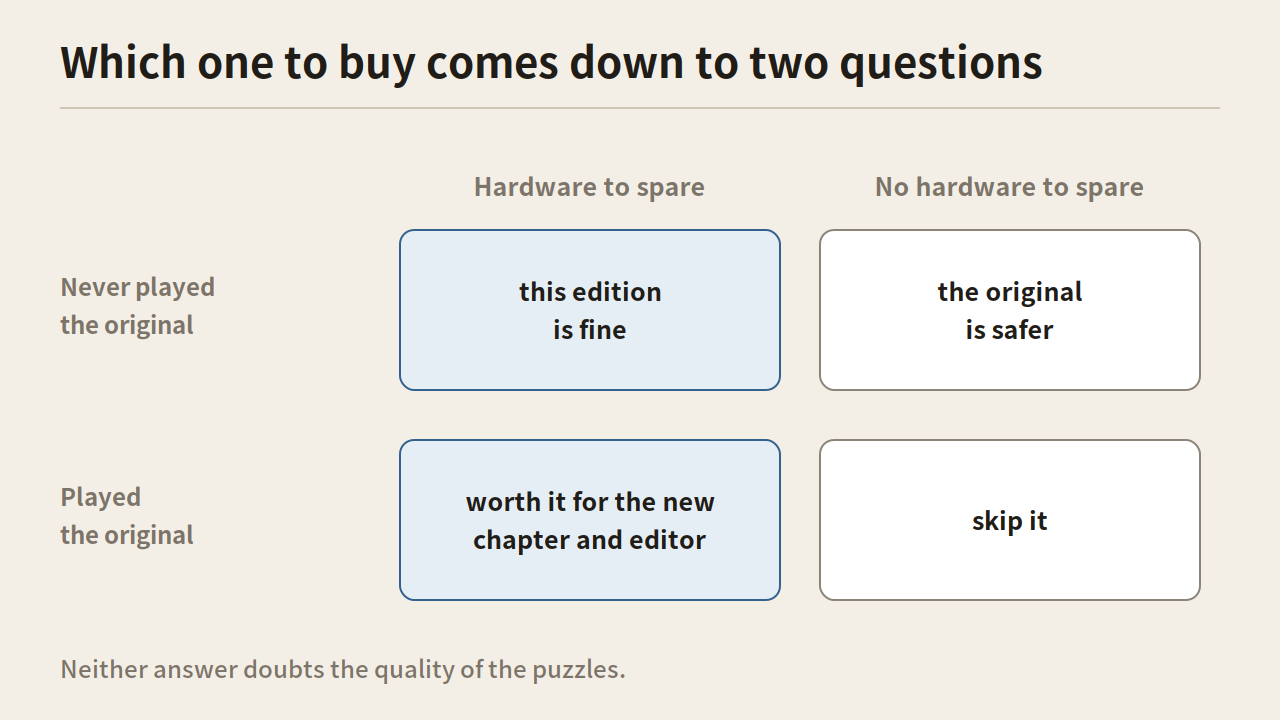 Two questions decide which one to buy (diagram, drawn for this piece)
Where are you with this game?
Press one and the game goes on your shelf. You can see it on your account page.
Reactions (no login)
Anonymous • one of each per visitor per day
Read next
Related reviews
The Talos Principle 2
Laser, Würfel und philosophische Dialoge haben in diesem Egoperspektive-Rätsel gleiches Gewicht.
The Talos Principle
Ein Roboter löst Prüfungen in römisch anmutenden Ruinen, während eine Stimme in seinem Kopf seine Selbstheit und Göttlichkeit infrage stellt.
Cryptmaster
Ein wortgetriebener Dungeon-Crawler aus der Ich-Perspektive: Tippe die wiedergefundenen Wörter, um Fähigkeiten auszulösen und Rätsel zu beantworten. Von Paul Hart und Lee Williams, in monochromer Bleistiftzeichnung und mit vollständig gesprochenem Erzähler.


