BLOG · 2026-09-03
Metal Gear Solid (1998) — a game about not being seen that used the controller port as a stage prop
Today Is Release Day #46 — September 3, 1998, PlayStation
September 3, 1998: a game whose goal was not to be seen
Hello, Toki here. Episode 46 of “Today Is Release Day.” Today’s game puts not being seen ahead of taking anyone down.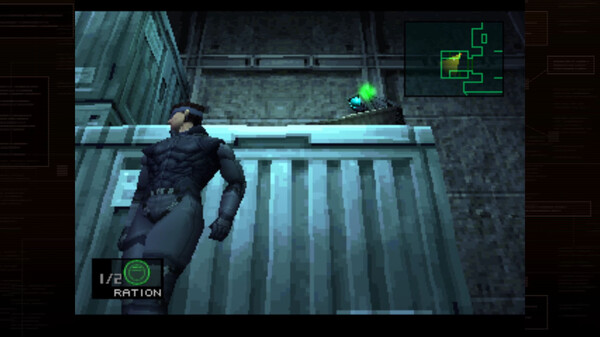 Screenshot from METAL GEAR SOLID - Master Collection Version (Steam store page / KONAMI)
Metal Gear Solid. Released on September 3, 1998, by Konami for the PlayStation. The price was 5,800 yen before tax; the product code was SLPM-86114.
North America got it that October, Europe in February 1999. Counting from the MSX2 original in 1987, it was the third game in the series.
Hideo Kojima directed, designed and wrote it. Yoji Shinkawa did the character design. Development was by Konami Computer Entertainment Japan.
Getting through without fighting: a cardboard box, a radio, and a moving camera
You play Solid Snake, sent alone into a snowbound island facility in the far north.
The first job is not to be seen. Press against a wall and let a guard walk by; pull a cardboard box over yourself and wait it out. Shooting your way through is the slower option.
For the first time in the series, the world was drawn in polygons. The camera changes angle from room to room, cutting like a film. Screenshot from METAL GEAR SOLID - Master Collection Version (Steam store page / KONAMI)
The other lead role belongs to the radio. Conversations run long, in voice and text, and much of the story — and much of the instruction — arrives over it.
The team was around twenty people; Kojima preferred a small group he could keep an eye on. The animation was done by hand rather than motion capture, and the layouts and camera angles were worked out by building the environments from Lego bricks.
Kojima put it this way: “if the player isn't tricked into believing that the world is real, then there's no point in making the game.”
“Please switch your controller to port two”
The scene people talk about most is the fight with Psycho Mantis, an enemy presented as a psychic.
To show off that power, the game reached outside the screen. First it reads your memory card and names other games you have played. Then it makes the DualShock buzz, as if he were moving objects with his mind.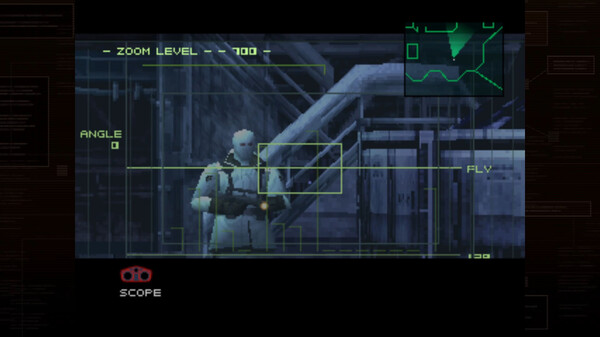 Screenshot from METAL GEAR SOLID - Master Collection Version (Steam store page / KONAMI)
Then he announces a blackout, the screen goes dark, and a label appears imitating a television’s video-input display: HIDEO. Plenty of players in 1998 thought their TV had broken.
And the way to beat him was to unplug your controller and put it in the second port. Not inside the fiction — you reach out and change the machine.
In 2008 the moment was recognised by Guinness World Records as the “Most Innovative Use of a Video Game Controller.” One radio frequency, meanwhile, was printed on the back of the box.
Called “a brand new genre,” and given an Excellence Award by Japan’s Media Arts Festival
The first reaction on release was to ask what genre this even was.
The British magazine Arcade credited it with “introducing a brand new genre: the sneak-'em-up.”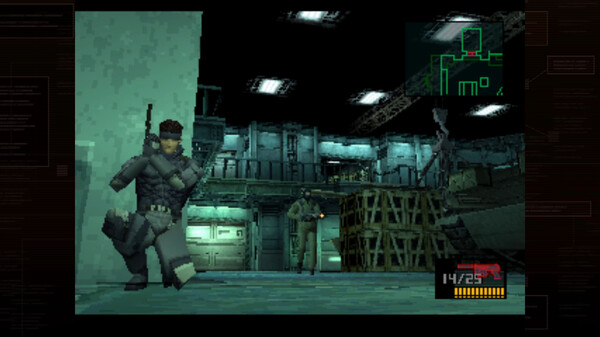 Screenshot from METAL GEAR SOLID - Master Collection Version (Steam store page / KONAMI)
IGN wrote that it came “closer to perfection than any other game in PlayStation's action genre.”
PlayStation Official Magazine – UK called it “the best game ever made. Unputdownable and unforgettable.” Computer and Video Games compared it to “playing a big budget action blockbuster, only better.” Next Generation gave it five stars out of five.
The record that stands out on the Japanese side is the 2nd Japan Media Arts Festival, for 1998. In the Digital Art (Interactive) division, Metal Gear Solid received an Excellence Award, credited to “Hideo Kojima (director / concept / screenplay).”
The Grand Prize that same year went to The Legend of Zelda: Ocarina of Time. Those two games took 1998 between them.
There were complaints. The difficulty was a wall for newcomers, you were sent back and forth along the same corridors, and the long radio calls could not be fast-forwarded. All of that was being said at the time.
The sales were unambiguous: over six million copies worldwide by early 2001. This is also the game the American magazine Fortune called the best story of the twentieth century.
Twenty-eight years on, the 1998 version is still on the shelf
On October 24, 2023, Konami released METAL GEAR SOLID: MASTER COLLECTION Vol.1 for Nintendo Switch, PlayStation 5, Xbox Series X|S and Steam.
It contains Metal Gear (1987), Metal Gear 2: Solid Snake (1990) and Metal Gear Solid (1998) — not remakes, but the games as they were. The screenshots in this article come from that release.
Tricks that lean on the hardware, though, do not travel well when the hardware changes. There is a precedent: the Windows version from 2000 dropped the Psycho Mantis scene with the memory card and the rumbling controller entirely, because it depended on PlayStation-specific peripherals.
The surprise of 1998 was built together with the box of 1998. Seen that way, the instruction to change ports was a rather extravagant one-time trick.
Which moment made you say something out loud?
Sneaking is a shelf category now. In 1998 it still needed a name.
September 3, 1998. Let me write the year down. Today, September 3, 2026, makes it exactly 28 years.
A cardboard box, and a second controller port. Both of them were about the outside of the game rather than the inside — and both have been retold for twenty-eight years.
Which moment made you say something out loud in front of the screen? If you remember the release date too, so much the better.
Reactions (no login)
Anonymous • one of each per visitor per day
Read next
Comments (no login)
No comments yet. Be the first to say something.