BLOG · 2026-09-04
Spore (2008) — critics averaged 84; on Amazon, 2,016 of 2,216 ratings were one star
Today Is Release Day #47 — September 4, 2008, the world's first launch, in Australia
On September 4, 2008, the first boxes in the world went on sale in Australia
Hello, this is Toki. Episode 47 of “Today Is Release Day.” Today’s game packs everything from a single cell to an entire galaxy into one box — an unusual simulation by any standard.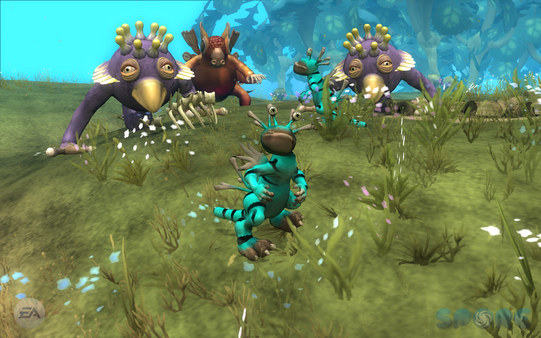 Screenshot of SPORE (Steam store page / Electronic Arts)
Spore. Developed by Maxis, published by Electronic Arts, for Microsoft Windows and Mac OS X.
The release was staggered across three days: Australia on September 4, 2008, Europe on September 5, North America on September 7. So the very first copies anywhere in the world went on shelves in Australia, on September 4, 2008. The Japanese edition also arrived that same September, from Electronic Arts.
The designer at the centre of it was Will Wright, the man behind SimCity and The Sims. Brian Eno and Cliff Martinez worked on the music.
The verdict split cleanly in two. Critics averaged 84. On Amazon, 2,016 of 2,216 ratings were a single star — and those one-star ratings were not about how the game played.
Cell, creature, tribe, civilization, space: five stages in one box
The game came in five stages: Cell, Creature, Tribal, Civilization, Space. You start as a speck in water, crawl onto land, form a pack, build a nation, and finally travel between stars.
Each stage changes not just the scenery but the way you play. It was built so that the genre swaps out five times inside a single game.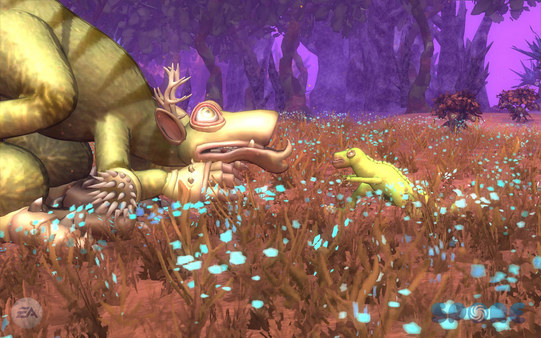 Screenshot of SPORE (Steam store page / Electronic Arts)
The real centrepiece, though, was the making. Whatever creature, vehicle or building you assembled would get up and move inside the game. Move the legs and the walk changes with them.
And what you made travelled into other people’s galaxies, while theirs turned up in yours. The sharing system was called the Sporepedia.
The volume was on another scale. By May 2009, more than 100 million creations had been shared.
“An amazing product — just not quite an amazing game”
On the numbers alone, the critics were kind. Metacritic put it at 84, an average drawn from 75 outlets.
The individual scores held up too: IGN Australia 9.2, Eurogamer 9, PC Gamer UK 91%, GameSpy 4.5/5, GameSpot 8.0, 1UP.com a B+.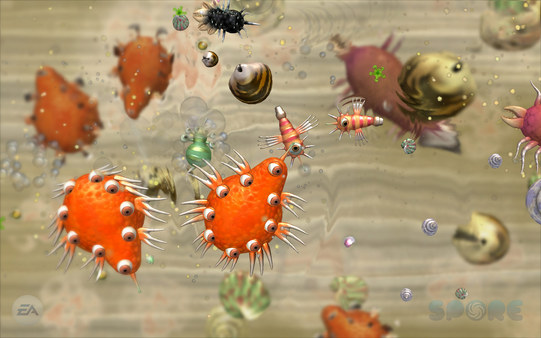 Screenshot of SPORE (Steam store page / Electronic Arts)
But look at how they praised it. PC Gamer UK wrote: “Spore's triumph is painfully ironic. By setting out to instill a sense of wonderment at creation and the majesty of the universe, it's shown us that it's actually a lot more interesting to sit here at our computers and explore the contents of each other's brains.”
It set out to make you marvel at the universe, and what turned out to be most interesting was rummaging around in other people’s heads. That is praise aimed at the system, not the play.
GameSpy called it “a technological triumph that introduces a whole new way of tapping into a bottomless well of content” — again, the technology and the supply of content.
And inside the same reviews sat plain reservations. GameSpot called it “a legitimately great game that will deliver hours of quality entertainment,” then noted that “Individual gameplay elements are extremely simple.”
Eurogamer gave it a 9 and still wrote that “for all their mighty purpose, the first four phases of the game don't always play brilliantly, and they're too fleeting.” Four of the five stages: grand in ambition, thin and brief in practice.
IGN put it most compactly: “while Spore is an amazing product, it's just not quite an amazing game.” The New York Times agreed that “most of the basic core play dynamics in Spore are unfortunately rather thin.”
That average of 84 is what you get when you flatten “stunning as a product, thin as a game” into one number.
Ten days after launch, 2,016 of 2,216 Amazon ratings were one star
The buyers left their record somewhere else: the Amazon review box.
As of September 14, 2008, 2,016 of the 2,216 ratings on the page were a single star. Nine in ten.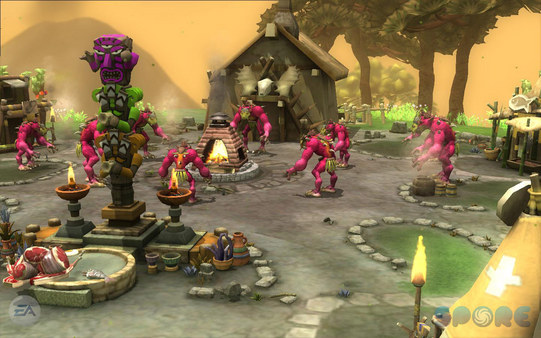 Screenshot of SPORE (Steam store page / Electronic Arts)
The rate of accumulation is on record too. The Register’s piece on September 10 counted 1,662 out of 1,797 — so more than 400 arrived in four days.
The reason was not the game. It was SecuROM, the copy protection, which allowed only three activations after installation — and uninstalling did not give one back.
If your PC died. If you replaced it. If you wanted another go in a few years’ time. That was where it stopped. The Register put it plainly: “Mostly, this isn't about the quality of the game.”
EA pushed back. On September 12, 2008, Mariam Sughayer of corporate communications said: “EA has not changed our basic DRM copy protection system. We simply changed the copy protection method from using the physical media, which requires authentication every time you play the game by requiring a disc in the drive, to one which uses a one-time online authentication.”
The argument being that they had swapped disc-in-the-drive checks for a single online check. She also called reports of spyware “absolutely false.”
Numbers came with it. Of 453,048 activations of the free Creature Creator, 77% were on one machine, 23% on more than one, and only 1% tried to activate on more than three. The typical customer, the argument went, was not inconvenienced.
The lawsuits came anyway. On September 22 a class action was filed over SecuROM being undisclosed and persisting after uninstallation. On October 14 another was filed over the DRM inside the free demo.
And here is the line I most want to write down today. According to The Register, the copy protection had been cracked roughly a day after the game went on sale in Australia.
So within about twenty-four hours of September 4, 2008, the people breaking it were outside the limit. The only people still inside the three-activation cap were the ones who had paid.
Eighteen years on, what survives is neither the 84 nor the one star
It did sell. EA reported two million copies in the first three weeks, and in the UK it took an ELSPA Silver award, which marks at least 100,000 sold.
Which makes it a slightly unusual kind of record: a great many people bought it, and a great many of those gave it one star.
The video above is “Spore Launch Date Teaser,” the announcement clip EA put out before release. A quiet little thing, from before all of it.
And from September 4, 2008 to September 4, 2026 is exactly eighteen years. What has lasted those eighteen years is neither the average of 84 nor the nine-in-ten one-star share. What lasted was the precedent: a review box used not to score a work, but to protest how it was sold.
Was there a game you got angry at for reasons that had nothing to do with the game?
A review box is supposed to be where you put a score for a work. In September 2008, what went in there was not a score but a protest.
September 4, 2008. Let me write the year down. Today, September 4, 2026, makes it exactly eighteen years.
A game in which you could build anything from a cell to a galaxy was argued about hardest over how many times you could install it. The mechanism sitting furthest outside the content took the whole year’s conversation with it.
Was there a game you got angry at for reasons that had nothing to do with the game? If you remember the release date too, so much the better.
Reactions (no login)
Anonymous • one of each per visitor per day
Read next
Comments (no login)
No comments yet. Be the first to say something.