BLOG · 2026-09-22
Libble Rabble (1994) - to bring a two-stick game home, the box came with a second D-pad
Today Is Release Day #63 - September 22, 1994, on the Super Famicom
The man who made Pac-Man made a game about fencing things in
Hello, Toki here. Episode 63 of "Today Is Release Day". Today's game came with a spare part in the box, because you could not play it otherwise.
Namco released Libble Rabble for the Super Famicom on September 22, 1994. Today makes it exactly 32 years.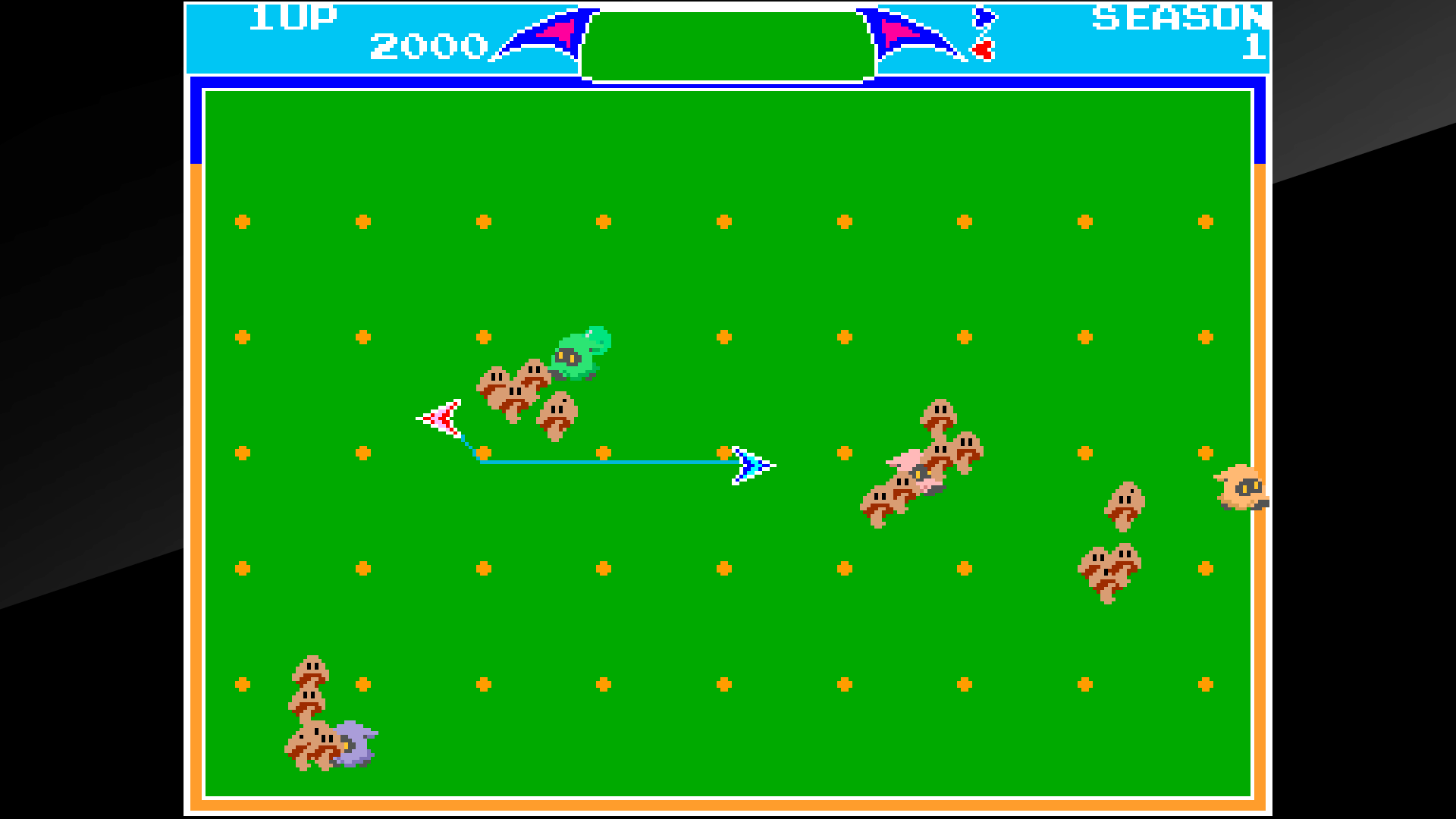 From a screenshot on the official Arcade Archives LIBBLE RABBLE page (HAMSTER)
It was born much earlier, though. The original is an arcade game that went out in December 1983, planned by Toru Iwatani, the creator of Pac-Man.
It took 11 years to reach a home console. The reason was not the game itself. It was the controls.
Two sticks, two arrows, and a line you close around things
The arcade cabinet had two eight-way sticks. The left one moved a red arrow named Libble, the right one a blue arrow named Rabble.
A line is strung between the two arrows. You walk around hooking that line on the pegs of the field until it closes around an enemy, and the enemy is gone.
The game calls this act of enclosing and clearing "bashishi". Each stage, called a season, holds 20 enemies named Mushlin. Clear all of them and you move on.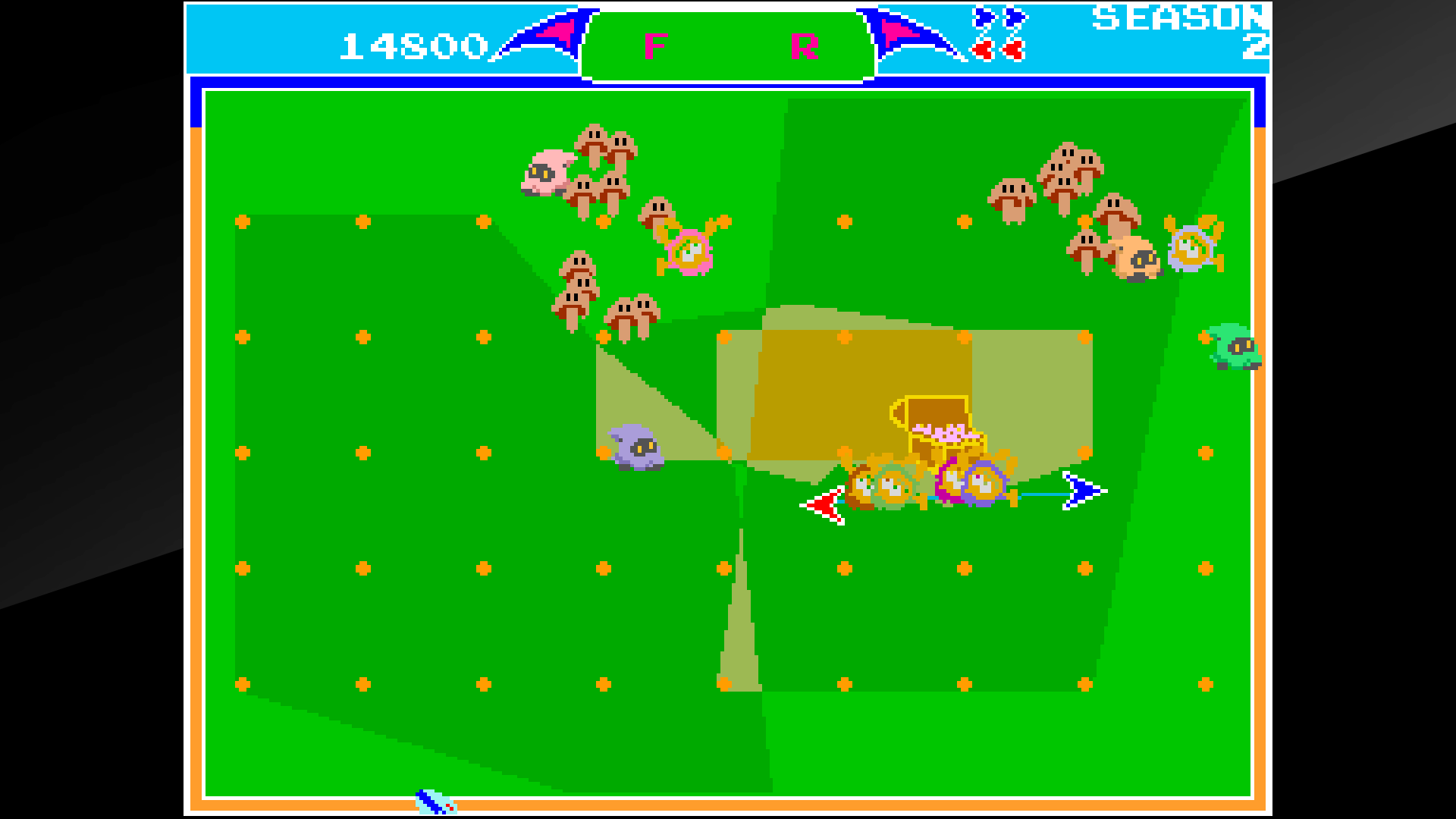 From a screenshot on the official Arcade Archives LIBBLE RABBLE page (HAMSTER)
Treasure chests are buried in the ground. Enclose a buried spot and a Topcup pops out, and six of them open a bonus stage. Remembering where the chests sit was the shortcut to a high score.
The idea came from an odd place. Iwatani was in a crowded disco and thought about roping the crowd off and making it vanish. On top of that sat a childhood game of claiming territory with nails and string.
The proposal is dated January 27, 1982. Its working title was Potato. Because the enemies carried potatoes, it even suggested teaming up with a snack maker.
"People stayed at the machine, but the income was low"
The location test ran on October 15 and 16, 1983. The cabinet shipped that December.
It was not badly received. In the trade paper Game Machine, it placed second among new table cabinets in January 1984.
As a business, though, it struggled. Kazuo Kurosu, who programmed it, looked back on it years later: "People who liked it got good fast and played for a long time, so there was a crowd at the machine, but the income was low."
It never reached North America either. The distributor there turned it down with a line worth keeping: a good product, but not a good commodity.
It stayed in players' memories all the same. In The Best Game, the 1991 ranking compiled by the magazine Gamest, it came in 27th of all time.
September 22, 1994: there was a second D-pad in the box
Eleven years later, on September 22, 1994, the Super Famicom version arrived. It was the game's first port to a home console.
The controls were the problem. The game needs two sticks, and a Super Famicom pad has only one D-pad.
Namco's answer was a part. The box included a plastic D-pad cover that sat over the four ABXY buttons, turning the right hand side into a second D-pad. You could also use two controllers and have two people drive one player.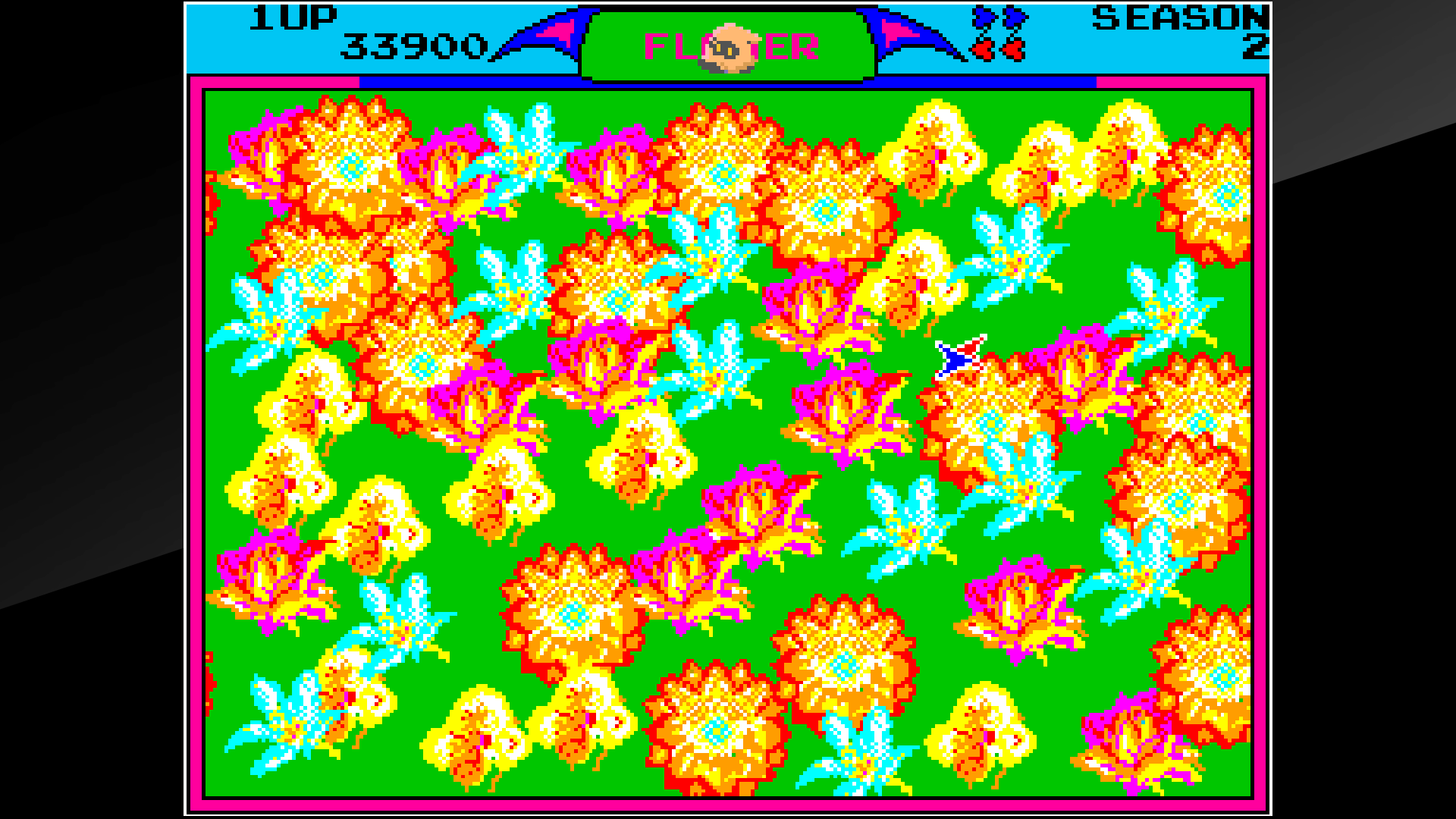 From a screenshot on the official Arcade Archives LIBBLE RABBLE page (HAMSTER)
The contents grew too. There is a storybook-style demo, a sound test, settings that imitate the dip switches of the arcade board, and a hidden Miracle Mode reached by a trick. The manual even reprinted Bashishi Book, the little booklet from the arcade days.
The reviews were quiet and positive. Famitsu's cross review gave it 29 out of 40. A readers' poll scored it 23.2 out of 30, with originality highest at 4.2 and music lowest at 3.6.
In 2021 the arcade version came back exactly as it was
Ports kept coming: the X68000 in 1993, the FM Towns in 1994, and the Wii Virtual Console in 2009.
Then, on November 11, 2021, Hamster's Arcade Archives brought the 1983 arcade version itself to Nintendo Switch and PlayStation 4.
This time the two sticks became the left and right sticks of a controller. A control scheme you once had to walk to a cabinet for now sits in your hands.
The video below is an episode of "Oretachi no Akeaka" from Famitsu TUBE. How the line stretches and closes is faster to see in motion than to read.
Nineteen ninety-four, for the record
September 22, 1994. If I do not write the year down like this, a piece never feels finished to me. Today, September 22, 2026, makes it exactly 32 years.
At the centre of this game is not shooting an enemy but drawing a line and closing it. Whatever ends up inside the closed shape disappears. That is the whole rule.
For that one idea the machine needed two sticks, and the home version needed a piece of plastic in the box. The shape of the play decided the shape of the hardware.
Did a game ever arrive at your house with a part that existed for that one title?
Reactions (no login)
Anonymous • one of each per visitor per day
Read next

Comments (no login)
No comments yet. Be the first to say something.