HISTORY · 2026-10-05
Knight's Tour (c. 840) — How Chess Without the Contest Became Poetry and Mathematics
From al-Adli's manuscript and Euler's paper to Warnsdorff's rule and the final count
Introduction — Every square, exactly once
This is a chessboard pastime with records going back to the ninth century. Place a knight, move it, and visit all 64 squares exactly once. That is the knight's tour.
The knight moves two squares one way and one the other. That jump alone is enough to build a path through the whole board. A tour that ends where it began is called closed; otherwise it is open.
It has nothing to do with winning at chess. It borrows the board and the piece for a solo pathfinding puzzle.
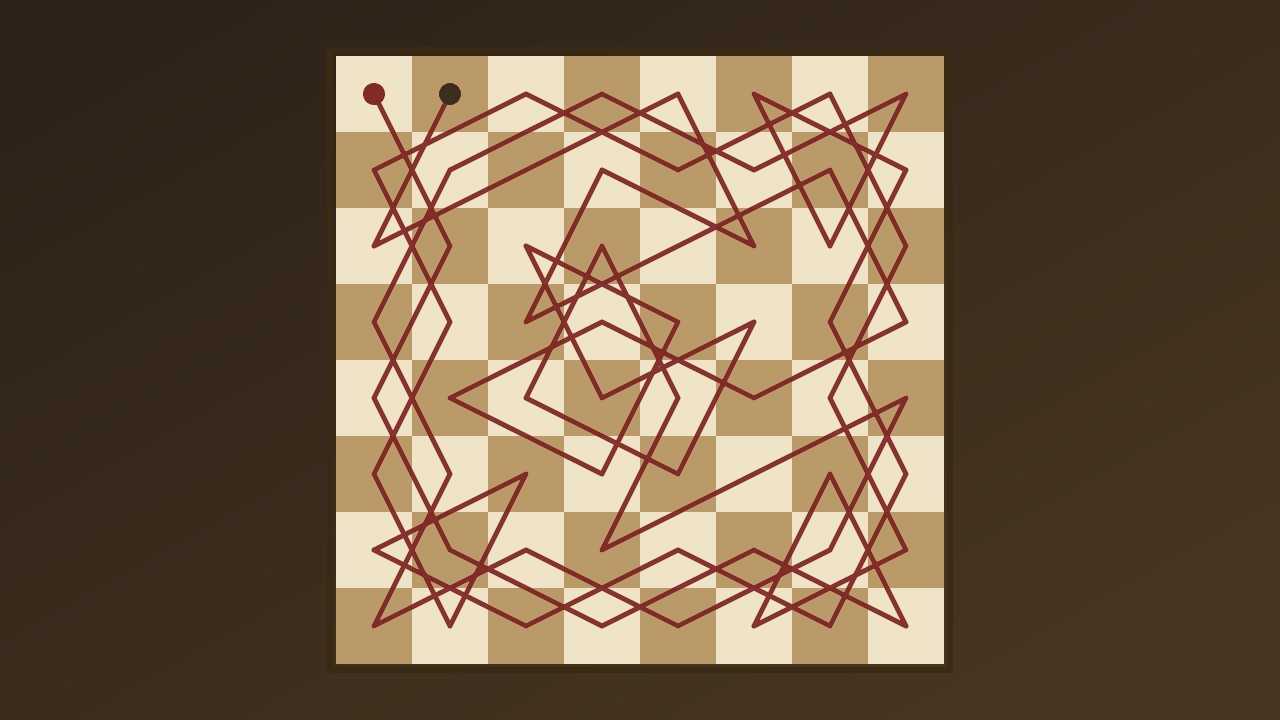 A single line crossing the board (illustration, AI-generated)
The era — Baghdad around 840, and a poem from India
The earliest examples we can check go back to about the ninth century. In the chess historian Murray's work, tours in Arabic chess manuscripts count among the oldest, and the name credited is al-Adli ar-Rumi (around 840). The original text is lost; it survives through later copies.
India has early examples too. The poet Rudrata's Kavyalankara (around 900) presents a tour on half a board as a poetic device called "the steps of a horse": put one syllable on each square, read by knight moves, and a second verse appears.
So the problem was not born as mathematics. It came from chess play and verbal games. Around the 1600s an Indian source (Bhat Nilakantha) also shows a symmetric closed tour. Dates vary by source.
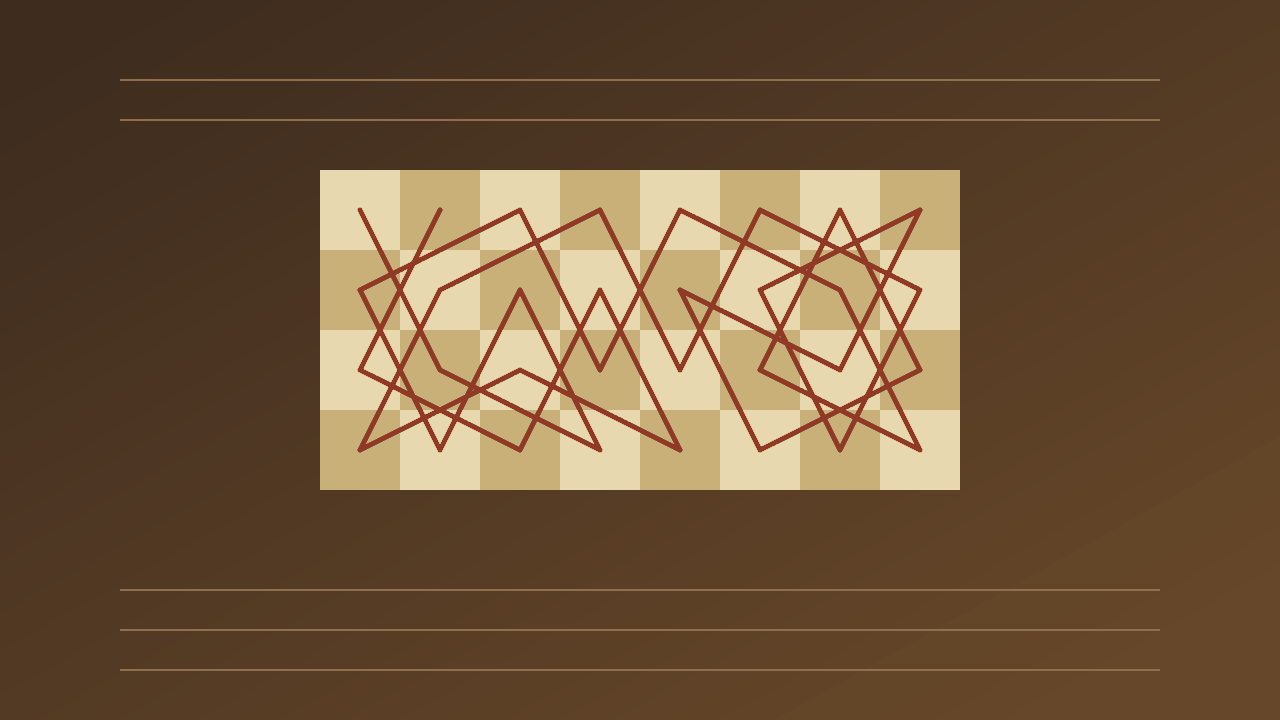 An old tour on half a board (illustration, AI-generated)
Mechanics — Fill the dead ends first
A knight changes square colour with every move. So a closed tour of 64 moves returning to the start is possible only when the number of squares is even.
The hard parts are corners and edges. A corner has only two exits; the centre has up to eight. Leave the edges for later and you run out of moves.
In 1759 the mathematician Euler treated the problem. The paper was written in 1758, presented in 1759 and printed in 1766 in volume 15 of the Berlin Academy's Mémoires (E309). In 1823 Warnsdorff gave a simple rule: of the squares you can jump to, pick the one with the fewest onward moves.
The rule is not a guaranteed method, but it works well by hand. The idea is to deal with the squares likeliest to become dead ends first.
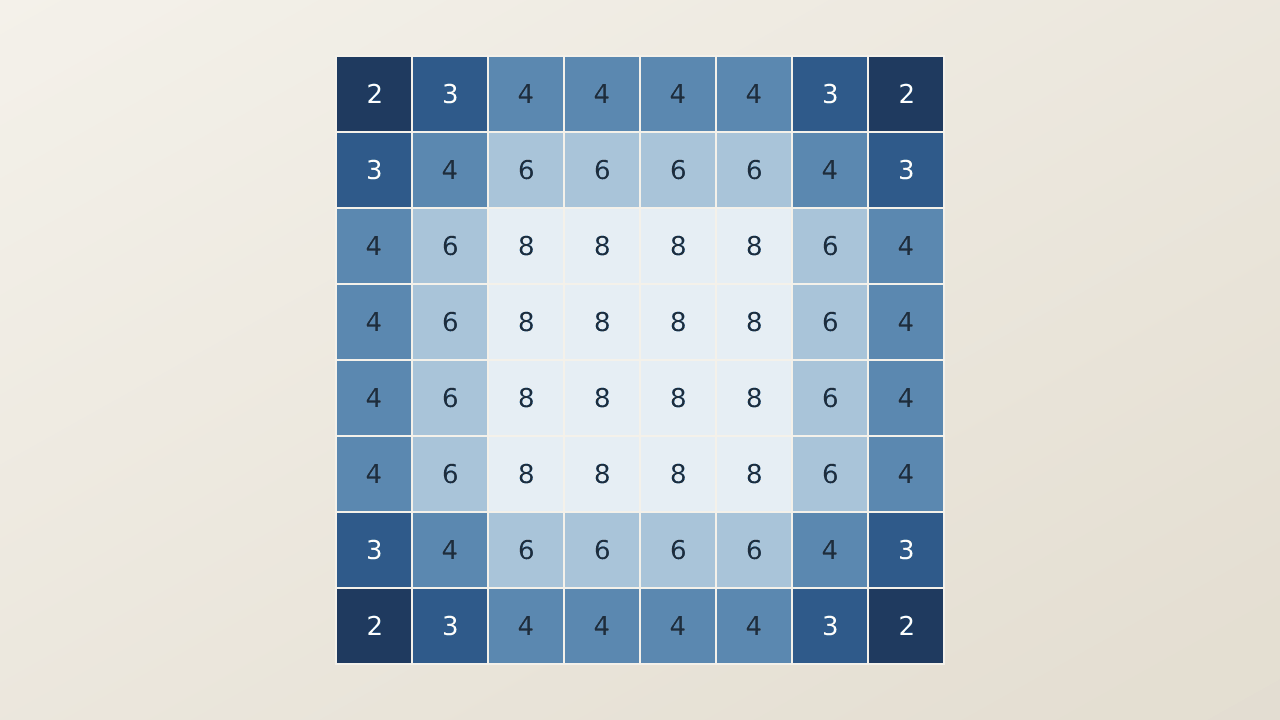 Exits per square: 2 in a corner, 8 in the centre (diagram, AI-generated)
Legacy — Counting, rules, and a novel
In the twentieth century the question shifted from "can it be made?" to "how many?" and "on which boards?". In 1991 Schwenk proved which board dimensions allow a closed tour. In 1997 Parberry gave a fast procedure that builds a tour even on large boards.
Counting advanced too. On 8×8, closed tours number 26,534,728,821,064 when direction is distinguished. Without direction it is 13,267,364,410,532, confirmed by McKay in 1997. The 1996 figure by Löbbing and Wegener differed from this.
It reached literature as well. In his novel Life A User's Manual, Georges Perec used a knight's tour on a 10×10 board to order the chapters.
Modern puzzles about passing through every cell once look like distant relatives. But I have not found a designer saying they drew on the knight's tour, so I do not claim a lineage.
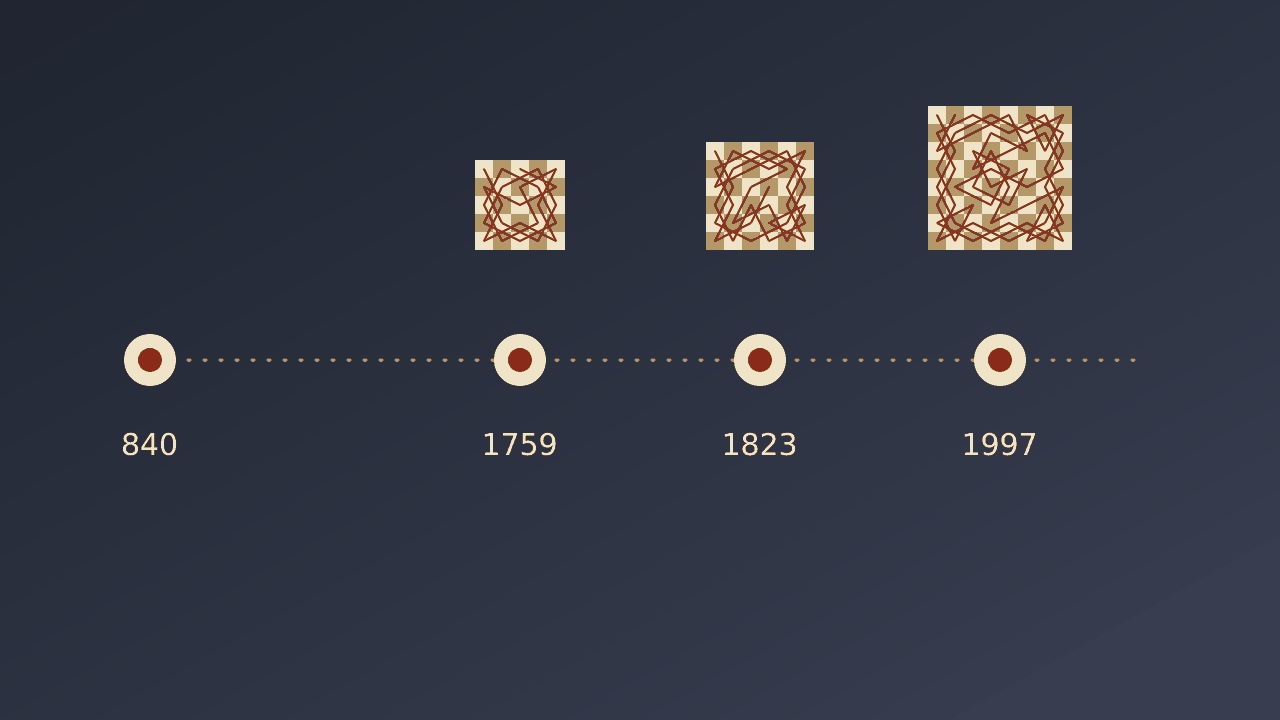 A timeline of over a thousand years (illustration, AI-generated)
References
Sources consulted:
・George Jelliss: Early History of Knight's Tours (Mayhematics)
・Euler Archive: E309, "Solution d'une question curieuse que ne paroit soumise à aucune analyse"
Note: the earliest date varies by source (around 840, around 900). Items on Warnsdorff, Schwenk, Parberry, McKay and Perec rely on the Wikipedia page above; I have not checked the original papers.
Closing — A borrowed board became mathematics
The knight's tour takes chess and removes the contest. Poets and manuscript copyists enjoyed it, and later Euler treated it as a mathematical question.
What this pastime shows, as I read it, is that there is no wall between play and mathematics. Those who solve, those who count, and those who write novels all stood on the same 64 squares.
 A closed tour returning to its start (illustration, AI-generated)
Reactions (no login)
Anonymous • one of each per visitor per day
Part of these series
Puzzle Incident HistoryEpisode 52 of 52