ESSAY · 2026-09-23
The Verb of Reflecting — A Puzzle Design Grammar From Portal 2 to The Talos Principle 2
Symmetry doubles your own hand; refraction turns a beam's path into an object — two ways "reflecting" can hold an answer
Introduction
"Reflecting" rarely gets to play the lead verb in a puzzle game. Pushing, rolling, and overlaying all feel more central. But build a puzzle around it and the verb turns out to occupy an unusual position: where the answer lives changes completely from one game to the next.
This essay compares three games: Portal 2 (2011, Valve), The Talos Principle (2014, Croteam), and The Witness (2016, Thekla, Inc.). I also touch on The Talos Principle 2 (2023), which adds a single new axis to an already mature grammar.
Line these three up and a hidden split appears inside the single word "reflect." Does the reflecting happen in an object placed on the board, or in the player's own hand? That question decides everything that follows.
Portal 2 — A Redirection Cube Is Placed, Not Aimed
Portal 2 (2011) layers a second kind of reflection onto the original game's portals, which already redirect space itself. To route a laser from an emitter to a receiver, the player carries a Redirection Cube and sets it in the beam's path. Turning the cube changes the reflection angle, but the player never bends the light directly.
The player's verb here is "place," not "reflect." The act of reflecting is delegated to a stand-in object, so the player can work out the angle in their head before committing. Portal 2 even runs two reflection systems side by side on the same board — light and space.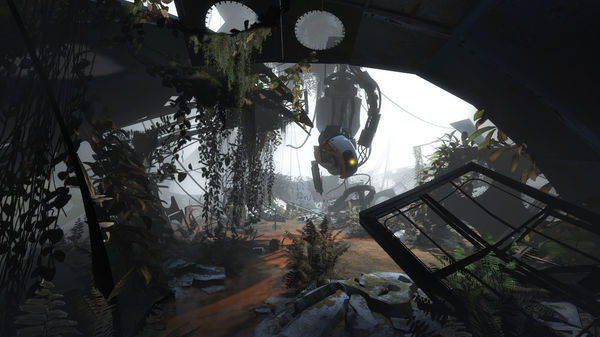 Portal 2 (official Steam screenshot)
Once a Redirection Cube is set, the beam's path stays fixed until something moves it again. That static quality makes Portal 2's light puzzles checkable before you commit, not just after. It is the opposite of what happens on The Witness's Symmetry island.
The Witness — Symmetry Doubles Your Own Hand
The Witness (2016, Thekla, Inc.) hides a section called simply "Symmetry" among its roughly 650 line puzzles. Two panels, one black and one white, are paired. Draw a line on one, and a point- or line-symmetric twin is drawn on the other at the same instant. The player only touches one panel, yet the answer has to hold on both.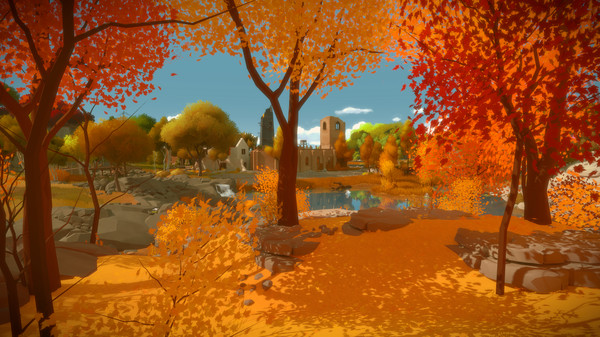 The Witness (official Steam screenshot)
That is the real difference from Portal 2's cube. Nowhere on a Symmetry panel is there an object called a mirror. What is being reflected is the player's own hand. One stroke becomes two the moment it is drawn, so the player is really operating two hands at once.
This doubled-hand feeling is close to what I wrote about self-cooperation puzzles in The Verb of Cooperating With Yourself. The difference is that a self-cloning puzzle lets you choose which self to move. A symmetry puzzle gives no such choice — both hands move together, always.
On this site's own difficulty scale, The Witness sits at the top tier. Most of that difficulty on Symmetry island isn't the puzzles' complexity — it's the time it takes to notice your hand has been doubled all along. Once you see it, boards that looked unsolvable suddenly resolve.
The Talos Principle — Turning a Beam's Path Into an Object, Then Adding Color
The Talos Principle (2014, Croteam) shares a grammar with Portal 2's cube on one point: light has to travel from an emitter to a receiver. The player carries hexagonal Connectors and sets them along the beam's path to bend it. A Connector emits nothing on its own — it only relays a beam that already exists.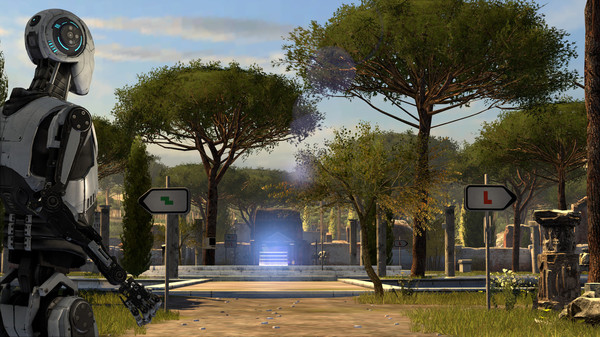 The Talos Principle (official Steam screenshot)
The puzzles sharpen as more connectors and obstacles (jammers, fans) enter the field, forcing the player to work the whole board backward from the goal. The verb stays "place." Unlike Portal 2, the emitter itself can't be carried, so the puzzle is purely about the path, not the source.
The Talos Principle 2 (2023) adds a color axis to that grammar. RGB Converters combine colored beams; inverters flip a color. The verb — relay a beam — never changes, but the beam now carries an attribute that has to match its target. Where I wrote about cutting verbs down in The Verb of Cutting Back, this sequel does the opposite: it keeps the verb count flat and re-engineers the combinatorial explosion through one added attribute.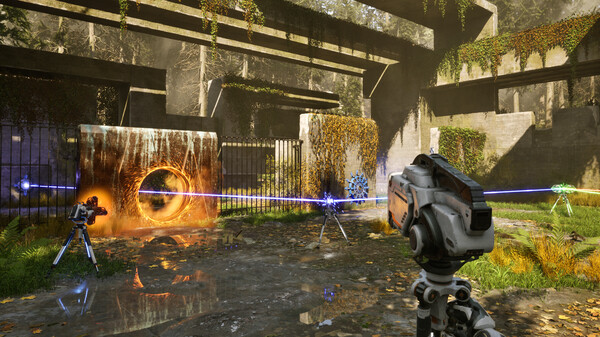 The Talos Principle 2 (official Steam screenshot)
What Portal 2 and The Talos Principle share is that reflection always lives in an object. Place it correctly, and the beam's path stops changing until you touch it again. That certainty is exactly what Symmetry island denies you.
Why One Verb Holds Two Different Answers
Line the three up and the same word, "reflect," points at two different places for the answer. In Portal 2 and The Talos Principle, an object on the board does the reflecting; the player's hand is just a tool for placing it. In The Witness, no such object exists — the player's own hand is what gets reflected.
That split shows up most clearly at the moment of a mistake. When reflection is delegated to an object, a mistake is fixable — move the object again. When it is delegated to your own hand, a mistake means you hadn't noticed something yet, and redoing the move tends to repeat the same blind spot.
This continues a thread from The Verb of Overlaying, where the answer lived at the seam between two images. Here, it lives at the seam between one hand and its mirrored twin. Seen through the Single-Verb Design lens, "reflect" is one word that still splits its design in two, depending only on who — or what — holds the mirror.
Closing
Portal 2, The Talos Principle, and The Witness all fall under one word, "reflect," yet they put the answer in completely different places. The cube and the connector hand the answer to an object; symmetry hands it to your own hand. Same verb, different subject — and the whole shape of the difficulty changes with it.
If I built a puzzle around this verb next, I'd want to switch between the two mid-board: let the player place an object and check the reflection early on, then take the object away so only their own hand carries it. I'd want to hide, for as long as possible, the exact moment a reflection they could verify stops being verifiable.
Reactions (no login)
Anonymous • one of each per visitor per day
Part of these series